
By Kevin Rademeyer, Sports Journalist.
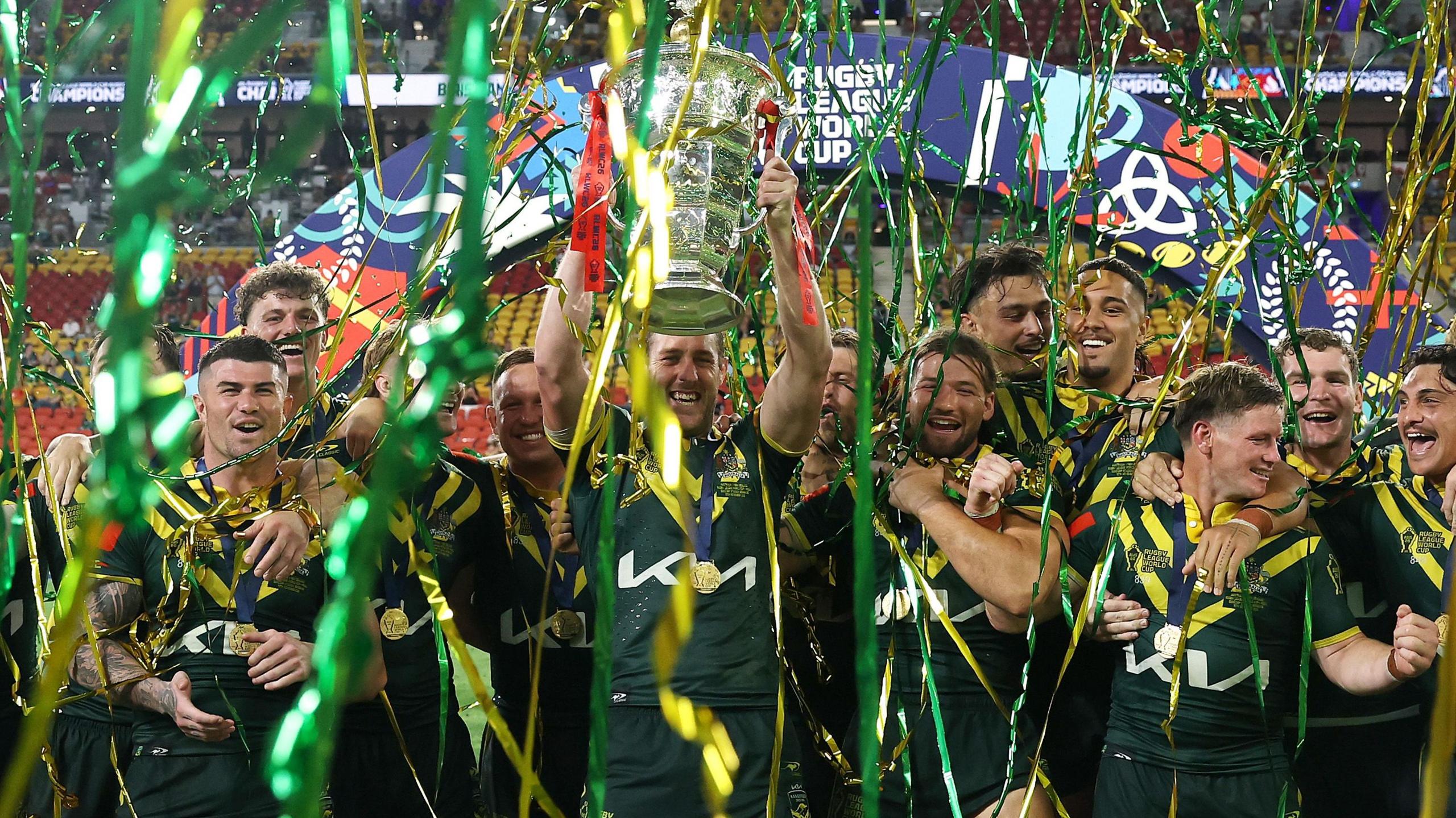
Australias 32–12 victory over New Zealand in Brisbane was not quite the final the tournament had promised.
For a while, it looked as though the Kiwis might provide the challenge capable of ending the Kangaroos’ extraordinary run. Instead, Australia found another level when it mattered, turning a contest that began evenly into a demonstration of their command of international rugby league.
The victory at Lang Park secured Australia’s 13th men’s World Cup title in 17 tournaments, their fourth in succession and their 10th in the last 11 editions.
They have now won 23 consecutive World Cup matches. The numbers are remarkable, but the manner of this latest triumph was just as telling.
New Zealand arrived with a formidable forward pack and a backline containing some of the most dangerous attacking players in the game.
Kalyn Ponga, the Golden Boot winner, had completed a remarkable return from a broken arm suffered in the tournament opener. The Kiwis had been building towards this occasion, and there was a genuine sense that the gap between the two nations had narrowed.
For Australia, the challenge was to make sure it stayed that way for only as long as necessary.
The Kangaroos had endured criticism during the group stages, with questions about selection and their performances. Coach Kevin Walters resisted the noise, backed his squad and kept his message uncomplicated.
“His side responded with a first half of clinical attacking rugby and a defensive performance that repeatedly denied New Zealand the space it needed. “We had such confidence in what we could achieve, and I was just happy we could have our best performance tonight,” captain Isaah Yeo said.
Australia established control before half time, opening up a 24–6 lead. Liam Martin crossed twice, while Jack Bostock, who would be named Player of the Final, scored either side of the interval.
Tom Trbojevic and Bradman Best also found the try line, with Cameron Munster adding three conversions and a penalty.
New Zealand managed one first half try through Casey McLean, but their attacking rhythm was repeatedly disrupted.
Ponga, whose return had been one of the stories of the tournament, struggled to impose himself. His influence was limited by Australia’s line speed and the pressure applied around the ruck.
Walsh, by contrast, was central to the Australian performance. The Brisbane Broncos fullback had been sidelined for eight weeks before the tournament and admitted afterwards that he had not been fully fit when the competition began. Walters continued to back him, and the decision was vindicated on the biggest stage.
“Everybody wrote us off, talking about how good the other teams are, how good their cultures are,”
Walsh said. “I feel like we got disrespected. All the Aussie fans coming out, how’s that for culture, baby?”
Bostock, too, struggled to find words for what Australia had achieved. “I can’t put it into words. Unbelievable,” he said. “We were written off early in the tournament and didn’t play our best in the groups. We put it all together on the big stage.”
Walters was particularly pleased with the defensive work after the break, when New Zealand attempted to find a way back into the contest. Isaiah Papali’i scored in the 65th minute, but Australia refused to allow the Kiwis to build sustained pressure.
“The big teams win the big moments with your defence and we did that tonight,” Walters said. He also pointed to the contribution of the entire squad, insisting that the tournament had been won by more than the players who started the final.
One of the evening’s quieter emotional moments came when James Tedesco was introduced for the closing minutes. The veteran fullback had lost the starting role to Walsh, but Walters wanted him involved in the celebrations on the field.
Tedesco confirmed it would be his final appearance in the green and gold. “I didn’t expect to be playing or getting any minutes, but Kevvie gave me the last five minutes,” he said. “To be part of it is pretty special. This will be my last time wearing this jersey, so it was pretty special.”
For Ponga and New Zealand, the disappointment was clear. “They moved the ball well and we made too many errors,” he said. “We worked so hard and we built throughout the weeks for this moment, and it didn’t come together.”
The women’s final had provided an earlier indication of Australia’s authority. The Jillaroos beat the Kiwi Ferns 34–10 to claim their fourth consecutive World Cup, with winger Jaime Chapman scoring a hat-trick in a commanding first half.
Chapman crossed twice inside the opening 15 minutes, including a powerful finish in which she carried three defenders over the line. Shaylee Bent, Jessica Sergis and Tamika Upton also scored as Australia built a substantial advantage. Sergis’ try was her 23rd in 18 Tests, while Upton added another landmark to an already decorated career.
Australia captain Isabelle Kelly was emphatic in her praise of Chapman’s finishing. “She’s so young , it’s quite scary,” Kelly said. “Once you get her strides going, she’s very hard to stop.”
New Zealand coach Ricky Henry acknowledged that his side had failed to cope with the pace of Australia’s opening spell. “We didn’t handle the speed of the game at the start,” he said. “They got on top and from there, we couldn’t regroup and get our rhythm.”
The men’s final may not have delivered the close finish many anticipated, but it reinforced a familiar truth. Australia remain the benchmark in international rugby league. New Zealand had arrived with ambitions of ending that reign. They left Brisbane with another reminder of just how difficult that task remains.