
By Sheree Bega.
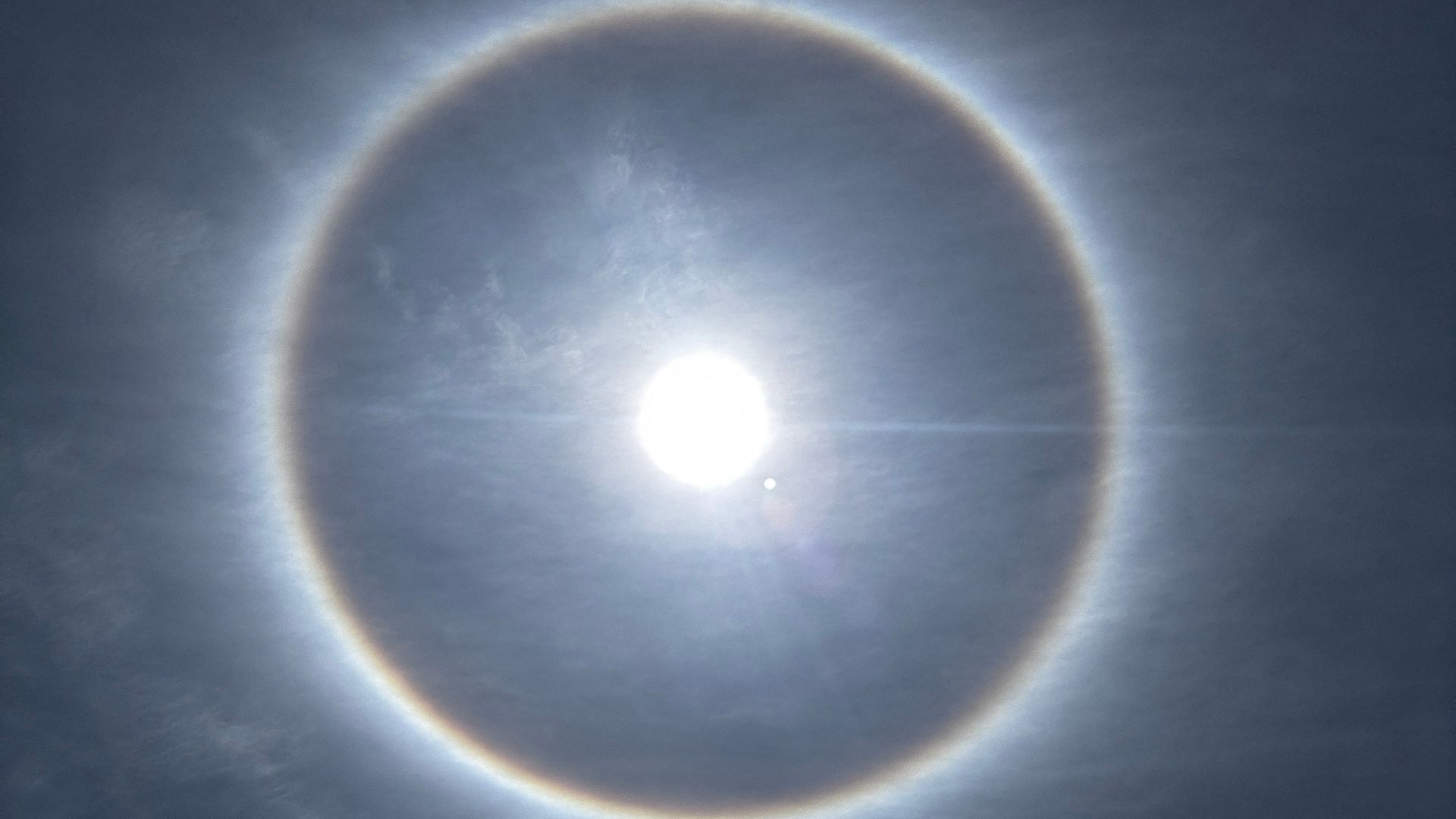
Residents of Johannesburg and Pretoria were treated to a spectacular sight on Monday as a large, rainbow-like ring appeared to encircle the sun, prompting curiosity about the unusual-looking phenomenon.
But while the luminous circle might have looked otherworldly, its explanation lies much closer to home – in tiny ice crystals suspended high in the atmosphere.
The phenomenon, known as a 22-degree solar halo, forms when sunlight passes through millions of microscopic, hexagonal ice crystals in high-altitude clouds, bending, or refracting, the light to create a ring around the sun.
South African Weather Service, Hannelee Doubell, said the display was dependent on conditions in the upper atmosphere, including the presence of ice crystals in high-level clouds.
Doubell described how sunlight passing through the ice crystals is bent to form the circular display.
The 22-degree halo is the most commonly observed type of solar halo. Its name refers to the apparent angle between the sun and the ring, which forms at a radius of about 22 degrees.
The crystals responsible are found in high, wispy clouds known as cirrus or cirrostratus clouds, where temperatures are cold enough for ice to form, she said. As sunlight enters and exits the crystals, it is refracted, producing the distinctive ring. Sometimes faint rainbow-like colours can be seen along its edges.
Although striking, the phenomenon is not unusual, Doubell said, and is not a sign of an approaching invasion from outer space or a planet appearing behind the sun.
“It happens frequently. It is not something out of this world,” she said.
“When it’s not overcast, you will see it. It’s a very local phenomenon, there’s no omen about it … it’s actually just normal.”
How long the halo remains visible depends on atmospheric conditions and the cloud cover. It can disappear as the clouds move or become obscured.