
By Estea Rademeyer, Sports Journalist.
Photo Credit: CSA.
South Africa’s response to Bangladesh’s historic first innings total of 400 was built on a combination of new opportunity and familiar international quality.
Marques Ackerman supplied the innings of the day, Zubayr Hamza provided the support, and Dane Paterson had earlier ensured that Bangladesh’s lower order could not run away with the game.
At stumps on day two of the first Test at the Wanderers, the Proteas were 287 for four, 113 runs behind. Ackerman’s 157 from 164 balls was the defining contribution, but the work done by Paterson in the morning had given South Africa the chance to take control of the match.
Rabada, the hero of the first day, finished with five for 70, his ability to find movement and maintain pressure proving central to the effort to dismiss Bangladesh.
Paterson, who had endured a difficult opening day, responded with four for 92 and made an immediate impact when introduced as the first change on the second morning.
His first delivery accounted for Mehidy Hasan Miraz, who drove loosely and edged to Wiaan Mulder at first slip. Paterson then removed Litton Das for 120, ending a superb innings that had taken Bangladesh to the brink of 400.
Litton had been selective about which bowlers to attack, often protecting the tail by turning down runs against Rabada and Marco Jansen.
Paterson’s change of pace unsettled him. A short delivery was pulled straight to Mulder at mid-wicket, giving South Africa a valuable breakthrough.
The seamer completed his four wicket haul by dismissing Hasan Mahmud and Taskin Ahmed as Bangladesh reached 400 all out. It was a significant total, the highest Test innings score by Bangladesh in South Africa, but South Africa had prevented the tail from adding a more damaging final flourish.
Rabada’s five wicket contribution was equally important. His figures of five for 70 underlined the value of his experience in an innings in which Towhid Hridoy had scored 137 and Litton 120. Bangladesh had recovered from early trouble to post a formidable total, but South Africa’s two leading seamers had kept the innings within reach.
The response with the bat began badly. Markram was dismissed for four by Mahmud, leaving the Proteas five for one. Ackerman, however, refused to retreat into a defensive shell.
The left hander had been backed by head coach Shukri Conrad to open despite having never previously done so in a red ball match before last month’s series against Australia.
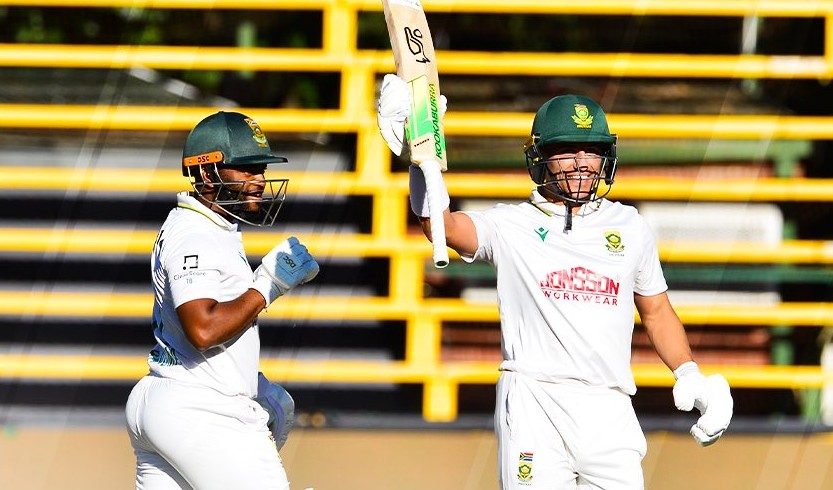
In his fourth Test, he delivered the sort of innings that justified the selection. His 157 included 21 fours and a six, and marked three consecutive Test innings with scores of 50 or more.
Hamza’s return was another important feature of the day. Playing his first Test since February 2024, he made 83 from 129 deliveries and shared a 202 run partnership with Ackerman. His innings gave South Africa stability while Ackerman attacked, and demonstrated the value of having a second batter capable of occupying the crease.
Ackerman said the intention was not to follow a rigid plan. He saw an opportunity to put Bangladesh’s spinners under pressure and took it. “It wasn’t a big conversation about how I was going to go about it,” he said. “I just felt like it was a good opportunity to score, especially with two spinners bowling, not a lot of turn on offer. And, yeah, I felt like I earned the right to really put them under the pump a bit.”
He admitted he was disappointed to be dismissed when he was, having wanted to attack the seamers again before the close. Mahmud eventually found the breakthrough, removing Ackerman and then Matthew Breetzke in quick succession to give Bangladesh a late lift.
The missed chance to dismiss Rickelton, dropped by Litton off Mahmud when the South African was still on nought, may yet prove costly. Rickelton survived to reach seven not out, while Bavuma was unbeaten on 19.
Ackerman’s confidence in the surface is important to South Africa’s plans. Although there has been some movement and the occasional ball has kept low, he believes batting could become easier in terms of pace as the match progresses.
“Yeah, it’s getting quite low, so I think as the Test progresses, I think it could just get lower and lower,” he said. “The chat will be just to try and bat as big as possible, make sure that we can get a good lead.”
He believes another substantial contribution is still possible. “I still believe that there’s another 100 out there for one of our batters.”
Before the series, Ackerman had been clear about the scale of the challenge Bangladesh presented. “We’re not taking them lightly,” he said. “Every team has world class bowlers. We know how big this is — we want to reach the WTC final and stay number one.”
That respect has been justified by Bangladesh’s batting, but South Africa have shown they have the bowling resources to compete. Rabada’s five wickets and Paterson’s response after a difficult first day were central to that.
The third day now presents a different test. South Africa need to turn their six remaining wickets into a substantial first innings lead.
Bavuma and Rickelton can extend the platform, while the middle order must ensure Ackerman’s work is not wasted.
Bangladesh will look to Mahmud, whose three wickets have kept the contest alive, and will know that an early breakthrough could expose the lower order. But with the pitch showing signs of slowing and the deficit already reduced to 113, the Proteas have put themselves in a position to dictate the next phase.
Rabada, Paterson, Ackerman and Hamza have done their part. The responsibility now rests with the rest of the batters to make the advantage count.