
By Jacob Mawela.
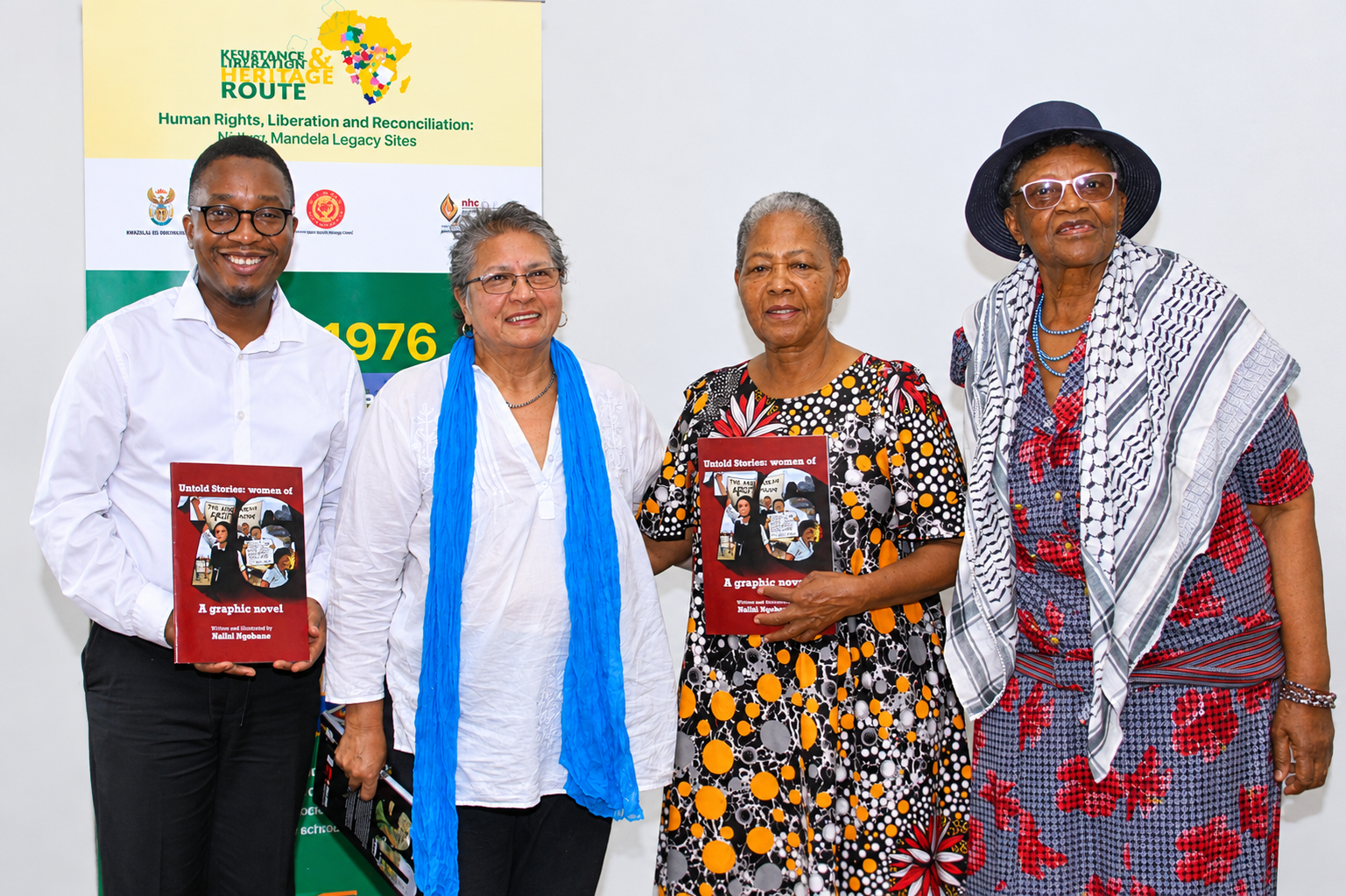
Caption: Nathi Ngubane, Maria van Driel, Antoinette Sithole and Fikile Ngcobo limned during the launch of the book, Untold Stories_ Women of ’76, at the Hector Pieterson Memorial and Museum in Orlando West.
Eyewitnesses to the Soweto Uprising of June 16, 1976 as well as a cohort of born-frees gathered for the launch of Untold Stories: Women of ’76, a graphic novel which narrates the story of the students uprising from the perspective of women, at the Hector Pieterson Memorial and Museum in Orlando West on the Saturday afternoon of November 14, 2026.
A continuation of the commemoration of the fiftieth anniversary of the historic day, the book narrates the stories of seventeen, mostly unheralded women, who include the widely-recognized Antoinette Sithole – the woman featured in Sam Nzima’s world-acclaimed photograph of the mortally wounded Hector Pieterson.
The launch took the form of a panel discussion facilitated by Tshepiso Maleswena, a holder of a PhD in History from WITS. Panelists were Ngubane, Maria van Driel, a coordinator at Khanya College, as well as two women who were caught in the middle of the uprising on the day, viz., Antoinette Sithole, Hector’s sister, and Fikile Ngcobo, who was an educator at Phefeni Junior Secondary School at the time.
The highpoint of the occasion was when Sithole and Ngcobo gave eyewitness accounts of the juncture in history which occurred half a century ago. Sithole intimated that she was a 17-year-old at the time with designs on becoming a pharmacist – a dream which petered out, she lamented in retrospect.
Queried by Maleswena as to what she’d say to learners today about education and what it cost her generation, Sithole responded thus: “we went out in the streets of Soweto for them to have a better education. South Africa mustn’t be known for the uprising, but for the results of the uprising.”
Ngcobo on the other hand, was a young teacher who’d recently arrived at Phefeni Junior Secondary School from Naledi High School – both schools being flashpoints of the uprising. On the day, she found herself and a colleague chasing after Mbuyiswa Makhubu – the son of her neighbour and friend – as he carried the dying Pieterson in his arms.
A candid speaker who kept on referring to herself as a dinosaur, Ngcobo further mentioned that subsequent to the shootings of the day, she became part of more than 200 educators who resigned en masse in solidarity with the students’ stance and in protest of Afrikaans being imposed on teachers and learners.
Another panelist, District Six-raised Maria van Driel was a Standard 8 pupil at Bridgetown High School when news of the Soweto riot reached Cape Town, whereupon she and some fellow learners decided to take a stand “in solidarity with our black brothers in Soweto” by participating in a large march across the Cape Flats into Cape Town where it was met by police teargas and mayhem.
Written and illustrated by Nathi Ngubane and edited by Professor Noor Nieftagodien and Ali Hlongwane, the graphic novel was published by the History Workshop at the University of the Witwatersrand.
In the introduction, Ngubane wrote that female students were key protagonists in the 1976 movement and in the resistance before and after the historic day – citing that women activists such as Deborah Matshoba and Mmagauta Molefe, were role-models of the ’76 generation.
The author further noted that not only were it students who were involved in the uprising – but also teachers, nurses, social workers, journalists, factory workers, et al.
The book is narrated in three movements focussing on Soweto, Alexandra and Cape Town – with chapters dedicated to each of the seventeen women.
The story commences in Soweto on that fateful day, with a fictional historian named Mami Vilakazi relating stories of women whose sacrifices were never recognized, to two youngsters who had gathered around her fruit stall.
After Vilakazi’s reminding the youth about their past history, Ngubane delves into Sithole’s recollection of that day’s events in which she became caught up in the incident which would result in the loss of her sibling and change the course of South Africa’s then oppressive status quo.
In the last panel limning Sithole wearing a lamentable facial expression, she relates that she became scared to inform her family regarding the tragedy which had occurred.
Other protagonists who feature in the novel include erstwhile Naledi High School alumna and Secretary General of the South African Student Movement, viz., Sibongile Mkhabela; Ma Vesta Smith, a community activist from Noordgesig; Miss Mainstay 1979 queen Masabata Loate; et al.
The book’s commissioner Professor Noor Nieftagodien, the South African Research
Chair in Local Histories and Head of the History Workshop at WITS, mentioned that it was primarily aimed at young learners – hence it being distributed to them for free at the City of Johannesburg’s heritage museums, viz., Hector Pieterson Memorial and Museum, the June 16, 1976 Interpretation Centre in Jabavu and the Alexandra Heritage Centre.
Part of an effort to address literacy as well as the preservation of history among society, the book will also be made available in pdf form for wider access and the choice of Ngubane as its author was motivated by the editors’ previous collaboration with him on a 2025 book about Malcolm X in Gaza, which explored Palestine’s story through the revolutionary’s perspective.
Containing colourful illustrations partly referenced from press images which documented the period, the novel is narrated in simple English which will make it an easy read for both the young and adult.
Chesterville-raised Nathi Ngubane holds a diploma in graphic design from the Durban University of Technology and has worked as a political cartoonist for The Citizen. His first children’s book, Duma Says: Wash your hands, wear a mask!, was published in 2020 during the Covid-19 pandemic.