
By Lehlohonolo Lehana.
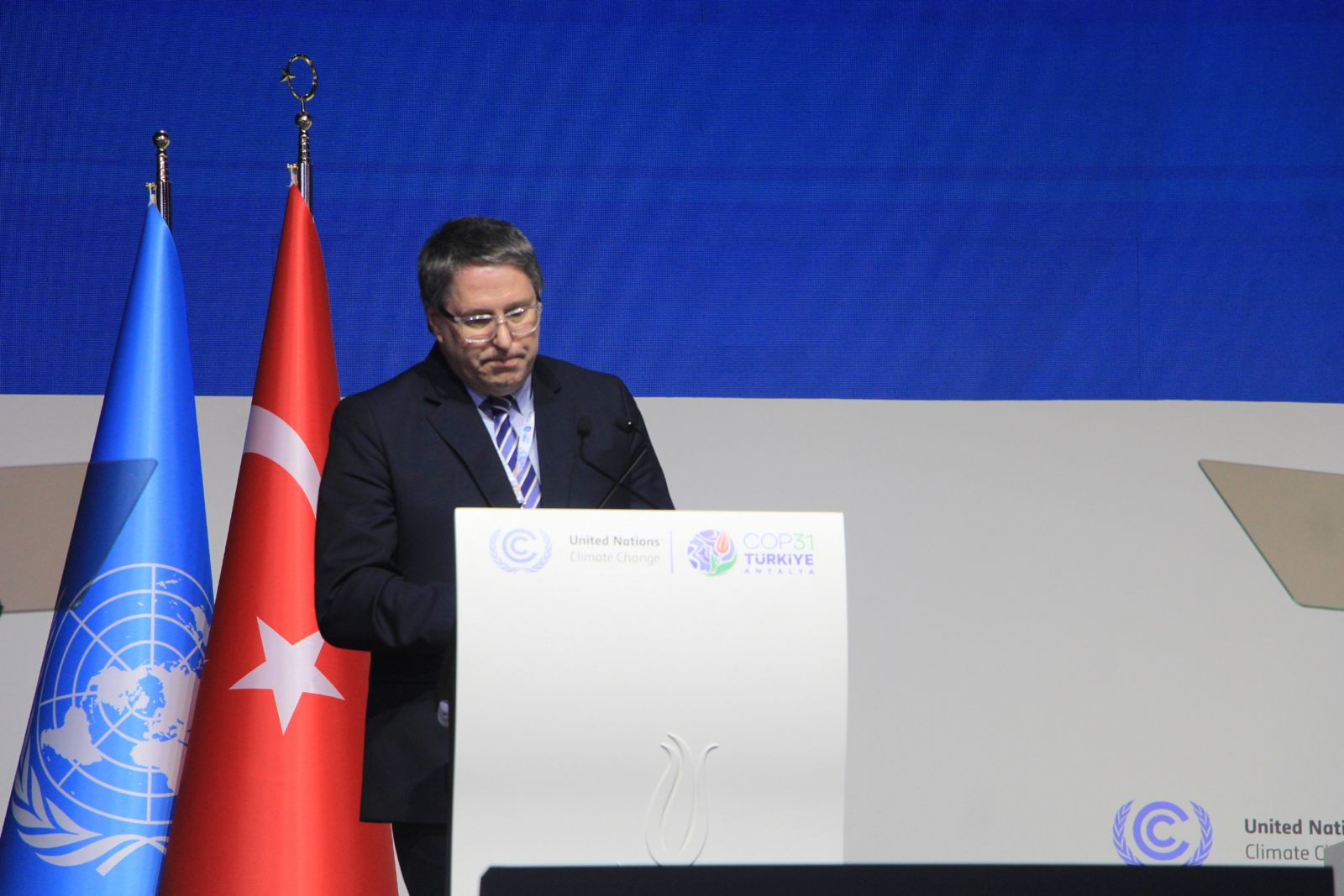
Photo Credit: DFFE.
Minister of Forestry, Fisheries and the Environment (DFFE), David Maynier, delivered South Africa’s national statement on behalf of President Cyril Ramaphosa, at the COP 31 to the United Nations Framework Convention on Climate Change in Antalya, Türkiye, 17 November 2026.
Ramaphosa is leading a high-level, multi-stakeholder South African delegation in California, United States to gain insights into the global artificial intelligence (AI) ecosystem and inform South Africa’s approach to the development, adoption and application of AI.
South Africa needs investments and provision of climate finance of approximately over R250-billion, (15,6 billion USD) to fully implement adaptation actions between 2026 and 2035.
Maynier said there has been progress in implementation, but significant gaps remain.
“In accordance with our second Biennial Transparency report, which we will submit this year, South Africa needs investments and provision of climate finance of over R250-billion, about $15.6-billion, to fully implement adaptation actions between 2026 and 2035.”
“The widening adaptation gap is of concern to us, this why we are calling for setting the benchmark for tripling of adaptation finance by 2035, including sufficient, predictable replenishments of the multilateral climate funds that meet the needs of developing countries as well as finalising the transitioning elements of the Adaptation Fund to serve the Paris Agreement at COP 31, to enable to monetise and use the share of proceeds from Article 6.4,” said Maynier.
He noted that South Africa has also suffered the negative impacts of severe climate events.
The Minister explained that, in fulfilment of South Africa’s mitigation commitments under the Paris Agreement, and the country’s contribution to global efforts, SA submitted its second Nationally Determined Contribution (NDC) last year.
It includes a mitigation target for the year 2035 and an updated adaptation communication that also includes information on loss and damage and the support needed for implementation.
The Minister said South Africa’s 2035 target to lower emissions to between 320-million and 380-million tonnes of CO2-equivalent represents significant progression from the country’s 2030 target of 350-million to 420-million tonnes of CO2 equivalent.
He said this progression is enabled by the massive opportunities that are emerging in electricity, electricity vehicles and future fuels, such as green hydrogen.
Additionally, Maynier also called for the operationalisation of the Just Transition Mechanism, which will facilitate international cooperation, technical assistance, capacity-building, knowledge-sharing and access to the means of implementation, particularly for developing countries.
The Minister said the mechanism should adopt a whole-of-economy and whole-of-society approach.
Fullview meanwhile learnt that a total of 75 countries and 94 institutions and organisations back Türkiye’s global electrification target announced under its COP31 presidency.
The countries include Germany, the UK, Norway, South Korea, Spain, Japan, Denmark, Canada and Kyrgyzstan. The European Commission has also confirmed the EU’s backing.
The target is included in the first draft text released after the first week of negotiations at the summit in the Turkish Mediterranean city of Antalya.
Electrification is considered a key part of efforts to reduce emissions and limit global warming to as close as possible to 1.5°C above pre-industrial levels.