
By Andre Lourence.
Data released by Statistics South Africa (Stats SA) today, 18 November 2026, on retail trade sales were mostly positive. Overall, real, seasonally adjusted retail trade sales were 2.8% higher year-on-year (y-o-y) in September 2026.
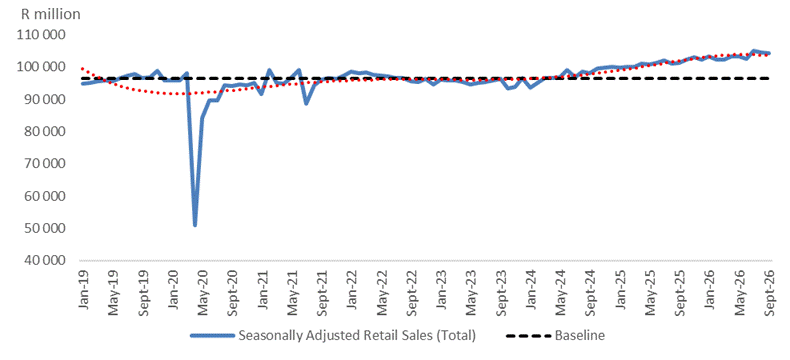
Retail sales have, in fact, recorded positive y-o-y growth every month since February 2024, the last time overall real seasonally adjusted retail sales contracted on an annual basis. Figure 1 shows the trend in retail sales since January 2019.
Figure 1: Retail trade sales: Constant 2019 prices, seasonally adjusted
Source: Statistics South Africa
The overall trend is encouraging, particularly given that household consumption accounts for more than 60% of expenditure on GDP in South Africa. Despite higher fuel prices and continued cost-of-living pressures this year, real retail sales have remained resilient. Year-to-September, overall retail sales in 2026 were 2.5% higher than over the same period in 2025.
However, the continued resilience of household spending needs to be considered alongside South Africa’s relatively weak savings position. Gross saving as a share of GDP has been on a broad downward trajectory over the longer term. This is concerning from a longer-term growth perspective because domestic savings provide an important source of funding for investment, while investment is necessary to expand the economy’s productive capacity and support sustainable economic growth.
This does not mean that stronger retail sales are necessarily causing lower savings. Household consumption can remain resilient for several reasons, including growth in household income, employment, access to credit and changes in saving behaviour. Nevertheless, the combination of resilient consumption and a relatively low national savings rate highlights a broader structural challenge for the South African economy: stronger consumption can support economic activity in the short term, but sustainably higher economic growth ultimately requires stronger investment and the domestic savings needed to help finance it.
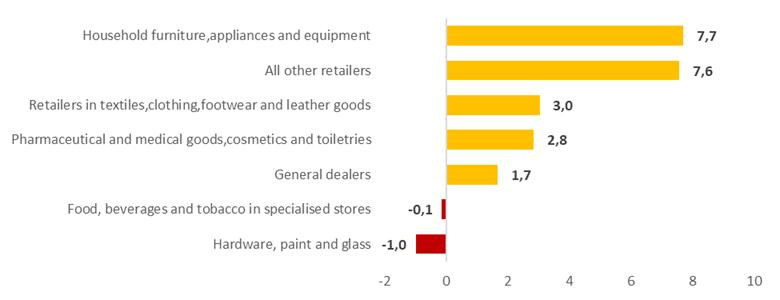
Lastly, the gains have not been evenly distributed across retailers. By far the strongest year-to-September growth was recorded by household furniture, appliances and equipment retailers, at 7.7%, followed closely by all other retailers, which includes jewellery, stationery, sporting goods and second-hand goods, at 7.6%. At the other end of the spectrum, food, beverages and tobacco retailers recorded a 0.1% decline, while sales by hardware, paint and glass retailers contracted by 1.0%.
The September data therefore point to a consumer sector that remains relatively resilient despite continued pressure on household finances. However, the significant divergence in performance across different types of retailers, together with South Africa’s weak savings position, suggests some caution in interpreting the strength of retail spending/sales as evidence of an equally strong underlying household financial position.
Figure 2: Growth by type of retailer, year-to-September, y-o-y percentage
Source: Statistics South Africa
The resilience of retail sales is undoubtedly positive for the South African economy in the short term. Consumers are still spending despite considerable pressure on household budgets, supported to some extent by improving real incomes, modest employment gains and strengthening credit extension. But this resilience should not distract from the more fundamental concern: South Africa saves too little.
Gross saving by the household sector amounted to only 1.2% of GDP in the second quarter of 2026, down slightly from 1.3% in the first quarter, while the national saving rate fell to 10.8% of GDP (from around 16.3% in 2009). Strong consumption can support economic growth today, but it cannot substitute for the investment required to expand productive capacity and raise potential growth over the longer term. Investment ultimately has to be financed, either through domestic saving or greater reliance on foreign capital.
Therefore, continued strength in retail sales is good news, but it is not an unqualified sign of economic strength. South Africa needs to move beyond an economy supported disproportionately by consumption towards one characterised by higher savings, stronger investment and increased productive capacity.
Andre Lourence is Mining Economist at KPMG South Africa.