
By Gcina Nhleko.
South Africa possesses one of its most powerful development assets in plain sight: a university sector rich in expertise, innovation, research capability and community partnerships.
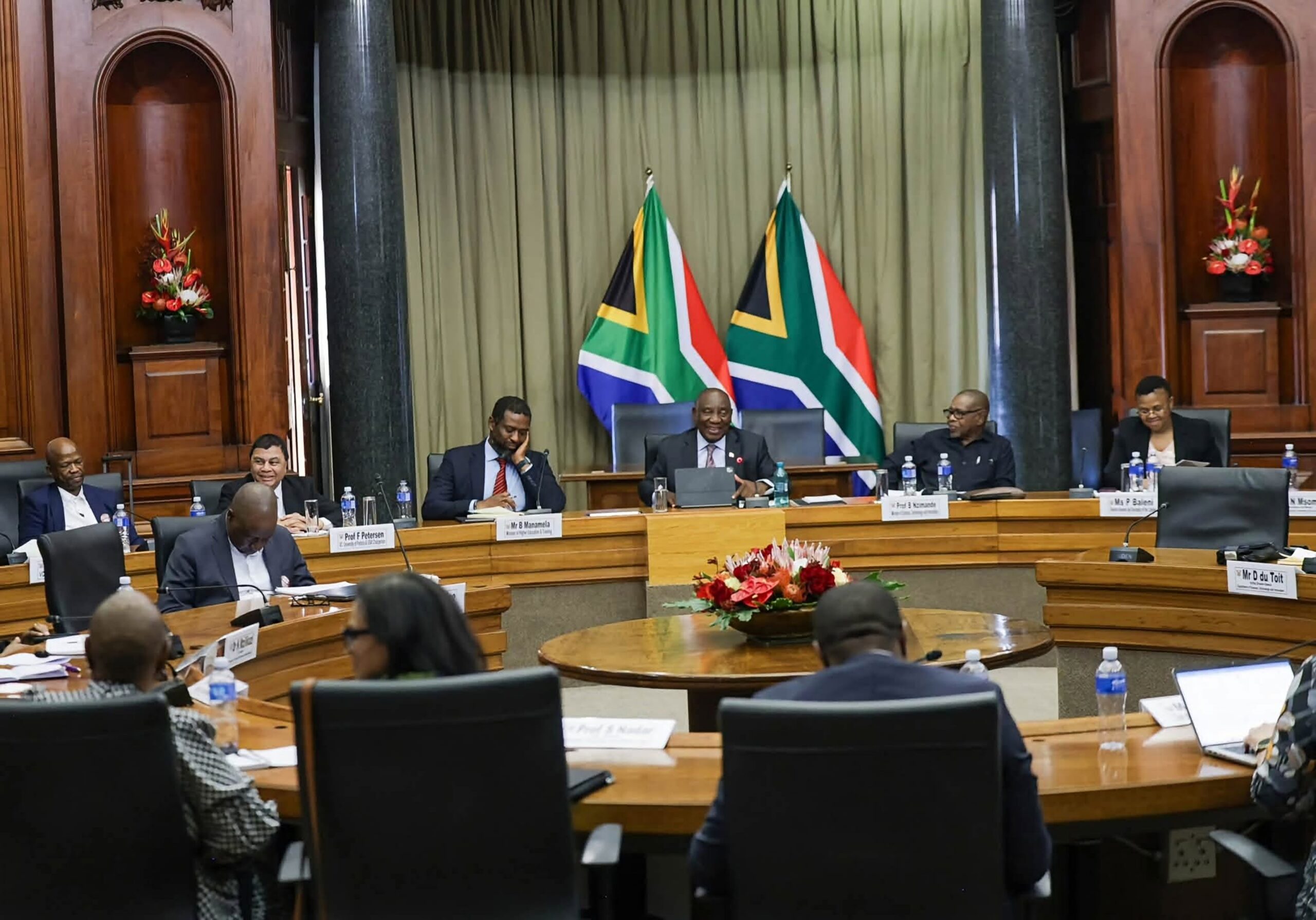
This reality was brought sharply into focus during the President’s Meeting with University Vice-Chancellors and Chief Executive Officers of Government Research Entities, where leaders from government, higher education and the science system convened to explore how strategic collaboration can accelerate the country’s development agenda.
Against the backdrop of pressing national priorities, ranging from skills development and economic growth to water security, energy resilience and technological advancement, the engagement affirmed the critical role of universities not only as centres of teaching and research, but as active partners in transforming communities, driving innovation and delivering solutions that improve the lives of South Africans.
The meeting highlighted a fundamental truth: no single institution can solve South Africa’s complex developmental challenges alone. Sustainable progress depends on partnerships among government, universities, science councils, industry and communities. When these sectors work together, knowledge is transformed into practical solutions, research becomes a tool for development, and innovation is translated into tangible improvements in people’s lives. This spirit of collaboration has become a defining feature of South Africa’s public universities, which are increasingly demonstrating their value not only through academic excellence but through meaningful societal impact.
The Presidential engagement at the Union Buildings focused on national priorities that demand collective effort and innovative thinking, including the Skills Revolution, Water Security, Energy Transition, Sovereign Artificial Intelligence, Re-industrialisation, the Bioeconomy, and the strengthening of a capable developmental state. These priorities align directly with the work already underway across South Africa’s universities, where scholars, students and communities are co-creating solutions to real-world challenges.
Across the country, universities are demonstrating that research is most impactful when it extends beyond academic journals and reaches communities where people live, work and learn. Far from being isolated institutions, universities are deeply embedded in society, collaborating with municipalities, businesses, schools, civil society organisations and local communities to address pressing developmental needs. The engagement reaffirmed that South Africa’s developmental challenges require more than collaboration alone.
They demand the strategic mobilisation of resources, expertise, research infrastructure, innovation capacity and partnerships across government, universities, science councils, industry and communities. By pooling these resources and working collectively, institutions can translate knowledge into practical solutions that drive economic growth, strengthen public services and improve the lives of citizens.
Collaboration in Action: Transforming Communities Through Impactful Partnerships
(You can browse the full Societal Impact Case Study Repository: USAf Societal Impact Case Studies Repository. As they appear on the website: www.usaf.ac.za)
The societal impact case studies showcased by Universities South Africa (USAf) provide compelling examples of how collaboration is producing meaningful outcomes for citizens across the country. These initiatives demonstrate the power of bringing together academic expertise, government support, community participation and industry partnerships to deliver sustainable impact.
Skills Development and Education
- Rhodes University: Creating pathways to educational success in Makhanda through sustained community engagement and support programmes that improve access to higher education.
- Nelson Mandela University: Equipping young people with coding and digital skills that prepare them for participation in the evolving digital economy.
- University-community partnerships: Strengthening educational outcomes by linking local learning needs to national development priorities.
Water Security and Community Well-Being
- University of the Witwatersrand: Transforming greywater management into opportunities for improved sanitation, water conservation and community enterprise.
- Central University of Technology: Monitoring contaminants in water sources to safeguard public health and support evidence-based decision-making.
- Collaborative water initiatives: Helping communities address water scarcity through innovative, locally relevant solutions.
Energy Innovation and the Just Transition
- University of Johannesburg: Delivering access to potable water, renewable energy, digital connectivity and livelihood opportunities through the Greater Gwakwani Community Upliftment Project.
- University of the Witwatersrand: Developing innovative approaches to provide safe and sustainable electricity solutions in informal settlements.
- North-West University: Advancing hydrogen and electrolysis research to support South Africa’s transition to a cleaner energy future.
Innovation, Industry and Economic Development
- University of Pretoria: Supporting the circular economy through innovations that improve resource efficiency and sustainability within the mining sector.
- University of Johannesburg: Unlocking the economic potential of indigenous flora to support entrepreneurship and bioeconomy development.
- Cape Peninsula University of Technology: Advancing space science and technology capabilities that contribute to South Africa’s growing knowledge economy.
Building a Capable Developmental State
- Central University of Technology: Combining infrastructure maintenance, skills development and job creation through innovative pothole eradication programmes.
- University of the Western Cape: Converting waste into economic opportunities that support environmental sustainability and community development.
- Research-driven partnerships: Providing policymakers with evidence-based solutions that improve service delivery and strengthen local governance.
The societal impact case studies reveal the breadth and depth of university contributions across South Africa:
- Clean water delivered where communities need it most.
- Coding and digital skills opening doors to future employment.
- Renewable energy solutions improving quality of life in rural communities.
- Artificial intelligence being used to address environmental challenges.
- Indigenous knowledge and biodiversity driving economic opportunities.
- Space science positioning South Africa as a global innovation partner.
- Student success initiatives expanding access to higher education.
- Research informing policy and strengthening public institutions.
- Waste transformed into community livelihoods and environmental value.
- Science and innovation improving everyday lives across the country.
One of the strongest messages emerging from the Presidential engagement was that South Africa already possesses the intellectual capital, research infrastructure and collaborative networks needed to address many of its developmental challenges. The task ahead is to strengthen partnerships, remove barriers to collaboration and ensure that knowledge generated within universities and science councils is translated into practical solutions that benefit society.
For government, universities and science councils, this represents an opportunity to build a more coordinated and responsive innovation ecosystem. For communities, it means greater access to solutions that improve livelihoods, expand opportunities and enhance well-being. For the country, it signals a future in which research, innovation, and skills development serve as powerful drivers of inclusive and sustainable growth.
The President’s Meeting with University Vice-Chancellors and Chief Executive Officers of Government Research Entities was a demonstration of what is possible when knowledge institutions, government, industry and communities work together with a shared purpose. Across South Africa, universities are already proving that collaboration generates impact, innovation creates opportunity, and research can transform lives. The challenge and opportunity now lie in scaling these successes to advance a more prosperous, equitable and resilient South Africa for all.
Gcina Nhleko is the Manager: Corporate Communications at Universities South Africa.