
By Abigail le Roux.
Most men will tell you they are against gender-based violence (GBV), but what are they doing about it?
It is a simple but uncomfortable question, and one that sits at the heart of a special two-part episode of The Anele Podcast: Her & Now, created for the 16 Days of Activism for No Violence Against Women and Children campaign.
Anele puts that question to her best friend of twenty years, broadcaster Sizwe Dhlomo; comedian Jason Goliath; and Jaco van Schalkwyk of The Character Company, a long-term mentorship programme for boys growing up without positive male role models.
Their conversation explores patriarchy, fatherhood, mentorship, emotional vulnerability and accountability, and asks what men can do differently.
Sizwe reflects on the pressure men face because of expectations created by patriarchy, and the importance of men being able to turn to one another for support. “Bro, I need a mentor… I need somebody to tell me it’s going to be okay.” He says that boys should be given the freedom, support and discipline to become confident in who they are rather than forcing them to live up to narrow expectations of masculinity.
Jason puts it down to presence over proximity: “You must pay attention when you’re at home and, because the men who cause harm are not strangers, we need to create consequences when other men behave in ways that cause harm.”
For Jaco, change begins with listening: “It starts with men understanding what their anger and frustration does to the women around them. He urges men to build a circle of four or five guys that you can talk to and really share a safe space, because from the vulnerability comes accountability.”
The conversation draws on the voices of over 6000 women in First for Women’s 2026/27 Her & Now Report Edition 2: A world built for someone else.
“The conversation around GBV cannot be separated from women’s safety,” says Seugnette van Wyngaard, Executive Head, 1st for Women Insurance. “We may not be able to address every factor that puts women at risk, but we can consider where our resources, influence and actions can make a difference. We need to listen to what women are telling us rather than assuming we already understand what they need.”
For First for Women, this commitment extends far beyond the 16 Days.
Since 2005, First for Women customers have helped the First for Women Foundation raise more than R110 million and support more than 170 000 women affected by GBV, with a percentage of every comprehensive vehicle and business insurance premium contributing to GBV prevention and support initiatives.
“The work we do with our Foundation sits at the heart of who we are,” says van Wyngaard. “When a woman chooses us, she becomes an activist. Her premiums don’t just protect what matters to her; she’s also helping build a safer South Africa.”
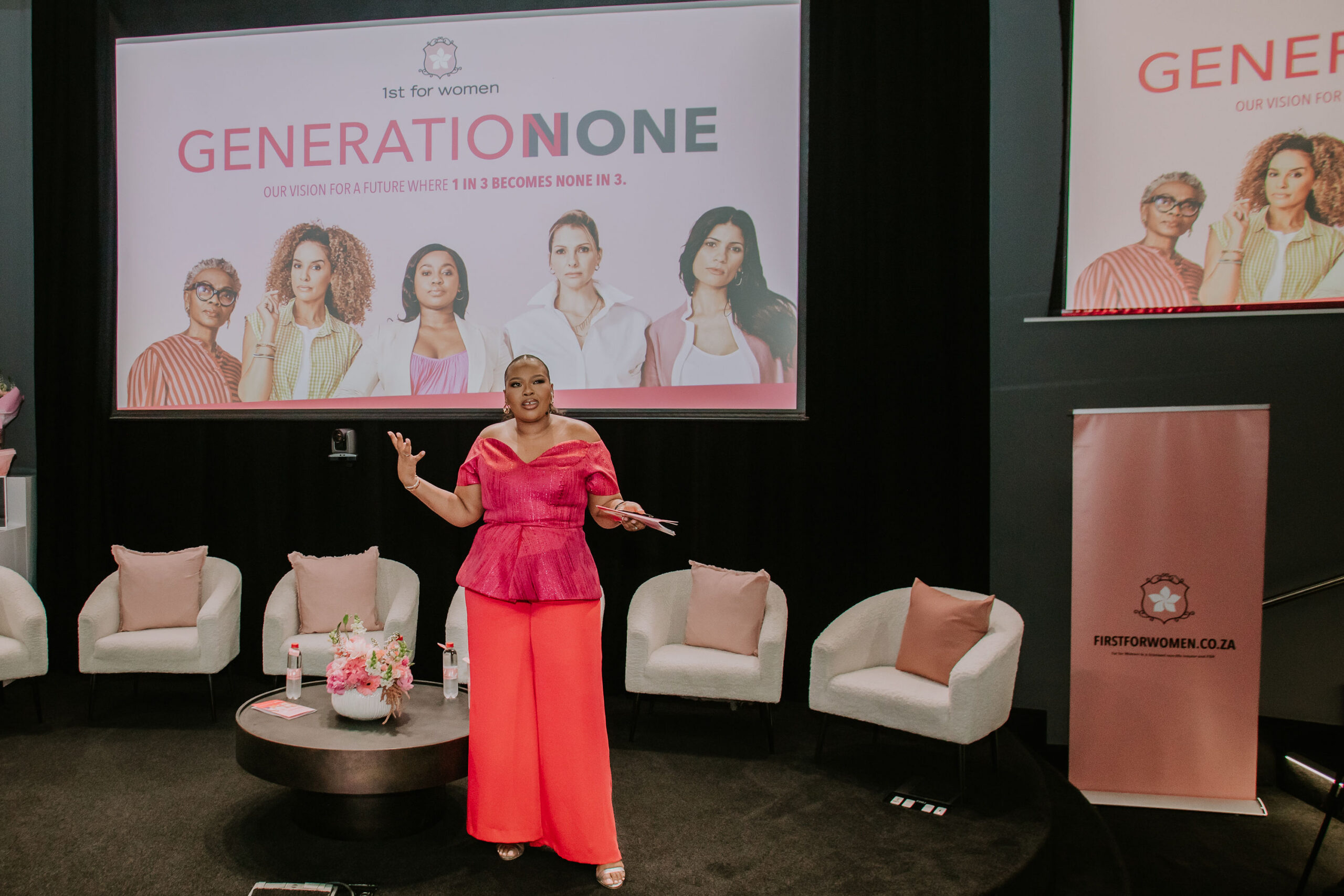
At an exclusive preview of the podcast episode, First for Women Foundation partners engaged in a panel discussion exploring what sustained action against GBV looks like in practice.
Representatives from Action Breaks Silence, REPSSI South Africa and Lawyers Against Abuse shared how their work tackles different parts of the problem: preventing violence by working with girls and boys, building safer support systems around children, and helping survivors access both legal and therapeutic support.
Debi Steven, Founder and CEO of Action Breaks Silence, said that “changing behaviour takes repetition, not one workshop,” with prevention starting with young people.
Naledi Kuali, Deputy Director of Lawyers Against Abuse, stressed that “no survivor should face the justice system alone,” legal protection and therapy must work together, from the first report through to recovery.”
For Celeste Matross, Country Director of REPSSI South Africa, support must reach the whole ecosystem around a child: “When every circle around a child is safe, that child can build the confidence to cope with whatever comes.”
Together, their work demonstrates that addressing GBV means intervening at multiple points: before violence occurs, when someone needs support, and when a survivor enters the justice system.
The podcast deliberately brings the conversation back to individual responsibility.
“If every conversation starts with men are the problem, men may leave the room, and we lose them from the solution,” says Jaco. It is precisely why Her & Now keeps men in the conversation or, as Anele puts it, this episode is “where the conversation starts, not where it ends.”
Part 1 premieres on the First for Women YouTube channel on 26 November 2026, followed by Part 2 on 3 December 2026.