
By Adelaide Changole and Bonolo Mokonoto.
Sovereign borrowing is competing with increased issuance by artificial intelligence (AI) firms, and local investors are placing a greater proportion of funds in hyperscalers’ stocks – potentially raising both yields and risks, according to the South African Reserve Bank (Sarb).
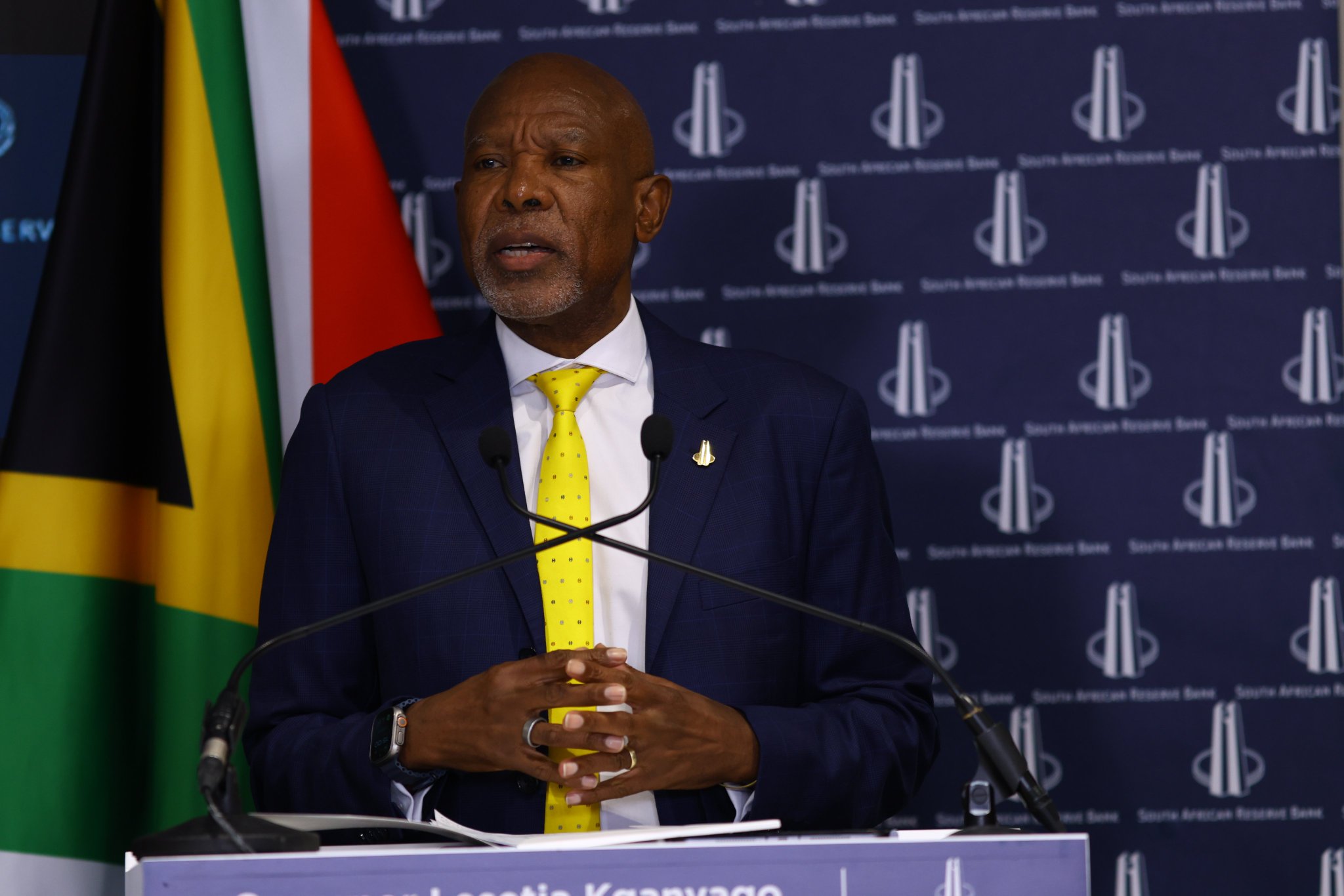
“Companies, in particular in the AI space, now compete with governments for long-term funding,” Sarb Governor Lesetja Kganyago said on Wednesday in Pretoria.
“That competition for funding is adding to the pressure on long-term borrowing costs.”
Domestic collective investment schemes analysed by the Sarb in its semi-annual financial stability review held almost 13% of their portfolio assets in related-companies by the third quarter, with more than two-thirds concentrated in Nvidia, Apple, Microsoft, Amazon and Alphabet, it said.
Any doubt on the capacity of AI-related investment to generate anticipated returns “could trigger a correction in major technology stocks, causing losses in domestic portfolios,” authors including Vafa Anvari, the head of macro-financial vulnerabilities at the authority’s financial stability department, said in the report.
With large cloud-computing companies turning to debt markets to help raise hundreds of billions of dollars to build out data-centre capacity, competitive pressures for issuance can “drive up borrowing costs” for sovereigns both locally and internationally just as yields are under pressure because of geopolitical concerns and higher policy rates, Anvari said in a separate presentation.
Domestic equities
The domestic equity market is also indirectly exposed to the technology cycle through Naspers and Prosus, which together account for about 8% of the market value of the JSE, the continent’s biggest bourse.
“A sharp global repricing could weaken investors’ risk appetite and prompt them to shift their portfolios away from emerging-market assets, affecting South Africa through portfolio outflows, exchange-rate depreciation, higher sovereign yields and tighter domestic financial conditions,” the authors said.
Despite the challenging global and domestic risk landscape, the Sarb sees the nation’s financial system as resilient and expects it to continue functioning efficiently over the next year barring major systemic events.
Preliminary results of the authority’s latest stress test show that banks “would remain above their regulatory capital requirements even in a severe downturn,” the governor said, adding the full results will be released in early 2027.
“Their capital buffers would, however, be eroded, leaving them with less room to absorb further losses.”
South Africa’s maturing debt will increase over coming years, near or exceeding R400 billion annually from the end of the decade through 2032, according to National Treasury.
This will have to be refinanced at significantly higher yields and in competition with AI-related debt binge, Anvari said.
Separately, the Sarb raised concern about cost-of-living pressures for households, many of which are increasingly relying on short-term, unsecured credit to survive.
The nation’s savings ratio – the proportion of savings by households relative to their disposable income – has been negative since 2022 and declined to the weakest in more than a decade in the third quarter, central bank data shows.
Elevated non-performing loans in revolving credit increase the probability that further shocks to income, inflation and employment would translate more quickly into arrears and credit losses, the Sarb said.
The composition of new debt warrants closer monitoring, it added.
Concerns about the uptake of buy-now, pay-later products and the lack of information about consumers’ obligations under them has caused the National Credit Regulator to institute mandatory reporting about them to credit bureaus as of 1 February 2027, the Sarb said.
It added that this new framework is expected to “improve the transparency of household financial obligations, strengthen affordability assessments and reduce the risk of excessive borrowing through product stacking”.
© 2026 Bloomberg.