
By Lehlohonolo Lehana.
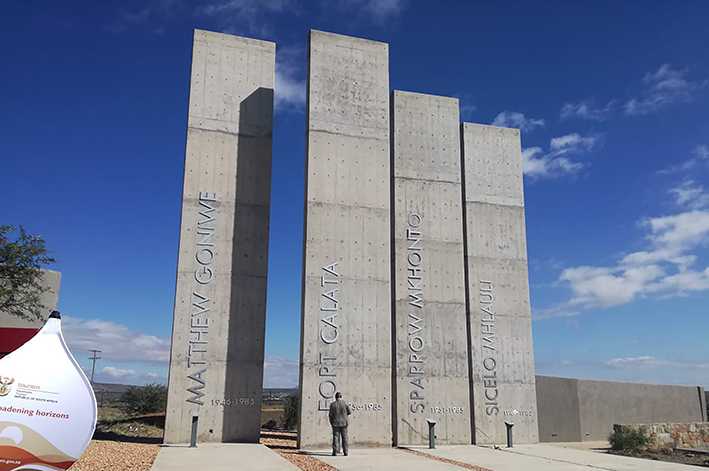
Cradock Four Garden of Remembrance. Courtesy: South African Tourism.
The Department of Justice and Correctional Services announced on Friday, that it will reopen an inquiry into the murder of four anti-apartheid activists, which became one of the era’s most notorious crimes but remains unsolved nearly four decades later.
On 27 June 1985, Mathew Goniwe, Sparrow Mkonto, Fort Calata, and Sicelo Mhlauli left Gqeberha, previously known as Port Elizabeth, after attending a meeting and were on their way home to Cradock.
However, the Cradock Four never arrived.
Goniwe, Calata, Mkonto, and Mhlauli were abducted and murdered, and their badly burnt bodies, with stab wounds were discovered in two different places days later. The anti-apartheid activists had attracted the attention of the National Party’s Security Branch (SB) on numerous occasions.
Former President PW Botha, attempting to suppress attendance at the funeral declared a state of emergency on the eve of the funeral. Nevertheless, thousands of people defied the state of emergency and attended the funeral on 20 July 1985.
Although the apartheid state denied its involvement in the murder of the Cradock Four, the identities of the killers began to emerge at the two inquests, including later when they applied for amnesty to the Truth and Reconciliation Commission (TRC). Revelations of the secret military signal dated June 1985 emerged, indicating that the four activists had been murdered at the behest of the State Security Council (SSC).
Minister Ronald Lamola acted on the recommendation of the National Prosecuting Authority (NPA) to approach the Eastern Cape Judge President to appoint a judge and reopen the inquest into the Cradock Four’s deaths.
This comes after two inquests were held, and according to the department, both the De Beer inquest in 1987 and the inquest in 1993 produced more questions than answers. The inquests also didn’t identify the murderers of the Cradock Four.
The department said the main reason for reopening the investigations is that it is in the interests of justice. It added the NPA is adamant the evidence made available after the De Beer and Zietsman investigations is new and was not previously presented before a fresh order was issued.
It added that there were multiple inconsistencies between the first and second investigations and the new evidence after the findings warranted a retrial.
Lamola said it is in the interest of justice to finally bring closure to the families of the Cradock Four, who have been waiting decades for the truth about who killed their loved ones.
“The privilege of presenting evidence in a democratic South Africa must be exercised. In the previous inquests, the voices of the families and those affected have not been heard. It is time for confidence in the justice system to be restored,” the minister said.
The families of Goniwe, Calata, Mkonto, and Mhlauli welcomed the announcement to reopen the inquest.
“We, the families, wish to state (as we repeatedly told the NPA) that we would have preferred the prosecution of those implicated in this heinous act rather than reopen what amounts to a third inquest into the murders of the Cradock Four. However, the avenue of prosecution was firmly shut down by spurious delays and the eventual death of the last known suspect, Herman Barend du Plessis, in May 2023,” the families said in a joint statement.
They added they were hopeful the inquest and the truth would bring light to the assassinations and help them seek closure and healing.