
By Lehlohonolo Lehana.
President Cyril Ramaphosa delivered an optimistic and hopeful address at the opening of the first government of national unity (GNU) Parliament on Thursday evening, promising a single-minded focus on growth and job creation, an accelerated reform programme, and a compromise on the difficult issue of the National Health Insurance (NHI).
Invoking the spirit and words of democratic SA’s first president, Nelson Mandela, 30 years ago, Ramaphosa said the GNU expressed the imperative of a joint national effort to reconcile the country and improve its well-being.
“We share a commitment to reconcile our nation by advancing social justice and equal prosperity for all. We are committed to improve the well-being of our country and its people through inclusive growth, the creation of jobs and the reduction of poverty. This is an undertaking that involves us all,” he said.
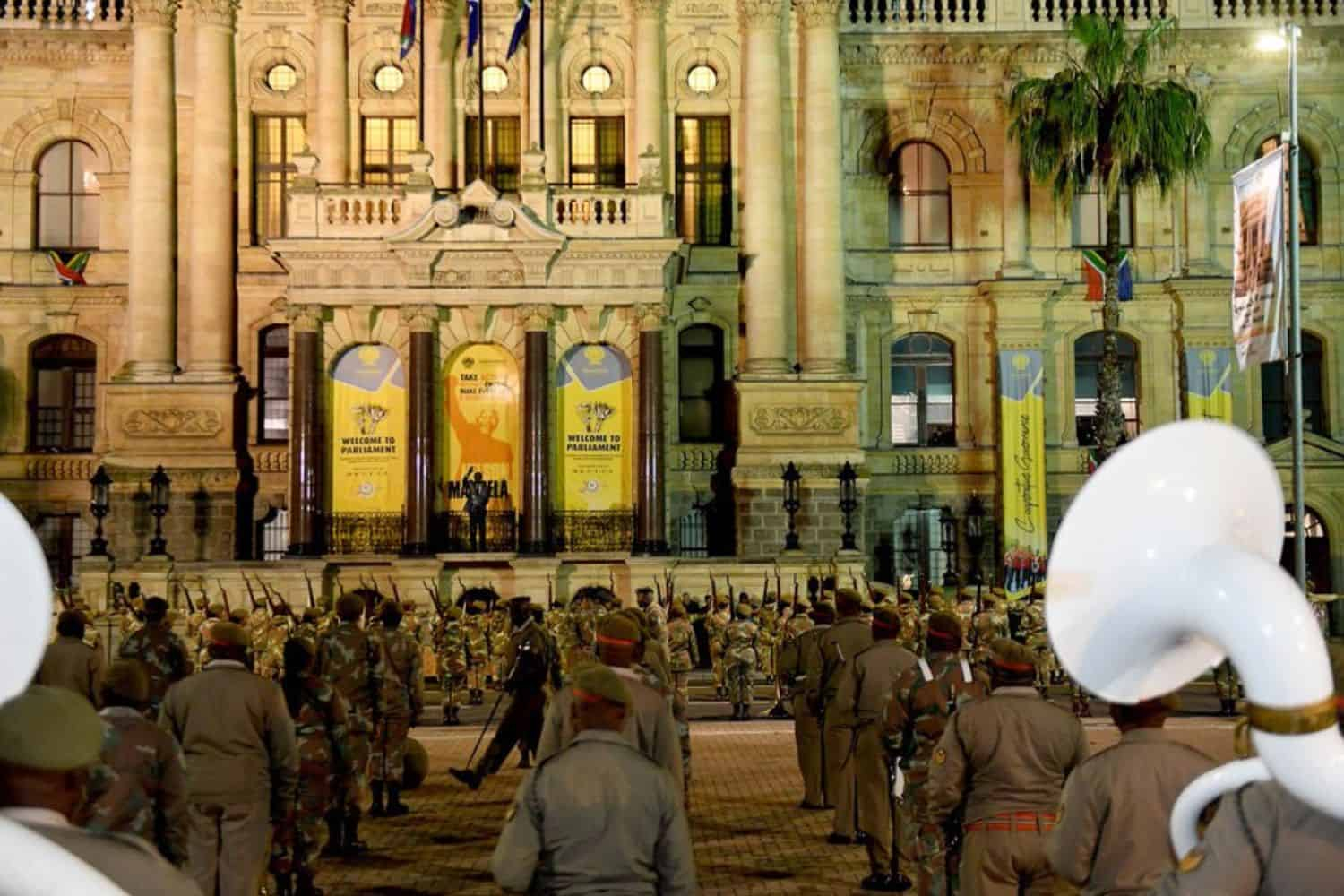
MPs debated Ramaphosa’s plan of action at the Cape Town City Hall on Friday, following his address on Thursday.
First up was ANC chief whip Mdumiseni Ntuli, followed by leader of the opposition, MKP’s John Hlophe, followed by DA leader and Agriculture Minister John Steenhuisen.
Ntuli was the first to take the podium, reiterating the ANC’s commitment to building “a South Africa that is truly united, non-racial, and non-sexist”.
He said as the largest party in Parliament, the ANC is committed to supporting the new administration and ensuring stability in governance.
“Our political differences should not make us enemies, nor should invalidate anybody’s rights or call to question our patriotism. This is the spirit with which the ANC parliamentary caucus commits to conduct itself,” Ntuli said.
Hlophe used his debate to criticise Ramaphosa, and the government of national unity (GNU) and its plans. He also commended Patriotic Alliance (PA) leader Gayton McKenzie for being “consistent”.
He slammed opposition parties for campaigning against the ANC before the elections, only to join the party in the GNU.
“There are parties here which campaigned against the ANC, but when the opportunity to be on the gravy train came, they went for it,” said Hlophe.
“So many parties openly campaigned against the ANC, but when offered blue lights, they suddenly fell in love with the ANC.”
Hlophe believes that the GNU should not have been established, calling it “a singularly very cruel joke by the Ramaphosa faction of the ANC and the Democratic Alliance”.
Although Ramaphosa called on political parties to join the GNU for “nation building”, Hlophe said the president only formed the GNU because he was desperate to hold on to power.
“If the ANC formed the so-called GNU on the basis that it was the largest party, you ask yourself, why was that principle not extended to the province of KZN? It’s a fact that MK party won KZN convincingly,” said Hlophe.
“A GNU is formed when there is a crisis. The only crisis is that the ANC has lost the majority.”
Hlophe said the GNU would not be able to address the challenges of poor South Africans unless the legacy of apartheid and colonialism is addressed.
He said the nation-building that Ramaphosa spoke of would not be achieved in a country where inequality was rife.
He further quoted former president Thabo Mbeki on inequality.
In 1998, Mbeki spoke of South Africa as one country, but two nations, in his debate on reconciliation and nation-building in the National Assembly.
Mbeki said: “We therefore make bold to say that South Africa is a country of two nations. One of these nations is white, relatively prosperous, regardless of gender or geographic dispersal. It has ready access to a developed economic, physical, educational, communication and other infrastructure.
“The second and larger nation of South Africa is black and poor, with the worst affected being women in the rural areas, the black rural population in general and the disabled. This nation lives under conditions of a grossly underdeveloped economic, physical, educational, communication and other infrastructure.”
According to Hlophe, nothing had changed since Mbeki’s speech in 1998.
Steenhuisen was booed by EFF MPs as he walked to the podium, and as if he walked there prepared, thanked them for “that wonderfully warm welcome from the Hadeda benches”.
It did not end there for Steenhuisen and the EFF as Mbuyiseni Ndlozi later rose on “a point of order” to remind Steenhuisen that he was a matriculant, unlike Hlophe, who made it as a judge before his impeachment this year.
“I wanted to respectfully address this honourable member with his rightful title as a matriculant. Seeing that there are confusions of titles today. This [Hlophe] is a judge, and this [Steenhuisen] is a matriculant.”
However, Steenhuisen had a perfect comeback in which he reminded Ndlozi of the party’s struggle to fight off Venda Building Society (VBS) Mutual Bank allegations this week.
According to the National Prosecuting Authority (NPA), about R2.3 billion was looted from VBS’ coffers.
But Ndlozi did not end there. He went on to call out McKenzie for “lying” about the country’s sovereign wealth fund.
“Don’t mislead the country. There is no sovereign wealth fund in this country. Take us seriously, please,” said Ndlozi after rising on a point of order.
McKenzie, however, had to preserve his dignity, and reduced Ndlozi to Julius Malema’s “ice boy”.
“Your peers, you always talk about education, are delivering papers while you’re an ice boy being sent around. You must not come to me. Don’t tell me about education.”
Ndlozi further defended Hlophe. This was after McKenzie slammed Hlophe for criticising the Roman-Dutch Law, which he used to judge cases during his time.
McKenzie had it twisted, according to Ndlozi.
“The judge has written a thesis when he was on the bench attacking Roman-Dutch law. Your illiteracy has not been bypassed. You come here and you lie, you must read. He didn’t even talk about sports and arts, but spoke of prison.”
Malema began by going back to 1994, insisting Ramaphosa showed signs of self-interest after that year’s momentous elections.
When it was clear that President Mandela was not going to make you the deputy president of the first democratically elected government in 1994, you threw tantrums and even boycotted his inauguration,” shouted Malema.
He would later invoke the memory of Madiba again when slamming Ramaphosa for his silence on the situation in Gaza, saying, “Mandela, a close friend of Arafat, should be turning in his grave”.
The EFF leader was unimpressed with Ramaphosa leaning on the National Development Plan (NDP) Vision 2030, declaring the goals have never and will never be met.
“All these things you said yesterday are meaningless because it is what you said in the six State of the Nation addresses you have given since you became president. None of the commitments you have made have been met.”
Malema detailed how the NDP had targets for jobs, unemployment, poverty, infrastructure development and GDP, that not only failed, but in all case deteriorated.
Ramaphosa will reply on Monday at 10:00.