
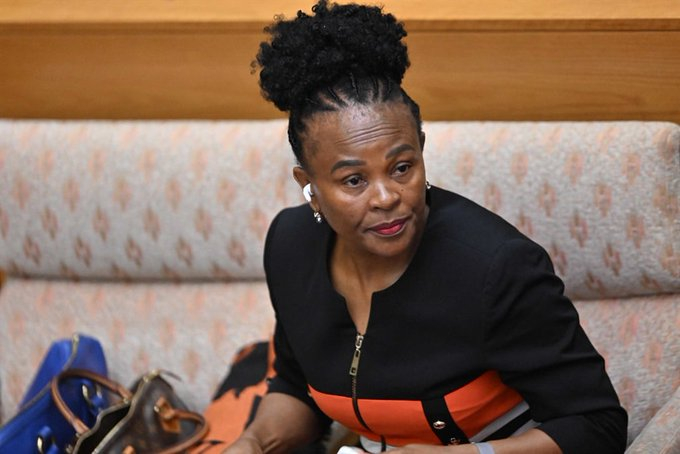
By Lehlohonolo Lehana.
The High Court in Pretoria heard that the removal former Public Protector Busisiwe Mkhwebane from public office does not disqualify her from receiving the gratuity awarded at the end of service.
Mkhwebane is seeking to have a multi-million rand gratuity paid out. She filed an urgent case against her former office in the High Court in Pretoria in March.
While previous public protectors received an end-of-service gratuity on leaving office, in line with the conditions of service passed by the National Assembly in 2002, the decision to withhold Mkhwebane’s gratuity was informed by a legal opinion stating she was not entitled to the R10 million due to her removal from office.
Mkhwebane was impeached in September 2023.
The current public protector, Advocate Kholeka Gcaleka, in her affidavit said Mkhwebane had no right to the remedy claimed as she did not vacate office but was removed for serious misconduct and incompetence.
Gcaleka mentioned that her office was not obliged to pay Mkhwebane any gratuity payments.
“She has no right to a gratuity payment,” said Gcaleka.
Gcaleka said her office paid Mkhwebane’s legal costs during the impeachment inquiry, despite the fact that the courts never determined whether Mkhwebane was entitled to counsel funded from the public purse, merely that she had the right to be assisted and represented by lawyers in the section 194 process in which MPS considered her fitness to hold office.
This, Gcaleka added, did not stop Mkhwebane from behaving as if she had an absolute right to unlimited funding from the state for lawyers of her choosing and no obligation to spend that which she was given wisely.
Her lawyer Advocate Dali Mpofu argued that for the purpose of the case, they will look at Mkhwebane’s service as an employment contract.
“The basic conditions of the Employment Act applies here because we know the Act applies to everyone except those people who are excluded from it such as members of the intelligence services and that kind of thing,” he said.
Mpofu said the central question in the matter is whether there’s a “legal or rational explanation” for the introduction of a forfeiture clause which would only entitle a public protector to a gratuity if they are not found guilty of certain transgressions.
“You can’t just dream up a forfeiture clause as you go along every day you wake up. A forfeiture clause is what you call a penal provision, by definition. It’s a provision that introduces a penalty. It’s why it’s called a forfeiture clause, because you forfeit that which has accrued.”
He said Section 6 of the Judges Remuneration and Conditions of Employment clarified that this gratuity should be paid once the person leaves the office.
Mpofu indicated that this section made it a legal right that Mkhwebane should receive her gratuity.
“It does not say that a judge must get that gratuity if he behaves well or if he turns down certain judgements,” said Mpofu.
“It simply says that gratuity ‘shall’ be paid and that’s it. Anyone who can argue that gratuity does not create at least a legal obligation on the state, which then has a corresponding legal right on the part of the judge, will be really gilding the lily,”Mpofu added.
Mpofu told the court that there was no source of the power Gcaleka exercised to deny Mkhwebane gratuity payment.
Advocate Tembeka Ngcukaitobi, who is representing Gcaleka and PPSA, asked for the matter to stand down until Tuesday, 20 August to respond.