
By Lehlohonolo Lehana.
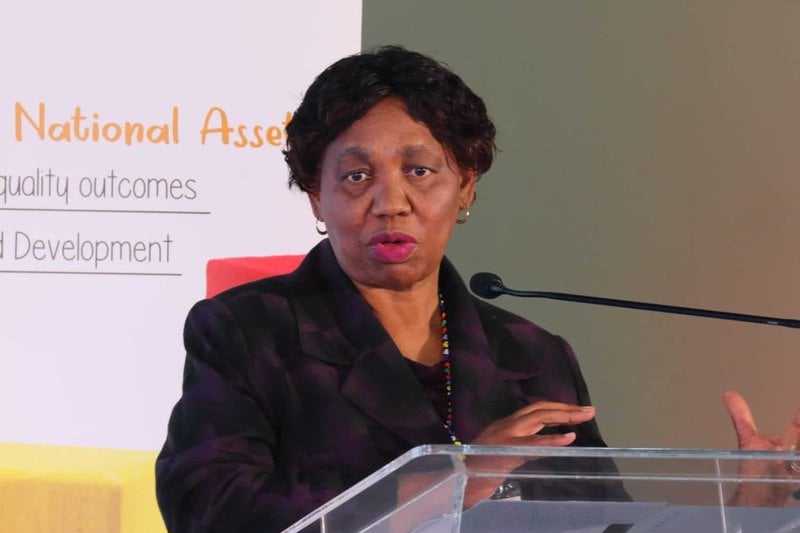
Basic Education Minister Angie Motshekga has visited the Kgatoentle Secondary school in Ga-Rankuwa, north of Pretoria, to monitor the re-opening of schools for the new academic year.
Motshekga was joined by Gauteng Premier Panyaza Lesufi and Gauteng Education MEC Matome Chiloane.
Kgatoentle Secondary School received an upgrade of its old infrastructure which included damaged roofs, as well as its damaged fence.
The state-of-the-art school, which has 46 teachers, boasts a multipurpose hall, nutrition centre, water reticulation system, a generator for loadshedding, two consumer centres, a sports centre with changing rooms and showers, and a WiFi.
Motshekga urged pupils to use the new school resources to enhance their academic performance.
“What is important is for you to focus on your books. All we ask from you is nothing but respect and humility,” said Motshekga.
“The resources here are to give you support and make learning easier for you.”
The minister said Kgatoentle obtained a 100% matric pass rate for the 2023 schooling year.
Motshekga is expected to announce the national pass rate for the matric class of 2023 on Thursday at 6pm.
She has again hit back at critics who says the country’s pass mark for the National Senior Certificate is 30%.
Education experts and opposition parties have previously criticised the Department of Basic Education (DBE) over the fact that the lowest possible pass mark for a subject is 30%.
She said the “30% pass mark” is a myth that gets perpetuated each year, but pupils also cannot be punished for a one-subject failure.
“I am not going make a child repeat a class because of 30% pass in Afrikaans when they have at least 4 level 7s for other subjects,” said Motshekga.
“We assess pupils based on five subjects; we do not combine all the marks to get a pass; that’s how things were done in the past; we do not do that anymore.”
She said she’s happy that the results system is stable this year, and that it will help them make improvements.
“We are releasing tomorrow. But for me where I sit having received the initial results, they are still being verified. The system is stabilising because for me the biggest fear is when you have a system that today you are at 30, tomorrow 50, 100. So it does show that there’s something wrong. When the system is stable we are able to see where the weak points are and the things we need to strengthen.”