
By Lehlohonolo Lehana.
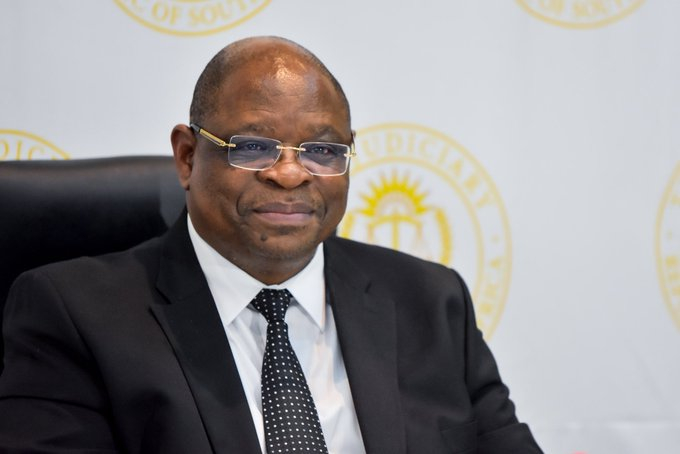
Outgoing chief justice Raymond Zondo on Wednesday delivered his final judgment before his retirement at the end of the month,after a distinguished 27-year judicial career.
Zondo’s term of an apex court judge is limited to a non-renewable 12 years or on reaching retirement age, whichever occurs first.
The court held a special ceremonial sitting,which we saw former president Thabo Mbeki and his wife Zanele, Anglican Archbishop Thabo Makgoba, Justice minister Thembi Simelane, her deputy Andries Nel, National Assembly Speaker Thoko Didiza, members of legal bodies and jurists were present at the ConCourt for the special sitting.
This was preceded by a ruling, delivered by Zondo, in which the court was asked to determine whether the 30 days referenced in section 59(3) of the Defence Act 42 of 2002 “include days on which a member of the regular force is not obliged to be on official duty”.
The case was brought by Molefi Jonas Mamasedi and revolved around the interpretation of section 59(3) of the Defence Act.
The Act reads: A member of the Regular Force who absents himself or herself from official duty without the permission of his or her commanding officer for a period exceeding 30 days must be regarded as having been dismissed if he or she is an officer, or discharged if he or she is of another rank, on account of misconduct with effect from the day immediately following his or her last day of attendance at his or her place of duty or the last day of his or her official leave, but the Chief of the Defence Force may on good cause shown, authorise the reinstatement of such a member on such conditions as he or she may determine.”
The SANDF argued that the 30 days in the Act referred to calendar days, while Mamasedi contended that they referred to the days he was required to be on official duty.
Mamasedi was not required to work on Saturdays, Sundays and public holidays. His working week was Monday to Friday.
In 2011, Mamasedi was a member of the Regular Force of the SANDF, holding the rank of sergeant. Section 59(3) of the Defence Act applied to him.
According to court documents, Mamasedi was absent from work from 29 November 2011 to 2 January 2012 without permission. He returned to work on 3 January 2012.
This period exceeded 30 calendar days if weekends and public holidays were included in the 30 days referred to in section 59(3).
However, if weekends and public holidays were excluded, Mamasedi’s absence was less than 30 days.
Upon his return to work on 3 January 2012, a Board of Inquiry was established to investigate his absenteeism.
He told the Board of Inquiry that he had been kidnapped and taken to an initiation school against his will.
However, his version was disputed as his father claimed Mamasedi had voluntarily attended the initiation school.
Despite the reasons for his absenteeism being deemed irrelevant, the Inquiry found against him and recommended his dismissal.
Mamasedi has been out of the SANDF since then, despite his appeals in the Gauteng Division of the High Court and the Supreme Court of Appeal.
He escalated the matter to the Constitutional Court, where his case was heard on 6 February 2024.
In a unanimous judgment, the Constitutional Court ruled against the SANDF.
The apex court found that in Mamasedi’s case, the 30 days referred to in Section 59(3) of the Defence Act did not include days when Mamasedi was not required to work.
It also declared that from 3 January 2012 to date, Mamasedi has been and continues to be a member of the Regular Force of the SANDF.
The SANDF’s refusal or failure to pay Mamasedi’s remuneration and other benefits from January 2012 to date was declared unlawful.
As a result, Mamasedi is entitled to payment of his remuneration from 3 January 2012 to date.
The SANDF was ordered to pay Mamasedi’s costs.
Meanwhile Zondo’s deputy and incoming Chief Justice, Mandisa Maya, led tributes the outgoing Chief Justice during the sitting.
The president of the National Association of Democratic Lawyers Mvuzo Notyesi, who opened his tribute by sharing an anecdote from a recent visit to the Eastern Cape. There, he mentioned, he met a young boy coincidently named Mnyamazeli Raymond who aspired to become a chief justice like his namesake.
“I enquired about what inspired this ambition and he candidly expressed his admiration of you whenever you appear on TV. This moment underscored two significant insights for me: first, you have indeed lived up to your name, Mnyamazeli, and second, your humility has left a lasting impression on those around you,” he said.
Notyesi also lauded Zondo for the “courage and commitment” he displayed at the helm of the commission.
National Prosecuting Authority (NPA) boss Shamila Batohi referenced this in her tribute to Zondo, saying: “Chief justice, I would like you to retire with the assurance that the real impact of the work of the commission will actually be felt, that we will have those responsible for the devastation of state [institutions] face justice.
“You displayed the necessary courage to act decisively and with impeccable resolve and at great personal sacrifice at times. On behalf of the NPA, we thank you for your integrity and working with a spirit of service and sacrifice.”
Simelane lauded Zondo for his “extraordinary commitment” and noted that the country’s history would “always be divided into two parts”; the pre and post- State Capture Commission era.
The first was one defined by “colleagues who had no accountability, impunity, consequences for the looting of state resources”.
“But the second chapter, which you eloquently wrote, is built on the findings and recommendations from the commission.
Zondo’s foray into practicing law began when he served articles under anti-Apartheid activist Victoria Mxenge before her assassination at the hands of Apartheid South Africa operatives.
Following that, he was a practising attorney in Durban, KwaZulu-Natal, before his first approach to the bench just three years after the dawn of democracy.
Zondo…was then appointed as a Judge of the Labour Court in 1997. In April 1999 he was appointed as a Judge of the then Transvaal Provincial Division of the High Court. He served for close to eleven years as Judge-President of the Labour Appeal Court and Labour Court. His ten-year term of office as Judge-President ended in April 2010.
Following 15 years on the lower benches, Zondo was then appointed as a Constitutional Court Justice in 2012.
In June 2017 he was appointed as Deputy Chief Justice of the Republic of South Africa. In January 2018 he was appointed as the Chairperson of the State Capture Commission.
With effect from 1 April 2022 he was appointed as the Chief Justice of the Republic. For the past two and a half years he has led the Judiciary of this country with great success. His term of office comes to an end on 31 August 2024.