
By Lehlohonolo Lehana.
Presidency confirmed receipt of a report by Justice minister Thembi Simelane on the loan she took from a company implicated in the VBS Mutual Bank scandal.
Spokesman Vincent Magwenya told a routine media briefing in Cape Town.
Simelane took a R575,600 loan from Gundo Wealth Solutions in 2016, a company whose director, Ralliom Razwinane, was a VBS fixer.
She is under pressure to step down after it emerged that she received a loan from a VBS-linked fixer to pay for a Sandton coffee shop.
He received a loan from Gundo Wealth Solutions during her tenure as Polokwane mayor.
Simelane told Parliament that she had repaid R849,000 on the loan some four years later in three payments, in October and November 2020 with a final payment in January 2021. She offered no proof of these payments and claimed she received no undue benefit.
The same company had solicited deposits of millions of rands from the Polokwane municipality on behalf of VBS, despite public finance rules barring municipalities from placing money with mutual banks.
In total, Polokwane deposited R349-million with VBS between 2016 and 2017. The full amount was withdrawn prior to the bank’s collapse in 2018, caused by extensive looting by the bank’s management, fixers as well as ANC and EFF politicians.
Razwinane, however, is facing charges of corruption for payments he received from VBS in connection with the Polokwane deposits. He was paid commissions, effectively success fees, for securing the deposits. Prosecutors labelled these payments corrupt.
VBS collapsed in 2018 after its coffers were depleted by a fraadulent scheme in which money flowed from suspense accounts to bank officials and their family members.
She also denied that there was any conflict of interest between her position as justice minister, with oversight of the National Prosecuting Authority, which is pursuing charges against several VBS corruption accused.
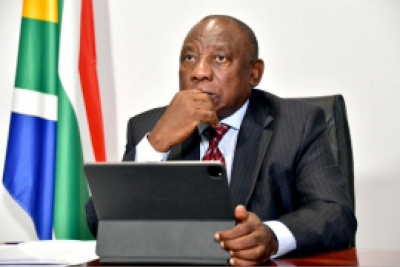
Magwenya said the president would apply his mind to her future after reading the report.
“Ramaphosa is in receipt of a report from the minister. As stated before, the president will exercise his discretion over the matter.
“In doing so, the president will not engage issues that he manages with ministers, including Minister Simelane, in the public domain.
“The president is committed to ensuring the highest levels of integrity within the national executive. He will consider all the facts on the matter before making any determination,” he added.
Meanwhile tensions between the National Prosecuting Authority (NPA) and the justice department were on full public display on Tuesday when Parliament’s justice committee met to discuss reports that the NPA was being blocked from accessing the database of evidence emanating from the commission of inquiry into State Capture.
National Director of Public Prosecutions Shamila Batohi told Parliament: “The NPA has been working on getting the access that we need for close to four years.”
Batohi said that the ID required “unhindered access”, and had been provided with “levels of access, but not the access that they need”.
However, justice director-general Doc Mashabane was adamant on Tuesday: “There is access.”
Professor Itumeleng Mosala, representing the State Capture Commission, flatly denied Batohi’s version, telling the committee: “It’s four years since the NPA has not been getting access — that’s not a fact. Can we give empirical proof that it’s not true, because we actually have it?”
Mosala gave assurances to the committee that “there is nothing in [the database] that we can’t make available to the NPA “— but simultaneously seemed to provide multiple caveats.
He said, for instance, that there were complications involving data “acquired under particular conditions, and those conditions have to be observed”.
He cited as an example data relating to individuals’ bank accounts, which he said the commission could not legally pass on because it would have to be subpoenaed from the banks themselves.
Mosala also expressed the position that only information which was admitted into evidence by the commission head, former Chief Justice Raymond Zondo, could be released.
“There is information which is highly sensitive… Some information was not used in the commission.”
Mashabane added that cognisance needed to be taken of “Popia [the Protection of Personal Information Act] and other related laws [which] govern processing of information”.