
By Lehlohonolo Lehana.
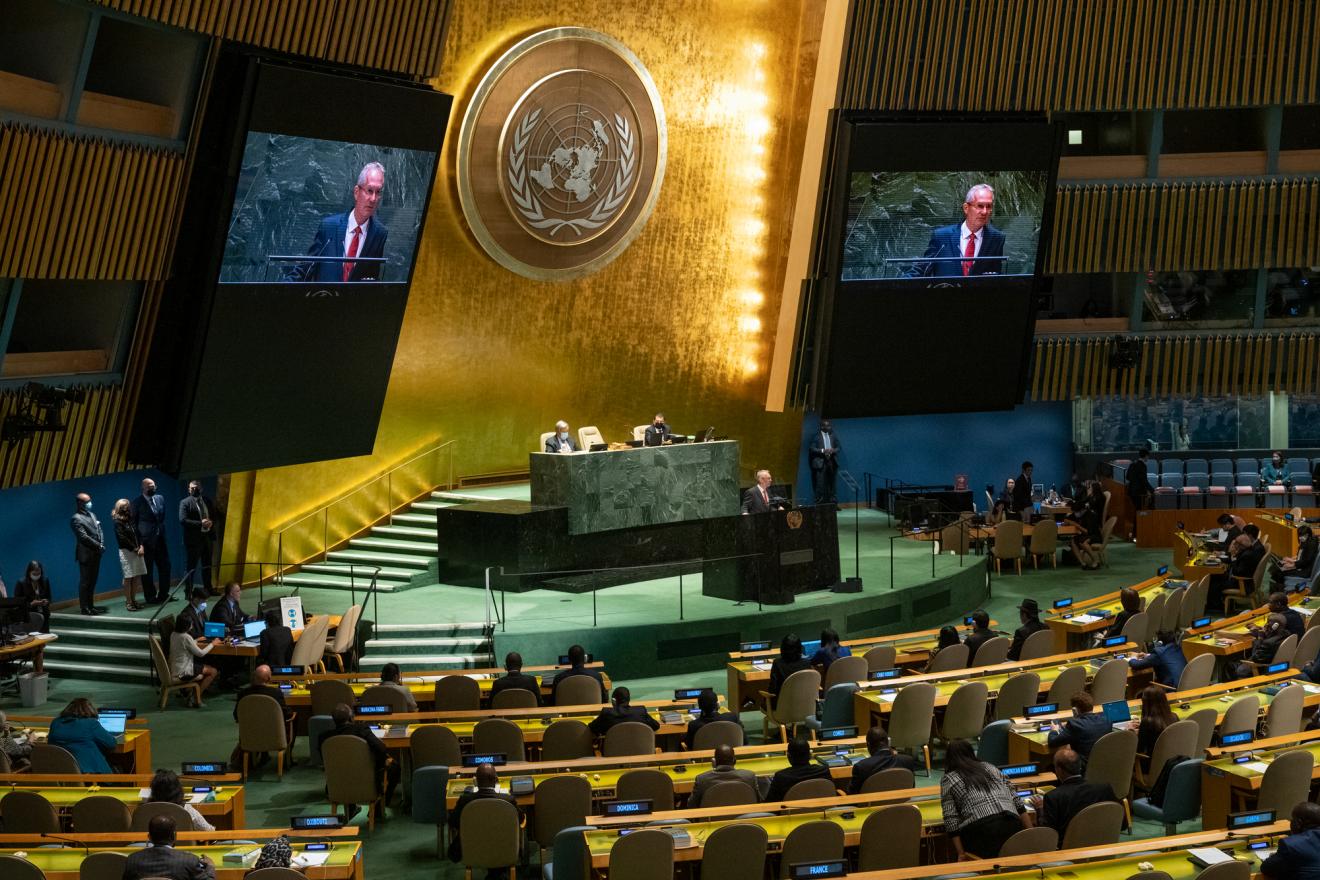
President Cyril Ramaphosa was the first African leader to address the 79th session of the United Nations General Assembly, UNGA, where he spoke on several issues, including the case at the U.N’s top court against Israel’s military operation in Gaza.
Ramaphosa recalled the end of apartheid and the UN’s support to “turn the tide against apartheid” during remarks focusing on Israel’s treatment of the Palestinians.
“The violence the Palestinian people are being subjected to is a grim continuation of more than half a century of apartheid that has been perpetrated against Palestinians by Israel. We South Africans know what apartheid looks like. We lived through apartheid. We suffered and died under apartheid. We will not remain silent and watch as apartheid is perpetrated against others.”
He called for reform of the United Nations Security Council during his speech and urged for Africa to be included as part of the council.
“Achieving and maintaining peace and security requires the collective will of the community of nations gathered here. It requires that the UN Security Council should be a more representative body and inclusive. Seventy-eight years since its formation, the structure of the United Nations Security Council remains largely unchanged.”
“Africa and its 1.4 billion people remain excluded from its key decision-making structures. This cannot continue.
The Security Council has not fulfilled its mandate to maintain international peace and security. The UN Security Council must be reformed as a matter of agency.”
One of the issues hotly debated at the UN this year is reforming the Security Council, which was formed from the ashes of World War II, when much of the world was still under colonial rule.
Permanent members – the five nations with permanent seats and veto power within the Security Council — “dictate the terms of international peace and security. “
The permanent members, also known as P5, include the United States, the United Kingdom, Russia, France and China.
Here’s a look at how P5 members have used their veto power to block resolutions on key issues recently:
- On Ukraine: Russia, a frequent user of its veto power, has vetoed resolutions related to Ukraine four times since 2014.
- Middle East: When the council considered a resolution regarding the region’s situation, with the Palestinian question specifically mentioned, the United States was the member to use its veto power a majority of the times (16 times), with Russia and China using it together 2 times. The US also vetoed a resolution this year asking to grant the UN membership to the State of Palestine.
- Meanwhile France and the UK have effectively stopped exercising the power, last using their vetoes in 1989.
Last week, Oxfam, a British-founded confederation of 21 independent non-governmental organizations, called for UNSC reform, saying the body needed to “stop the ‘Permanent Five’ from being their own ‘judge and jury.”
The UN Security Council (UNSC) is failing people living in conflict, with Russia and the United States particularly responsible for abusing their veto power which is blocking progress toward peace in Ukraine, Syria, and the Occupied Palestinian Territory and Israel, “Oxfam said.
A new Oxfam report released last week found that permanent members “are exploiting their exclusive voting and negotiating powers to suit their own geopolitical interests. In doing so, they are undermining the Council’s ability to maintain international peace and security, “it said.
In his opening remarks at the Summit of the Future where the pact was adopted, UN Secretary General Antonio Guterres warned that the UNSC has become “outdated and its authority is eroding.”
“Unless its composition and working methods are reformed, it will eventually lose all credibility,” he warned. “We must take the first decisive steps towards updating and reforming international cooperation to make it more networked, fair and inclusive – now. And today, thanks to your efforts, we have,” he added.
Ramaphosa described the Pact for the Future, adopted by the General Assembly, as a chance to “reinvigorate the multilateral system” and fulfill promises to reform global governance, including the Security Council and international financial institutions. He also urged support for Africa’s developmental agenda, known as Agenda 2063.
He emphasized that the pact “must involve strengthening multilateral action for sustained peace.”
We must pursue the attainment of just and sustainable peace based on international law,” said Ramaphosa, whose government took Israel to the International Court of Justice (ICJ) for genocide over Tel Aviv’s indiscriminate offensive on the besieged Palestinian enclave of Gaza since Oct. 7 last year.