
By Lehlohonolo Lehana.
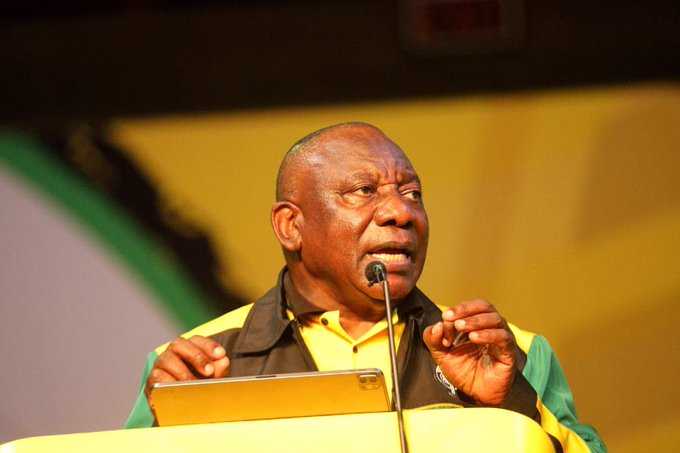
The African National Congress (ANC) President Cyril Ramaphosa says he does not regret granting former President Jacob Zuma remission of sentence.
Zuma was sentenced to 15 months behind bars by the Constitutional Court but was released three months into his term.
Ramaphosa addressed the media on the sidelines of his election campaign in Gauteng on Saturday.
In terms of Section 84(2)(j) of the South African Constitution, the president – acting as the head of state – is “responsible for pardoning or reprieving offenders and remitting any fines, penalties or forfeitures”. Ramaphosa relied on this provision (mirrored in Section 82 of the Correctional Services Act) to order a 12-month reduction of the sentences of all prisoners not serving time for certain categories of serious or violent crime. He granted low-risk offenders an additional 12-month remission of their sentences.
For low-risk offenders like Zuma, who had less than 24 months of their sentence remaining, the remission in effect “extinguished” the remaining part of their sentence. As a result, Zuma no longer had any prison sentence to serve, and was therefore a free man.
Earlier in the week, the Electoral Court ruled the former president could contest elections and his face would be allowed on the ballot paper.
The Electoral Court issued a hurried order without reasons on Tuesday, as it had to decide on the matter in accordance with strict deadlines of the Electoral Commission of South Africa (IEC).
This led to the court not yet giving reasons why it ruled the way it did, but based on some of the arguments advanced by Zuma’s legal representative advocate Dali Mpofu, we can narrow it down to one or two possibilities. The reasons are expected in a written judgment next week.
The first is Ramaphosa and his Justice Minister Ronald Lamola scored a spectacular own goal when they handed Zuma a remission of sentence in August last year in a politically-motivated bid to likely avoid July Riots 2.0 if Zuma was forced back to jail.
Mpofu argued in court that when Ramaphosa gave Zuma a remission of sentence after serving just three months in prison, he effectively reduced his 15 month sentence to three months.
The significance of a reduced three month sentence by remission, is that according to rules of Parliament: “Every citizen who may vote is entitled to be a member of the National Assembly except.”
– People convicted of an offence and sentenced to more than a year in prison without the option of a fine after October 1996. Such people qualify for membership of the National Assembly again five years after their sentences have been completed.”
Of course, the court has yet to advance the reasons, but this is a high possibility.
Ramaphosa said, “We took the decision, as we decided that we should move in that direction. And the remission was a generalized mission. It was not specific to him. So when I took the decision, it was not specifically aimed at former President Jacob Zuma.”
“It was a broad decision that affected many other people who needed a remission and it was being done so that we can reduce the numbers of people in our prisons because they are burgeoning at the seams. There are too many people in our prisons, so I don’t regret that decision.”
And what is happening with the IEC case is what happens in politics and state governance issues and we handle it as we move on.”
Ramaphosa added that the Electoral Commission is independent and isn’t playing into the political arena by approaching the Constitutional Court.
“And so no individual IEC consular should be pointed out as having done this or that. It is the entire IEC commission that has taken the decision. And the decision is based, as I heard it and understood it, on bringing clarity to the law, so that the Constitutional Court, which is the repository of the entity that should interpret our law, so that they interpret the law and give clarity once and for all, for all parties and for all time.
“So that is what has given it. And I don’t really buy this notion that the IEC is venturing into politics, the IEC is inherently non-political. It is independent and we must defend independence, just as we should defend the independence of our courts.”
On 29 May, nearly 28 million South African registered voters have the chance to elect representatives to the national and provincial parliaments.
It will be the South Africa’s seventh democratic general election.
The elections have taken place every five years since 1994, when white-minority rule ended and the ANC came to power.