
By Lehlohonolo Lehana.
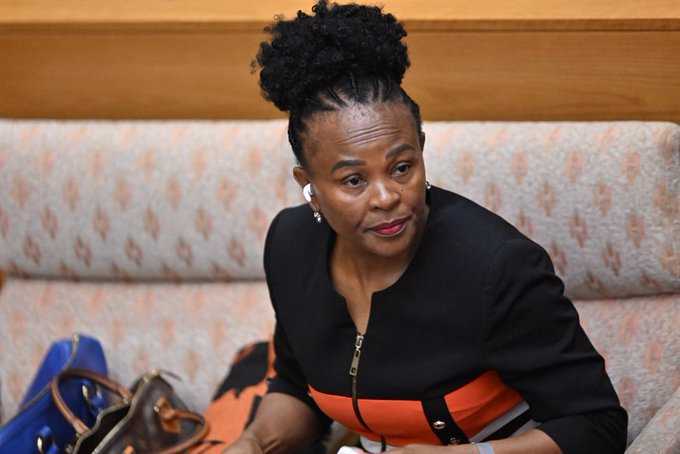
The Gauteng High Court has blamed the Public Protector’s office for delays in the case of Busisiwe Mkhwebane’s R10 million gratuity claim and ordered it to pay punitive legal costs.
Mkhwebane approached the High Court in Pretoria to force the Office of the Public Protector to pay her gratuity.
She was impeached in September 2023, a few weeks before the end of her seven-year term as head of the Chapter 9 institution.
Judge Colleen Collis removed the matter from the urgent court roll for enrolment on an alternative date, this after the court determined that the matter was not ripe for hearing on Thursday.
“It appears that the parties hold different views on what the issues ought to be that the court must determine today but in essence what overlaps is, in fact, the urgency of the application. On the side of the 1st and 2nd respondents on whether ought to have been enrolled on the urgent roll today…now the present application is a matter of great importance to all parties concerned, it raises issues of a complex nature before the cour. The outcome of these proceedings holds serious consequences for both the parties of the court, on the side of the applicant. If this relief is to be refused, it is against this backdrop, totality of the evidence that needs to be placed before this court,” says Collis.
Mkhwebane’s legal counsel, Advocate Dali Mpofu, argued that the decision not to pay her gratuity was unlawful and that Mkhwebane is entitled to costs if the matter is considered not urgent.
The Public Protector’s office is required to submit documents that informed the decision not to pay Mkhwebane her gratuity.
“I raised it with my learned friend, I said well you can’t give us an answering affidavit, you must give us the record. It was on that occasion when the record was promised. Instead of being given a record, we are given something called an answering affidavit and a condonation notice,” said Mpofu.
In the papers filed in court, Mkhwebane alleges that her successor Kholeka Gcaleka, is refusing to pay what is due to her.
When the court sought an explanation from the respondent regarding the failure to comply, counsel cited an unreasonable timetable.
“The first question is, did the applicant formulate reasonable timeframes, is it your case that it was not reasonable, absolutely not, we examine that at paragraph 11,” says Advocate Tembeka Ngcukaitobi SC, on behalf of Office of the Public Protector.
Following all submissions, the court concluded that the matter was not ripe for hearing and ordered that the application be removed from this week’s urgent roll for enrolment on an alternative date to be determined by the Deputy Judge President upon being requested by the parties.
The Office of the Public Protector was ordered to deliver the record and reasons behind the decision not to pay the gratuity before 19 April 2024.