
By Lehlohonolo Lehana.
Former African National Congress (ANC) President Thabo Mbeki has hit back at claims that his administration was warned about a brewing power crisis in 2008 but did nothing about it.
Mbeki says his previous apology for the Eskom crisis was not appropriate,instead pointing a finger at his predecessor’s administration and the utility itself.
He apologised during his last State of the Nation Address in 2008, before he was eventually recalled by the ANC in September 2008.
“It is however necessary that we take this opportunity to convey to the country the apologies of both the government and Eskom for the national emergency which has resulted in all of us having to contend with the consequences of load shedding,” he said in his Sona 2008.
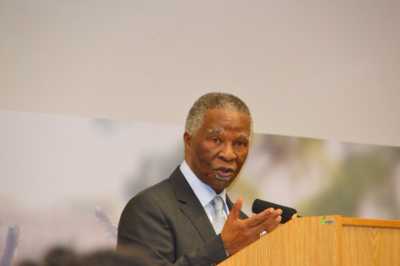
Mbeki delivered an address on the commemoration and reflections on South Africa’s 30 years of Freedom and Democracy, at Freedom Park, Pretoria, in Tshwane.
He claimed the first instance of load shedding came six years later and was part of larger sabotage.
The former president said he recently learnt, through a confidential special investigations unit report into Eskom, that he should never have publicly apologised for the power crisis as it was a man-made crisis from Eskom internally. The special investigations unit report is under lock and key at the Union Buildings at the Office of the Presidency since about 2018.
He explained that the report showed that Eskom had internal controls and monitoring processes which would monitor the internal performance of power stations.
Mbeki said the report showed the load shedding crisis at the time was “easily avoidable”.
The former president believes the decision to oust him as ANC president and a short while later as the president of the country was part of the counter-revolution.
Merriam-Webster describes counter-revolution as “a revolution directed towards overthrowing a government or social system established by a previous revolution”.
This explains why Mbeki is adamant that there was a hand of the apartheid government behind the move to remove him.
“This is (why) the apartheid regime paid a lot of attention to the task to infiltrate as many of its agents as possible into the ANC and the rest of the broad democratic movement,” he said. “Though much was done by the ANC to discover and expose these enemy agents, the hard reality is that a considerable number remained undetected within our ranks.
“Quite early after the formation of the 1994 government of national unity, we approached the heads of the former SADF, the SAP and NIS to request that they give us the lists of these agents so that we could discuss with and demobilise them. Effectively, all three services turned down our request. The counter-revolution used these agents in the ranks of the ANC to intervene in the Polokwane national conference as it did.”
It was at the 2007 ANC Polokwane conference that this “counterrevolution” manifested itself when he was ultimately removed as president of the party at the conference that ushered in his successor Jacob Zuma.
The divisions within the ANC are mainly attributed to this conference which eventually saw those who had supported Mbeki’s move for a third term leave the ANC to form COPE.
Mbeki futher has taken aim at Zuma, suggesting he had sabotaged the South Africa’s economy to collapse the state.
While the first saw much progress, the other was filled with more difficulties and slowed growth.
He also highlighted several commissions to look at government maladministration, State Capture, and alleged corruption; before criticising the state of the country under Zuma.
Quoting the findings of reports into state capture, Mbeki suggested Zuma had sabotaged the country nearly to the brink of collapse, and claimed he was “a wolf in sheep’s clothing”.
This provides us with a conundrum. Here, according to the judicial commissions, we have a head of government [Jacob Zuma] who joins a process to reduce the very revenues he needs to enable the government to discharge its responsibilities, up to the point of the possible collapse of that government.
“How do we explain this puzzle? The only logical way to explain this is, as challenging as it might be even to comprehend, here we are dealing with a wolf in sheep’s skin”.
Mbeki has dismissed the notion that has been going around, especially ahead of the May 29 election, that the ANC-led government had “completely failed” in the past 30 years.
The charge that some make repeatedly, that the past 30 years of our democracy have been a disastrous period for our country and people, is entirely false and serves ignoble purposes,” he said.
“Rather, the achievements realised as a result of the efforts of our people as a whole during the first 13-15 years of our democracy demonstrate this vitally important consideration that together we have the capacity to take this country to great heights.