
By Lehlohonolo Lehana.
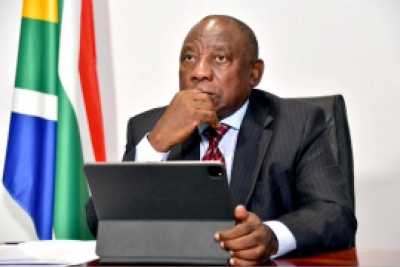
President Cyril Ramaphosa says South Afirca has become an increasingly attractive investment destination that has drawn R1.5 trillion worth of commitments from big businesses.
In his weekly letter to the public, the president highlighted big-brand auto manufacturers like BMW, Volkswagen, Mercedes-Benz, General Motors, Ford, Toyota, Nissan and others expanding their presence in the country with increased investment.
Ramaphosa pointed to annual investment conferences held in South Africa over the current term, which he said attracted R1.5 trillion in investment commitments across a broad range of economic sectors.
Over one-third of these pledges have translated into job-creating businesses and business expansions in renewable energy, mining, packaging, automotive, retail, manufacturing, transportation, and other sectors,” he said.
While the president touted positive investment in South Africa, he did concede that foreign direct investment (FDI) as a percentage of GDP was not at the levels it should be.
Ramaphosa is seen to be pushing back against the narrative that South Africa is in trouble with investors.
There has been much criticism since Shell announced that it has decided to reshape the downstream portfolio and intends to divest shareholding in Shell Downstream South Africa (SDSA).
In its latest energy transition strategy report in March, Shell said it planned to divest from 1,000 service stations in 2024 and 2025 as it pivots to charging options for the electric vehicle market. It seems that South Africa’s service stations fit that bill.
The move will mark the end of an era as Shell has been a fixture of South Africa’s energy landscape for 120 years.
Shell House in downtown Joburg was the former HQ of the African National Congress (ANC) and was a donation from the oil company to the party.
The move will also be seen as the latest blow to South Africa as an investment destination in the wake of mining giant BHP’s bid for Anglo American minus most of its assets in the country.
Trade, Industry and Competition Minister Ebrahim Patel said Shell’s decision to exit SA isn’t a reflection on the country’s attractiveness as an investor destination.
The move to reshape the downstream portfolio, see it part ways with its majority shareholding in Shell Downstream SA, which includes its service stations.
Dawie Roodt, the chief economist at the Efficient Group, said the move is unlikely to affect workers, as it would be business as usual when a new buyer takes over.
“The filling stations, or garages as we call them in South Africa, in many other countries are being sold off. So they are not really interested in retail business because they are not as profitable as the other kinds of businesses in which Shell is involved in.
“There are many examples of companies that do not have much confidence in South Africa. In the case of Shell, that is not necessarily the case but I think it could be a contributing reason.