
By Lehlohonolo Lehana.
The provisional cost of reconstructing parliament, including the installation of ICT and broadcasting equipment, is estimated at R3bn, though the final cost will depend on the contract value determined by the contractor.
While building costs were scaled down somewhat to R2.1-billion, the addition of R943-million for information technology (ICT) pushed costs to just over R3-billion.
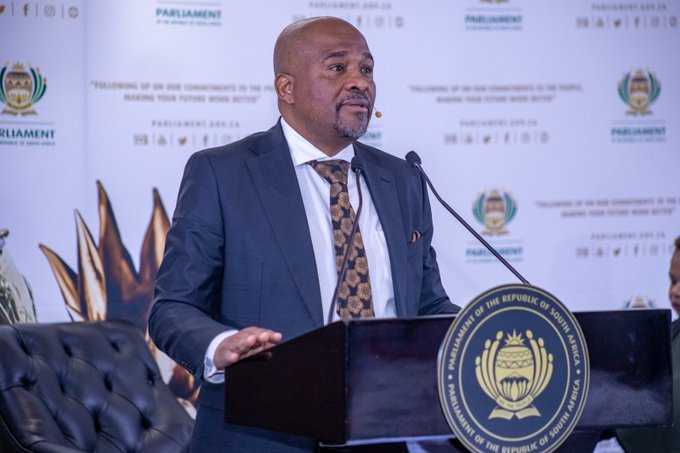
This emerged from a media briefing by parliamentary officials on Thursday when the presiding officers of parliament handed over the site to the demolition contractor.
The Parliament rebuilding project is headed by the Development Bank of Southern Africa (DBSA) as the implementing agent. Maziya General Services has been awarded the reconstruction job under the watchful eye of the DBSA.
To date, a temporary roof over the Old Assembly building has been erected while a “demolition design package” has been finalised, the contractor appointed and the Labour Department’s construction work permit applied for.
Demolition of the old parliament was previously expected to commence from April 2024 with construction starting in May – but this has also been pushed back, to July and August 2024, respectively.
Fullview understands that by late April not all items had been removed from the fire-wrecked buildings, including furniture and gifts given to National Assembly speakers that had been left behind in the presiding officer’s wing. Those gifts were not part of the arts, paintings and sculpture inventory, which had ensured the artworks were recovered, sent for restoration where necessary and to safe storage. Parliament is on public record as having lost artworks worth R5,234,179.97 in the fire.
As part of the update, parliament has also launched a new website to track the process, as well as a WhatsApp chatbot where South Africans can “have their say” on the project.
Secretary to Parliament Xolile George said, it was still early to say what will be the true cost of the rebuilding of Parliament.
“By the time the full design is done there will be engineering scoping, there will be assessment engineering economics to striking the balance between maintenance of heritage and the modernisation we have now explained around the buildings. That detailed design may either confirm that this is the amount we need on the actual brick and mortar or it is more,” said George.
The final design, which will be signed off by Parliament and National Treasury will state the actual cost to rebuild Parliament.
In a symbolic handing over of keys at Parliament on Thursday afternoon, Acting Speaker Lechesa Tsenoli appealed to the contractor to stay on the straight and narrow.
“Do us proud. We don’t want to hear questions about things you’ve done, that you should have done differently.”
Chairperson of the National Council of Provinces (NCOP), Amos Masondo, said Parliament was mindful of ensuring this rebuild sticks both to deadline and to budget.
“The burning of Parliament was a set back but we want to turn that around and make it a positive development.”
Timelines for the project have again been revised, with the final handover and completion moving from December 2025 to 20 April 2026. The final account and closeout is now expected in July 2026 (previously February 2026).
For the incoming post-election MPs, the parliamentary precinct is set to remain a construction site for about 18 months into their term.
Watch Live in the video below:
Video Courtesy of Parliament.