
By Lehlohonolo Lehana.
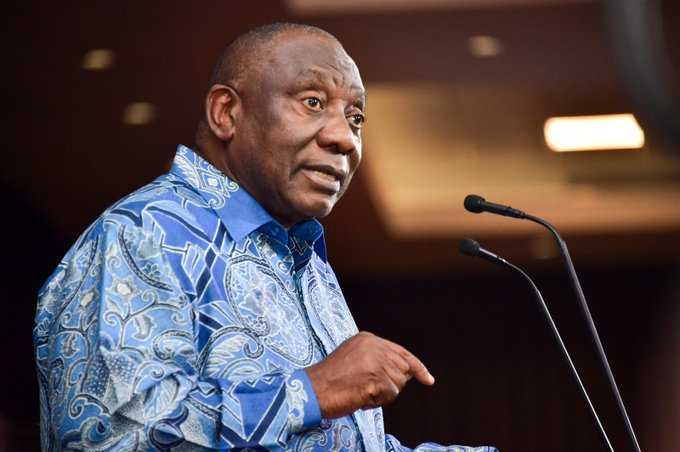
The African National Congress (ANC) president Cyril Ramaphosa announced that his party will invite other political parties to form a Government of National Unity (GNU).
Ramaphosa made the announcement late on Thursday after an hours-long meeting of the party’s National Executive Committee (NEC) in Johannesburg, where ANC leaders held talks to try to agree on a post-election strategy.
The ANC has been in power for 30 years but lost its majority in the 29 May elections. It secured just over 40% of the national vote, while the main opposition, the DA, got 21.8%.
More than 50 parties contested the election with at least eight of them receiving significant shares of support.
As a result, he said that the party views that the “best way forward” would be to form a “GNU” to tackle job creation, the growth of our economy that is inclusive, the high cost of living, service delivery, crime and corruption.”
“This moment calls for the broadest unity… and multi-party co-operation is needed if we are to overcome these [abovementioned] challenges,” said Ramaphosa
He said that establishing a GNU would be “building on a very rich history of cooperation across divides of politics and ideologies… drawing on experiences when the country was experiencing great difficulties,” as seen in the GNU in the country’s first post-apartheid administration.”
Ramaphosa said that the ANC is willing to engage with any party “that wants to advance the interests of South Africa.”
However, in order to form part of the GNU, Ramaphosa said that parties should commit to “shared values, nation building, and cohesion.”
These values include “respect of the Constitution and the rule of law, social justice and equity, human dignity, non-racialism, non-sexism, stability, transparency, integrity,community participation, and good governance,” said Ramaphosa.
Additionally, Ramaphosa said that all agreements should be transparent, with measures to hold all those involved accountable. As such, he calls for a signed “common minimum programme that focuses on measurable growth and inclusion.”
Earlier, ANC secretary-general Fikile Mbalula explained that officials from the party met to map out a strategic framework for coalitions that was presented to its National Working Committee (NWC).
The NWC met earlier this week and on Thursday presented the revised framework to the NEC.
The NEC then deliberated and decided on how to approach coalitions.
Among the suggestions put to it was a straight-forward coalition agreement with one or more of its political rivals, and a coalition of national unity that would see all parties represented.
A government of national unity, which ANC officials said is the first option on the table, evokes South Africa’s transition from apartheid’s white minority rule to a democracy in 1994.
Any unity government plan from ANC would still have to be taken to those other parties, some of whom are more opposed to each other than ANC. DA has pledged never to work with EFF or MK, for example, and there are clear divisions to overcome.
However, given the wide-ranging ideologies, there are still risks of potential instability and gridlock within such a government due to the necessity of managing multiple partners with diverse interests.
“The ANC notes that we do have ideological and political differences with several parties in our political landscape. However, we will not preclude the possibility of working with any party so long as it is in the public interest, and it is in keeping with the [abovementioned] principles,” said Ramaphosa.