
By Lehlohonolo Lehana.
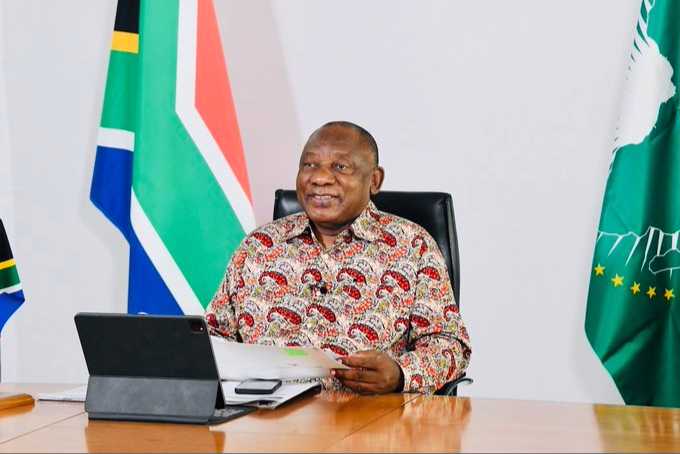
President Cyril Ramaphosa says the next administration must sustain policy reforms aimed at accelerating economic growth, as key political parties meet to discuss helping form a new government.
Writing in his weekly newsletter days after the national executive committee of the African National Congress (ANC) agreed that it should initiate talks with other parties on the formation of a possible government of national unity (GNU).
ANC won 40 percent of the vote — its lowest score ever — on May 29 and, for the first time since the advent of democracy in 1994, it needs the backing of other parties to govern.
The ANC will have 159 members in the 400-seat National Assembly, down from 230 in 2019.
The DA won 87 seats with a liberal, free-market agenda.
The EFF secured 39 lawmakers and supports land redistribution and the nationalisation of key economic sectors. The IFP, which had struck a pre-election deal with the DA, gained 17 seats.
Former president Jacob Zuma’s uMkhonto weSizwe (MK) party, which came third in the election, winning 14.6 percent of the vote and 58 seats, said it was to file a court appeal to prevent the new parliament from convening, pending a separate complaint over alleged election irregularities.
In 2020, government established Operation Vulindlela, a wide initiative to accelerate the implementation of reforms to support economic recovery.
“The structural reform process has produced tangible results and laid the groundwork for sustainable growth into the future.
“Regardless of the form or composition of the incoming administration, it is important that the momentum of reform be retained and sustained,” he writes, arguing that a change in direction would derail progress and “take us back to the starting blocks”.
Similar sentiments have been expressed by both organised business, as well as the Democratic Alliance (DA), which sustained its position as the second-largest party following the May 29 poll, garnering 21% of the vote, while the ANC’s support slumped to only 40%.
The parties that came in third and fourth respectively, namely the uMkhonto we Sizwe Party and the Economic Freedom Fighters, are far less supportive of both a GNU and the reforms, favouring a more State-dominant economic pathway, despite the country’s weak fiscal position and financial and operational frailties of the corruption-prone State-owned companies.
In its framework for multi-party government, the DA describes the full and urgent implementation of Operation Vulindlela as critical for success and that it should, thus, be included as one of the “foundations for a governing agenda”.
Business Leadership South Africa CEO Busi Mavuso calls for the continuation of Operation Vulindlela, and urges the yet-to-be-formed new administration to actively back the initiative, which is driven by the Presidency and the National Treasury.
In a statement supporting moves towards multiparty and multistakeholder collaboration, Minerals Council South Africa CEO Mzila Mthenjane also highlights the progress being made as a result of cooperation on various economic reforms.
“In the past year, the government and business groups, including the Minerals Council, have been cooperating to fix South Africa’s energy, rail, roads and ports, and crime and corruption crises through committees in the Presidency.
“These committees of government ministers, their senior officials, leadership of state-owned companies and business leaders, several of them CEOs of mining companies, are making a positive difference,” Mthenjane said.
In his letter, Ramaphosa quotes a Bureau for Economic Research statement that argues that there is no need to “reinvent the wheel and that the sustained implementation of the existing reforms have greater currency than “miracles or fairy tales”.
“Modelling by the National Treasury showed that the successful implementation of key reform could raise GDP growth to over 3% a year, add an additional R600-billion to revenue and create a substantial number of jobs over ten years, “Ramaphosa writes, while urging political parties to work together to sustain the reform momentum.
By deepening our partnership as government, business and labour, by accelerating structural reform, by continuing the work to strengthen state capacity and improve the operation of state-owned enterprises, we are firmly on course for realising greater economic growth and creating more jobs.