
By Lehlohonolo Lehana.
The African National Congress (anc) wants the Government of National Unity (GNU) to be in the interests of the country, that parties must agree on a minimum programme on key issues, and is comfortable with a collective executive system, which would mean sharing executive positions with the parties that come on board.
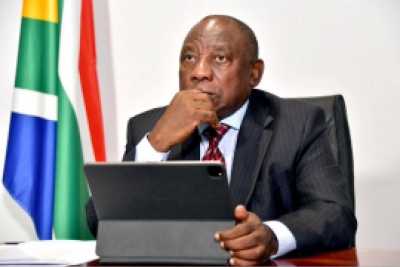
ANC President Cyril Ramaphosa announced on Friday that his party has decided on a government of national unity as the best option to move the country forward after the 29 May elections.
Al Jama-ah revealed that its leader and Member of Parliament, Ganief Hendricks was invited by the ANC over the weekend as part of the latter’s consultation process on plans to settle for the government of national unity.
Although Al Jama-ah welcomed the ANC’s wide consultation process with political parties, Hendricks said he made it clear that his party is “strongly opposed” to a government of national unity.
The opposition leader said during his engagement with the ANC, he strongly warned the Luthuli House-based party to avoid getting into a unity government with the Democratic Alliance (DA), describing the government of national unity as “mere modernised approach of apartheid”.
“Less dependence on white monopoly is the only way to prosperity for all South Africans. The country’s economy should be controlled by blacks, the reparation of land will not be achieved by a government of national unity. Codesa delayed true freedom and a GNU will further bury these aspirations which would eventually lead to a bloodbath,” said Hendricks.
“The party views the GNU as a mere modernised approach of apartheid with a clear objective for a regime change through a soft coup. Lessons must be learnt from the past 30 years of freedom which are described by many as fake,”he said.
“South Africa must govern and serve her people without any interference from the former colonial ‘masters’ which is against the ANC’s policy of non-racialism. The inequalities existing amongst South Africans have been allowed to grow to alarming proportions and this requires a radical change.”
Hendricks raised concerns that the freedoms South Africans were enjoying would be reversed if the DA was incorporated into the government of national unity.
“Al Jama-ah outrightly rejects a government of national unity because it will include the values of the ‘moonshot pact’ which is anti-humanitarian, supports the genocide of Palestinians and its policies are anti-poor leaving the vast majority of South Africans out in the cold,” said Hendricks.
Patriotic Alliance (PA) leader Gayton McKenzie says his party was in favour of a GNU and would not be swayed by elements in the ANC.
McKenzie took it to X (formerly Twitter), saying their decision on the GNU would be based on what the ANC would offer them and their wishes.
“Snakes within the ANC are trying hard to convince the PA to stay out of the GNU because they wanna use us to get to their President. Our decision will be based solely on what our constituency is being offered by the ANC and not your factional wishes. We are in favour of GNU,” he said on X.
Rise Mzansi has expressed its intention to engage other political parties and taking part in the national dialogue on coalitions or in joining the proposed GNU.
In a statement, the party says it will listen and speak with a number of parties with an intention of advancing the interests of citizens of this country.
The unity government now appeared a more likely scenario than a direct coalition between the ANC and the main opposition DA, which gained the second largest share of the vote with nearly 22%.
More than 50 parties contested the election with at least eight of them receiving significant shares of support.
Chief justice Raymond Zondo has declared June 14 as the date of the first sitting of the National Assembly and June 15 the first sitting of the National Council of Provinces (NCOP).
The date puts pressure on political parties to reach an agreement on the appointment of the speaker of the National Assembly.
The DA and the Inkatha Freedom Party (IFP) appear interested in joining the pact that would see the inclusion of smaller parties in government.
But the proposal has gotten some pushback from the Umkhonto weSizwe Party (MKP) and the Economic Freedom Fighters (EFF).
The South African Communist Party (SACP) also opposes the unity government if the DA is included, while Congress of South African Trade Unions (COSATU) prefers to discuss the matter with the alliance before making a decision.