
By Kevin Rademeyer.
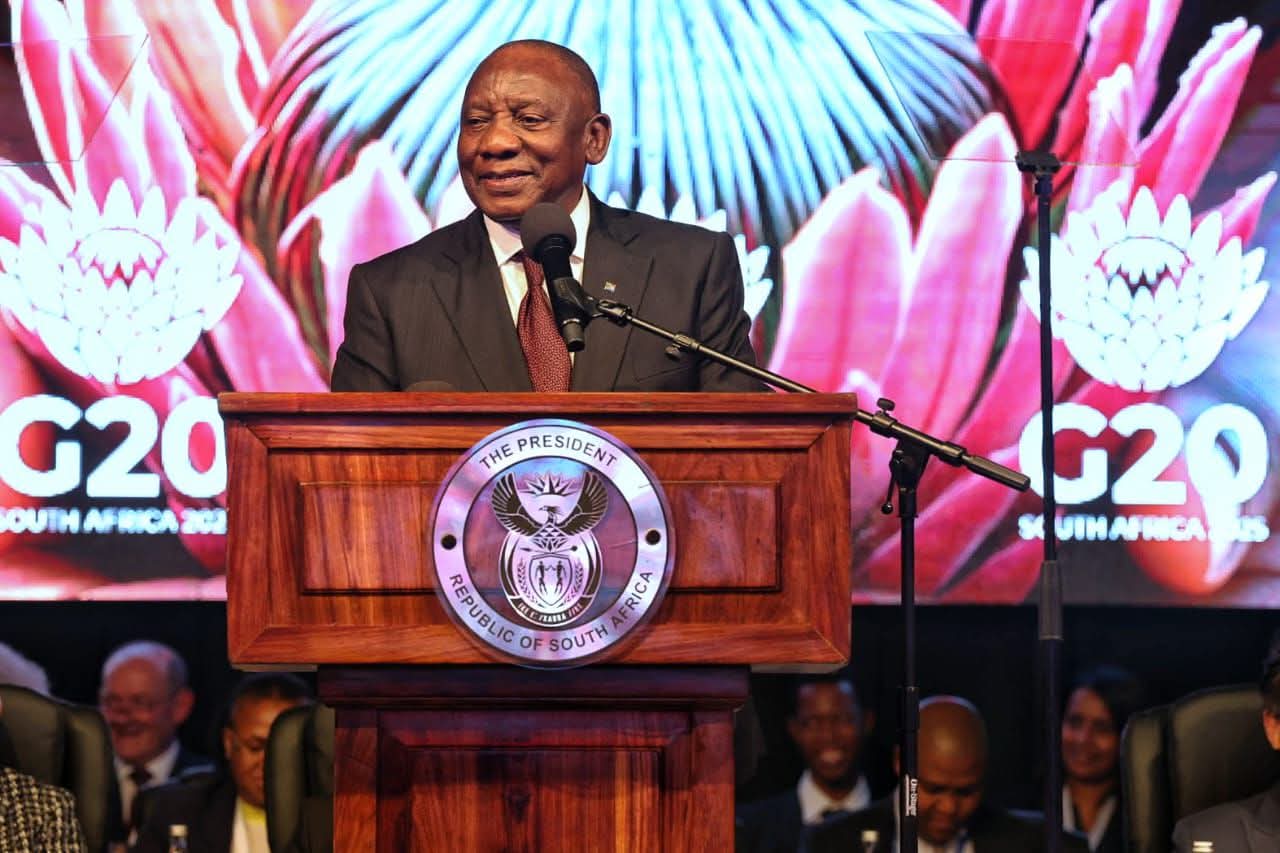
As South Africa assumes its pivotal role in the Group of 20 (G20) presidency, President Cyril Ramaphosa has firmly dismissed suggestions that the United States is boycotting the forum, despite sharp ideological differences and the absence of key American officials.
Speaking to journalists on the margins of the G20 foreign ministers’ meeting held at the Nasrec Expo Centre in Johannesburg, Ramaphosa emphasized a commitment to dialogue and collaboration, underscoring that the U.S. remains an integral part of the G20 framework.
“We will persist in identifying pathways and mechanisms to maintain constructive relations, regardless of apparent divergences,” Ramaphosa declared late Thursday. “I am driven by a solutions-oriented approach, and I am confident that [U.S.] President [Donald] Trump shares this perspective. Together, we will navigate these challenges.”
The G20 foreign ministers’ gathering, the first of its kind hosted on African soil, has spotlighted South Africa’s ambitious agenda centered on solidarity, equality, and sustainability—principles that echo the priorities set by Brazil during its 2024 presidency.
These themes, however, have drawn criticism from the new U.S. administration. Earlier this month, U.S. Secretary of State Marco Rubio derided them as reflective of “DEI” (diversity, equity, and inclusion) policies, which the Trump administration has actively sought to dismantle domestically. Rubio’s decision to forego the Johannesburg meeting, coupled with U.S. Treasury Secretary Scott Bessent’s announcement on X that he would miss the upcoming G20 finance ministers’ meeting due to commitments in Washington, fueled speculation of a deliberate American disengagement.
Ramaphosa, however, rejected such interpretations. “The absence of the Secretary of State is not a catastrophe,” he said. “The United States is represented here, and they remain fully engaged in the G20 discussions. This is not a boycott.” The U.S. delegation, led by Chargé d’Affaires Dana Brown, has indeed participated actively, though the lower diplomatic rank signals a tempered commitment amid domestic policy shifts.
A Platform for Africa’s Voice
In his opening address on Thursday, Ramaphosa positioned the G20 meeting as a historic opportunity for Africa to assert its narrative on the global stage. “The challenges of our time—climate change, inequality, and debt—demand partnership and collective action,” he stated. He highlighted the disproportionate burden borne by African nations due to climate change, a crisis he described as “no longer a looming threat but a devastating reality.” Ramaphosa urged the world’s leading polluters to take meaningful action, a pointed reference to nations like the U.S., which under Trump has exited the Paris Agreement and reversed decarbonization efforts.
The president’s remarks resonate deeply in a continent grappling with the fallout of climate-induced disasters and economic vulnerabilities exacerbated by global inequities. “Africa suffers from a crisis it did not create,” he told reporters, calling for the G20 to amplify the continent’s plea for justice and support.
Global Solidarity Amid Fractures
The Johannesburg meeting has emerged as a testament to South Africa’s diplomatic pull, with major powers—including Russia, China, India, Canada, and the European Union—dispatching senior ministers in a show of solidarity. Russian Foreign Minister Sergey Lavrov, arriving early Thursday, hailed the event as a “milestone for Pretoria and Africa,” suggesting it could serve as a lesson for Western nations in fostering cooperative rather than unilateral approaches. Similarly, Canadian Foreign Minister Mélanie Joly and EU Foreign Policy Chief Kaja Kallas affirmed their support for South Africa’s leadership.
This unity stands in contrast to widening geopolitical rifts, particularly with the U.S., where the Trump administration’s recent moves—such as Vice President JD Vance’s provocative statements at the Munich Security Conference aligning with far-right European factions—signal a retreat from traditional alliances. Ramaphosa acknowledged this “lack of consensus among major powers” but insisted that the G20 must rise above such divisions to address pressing global issues.
A Four-Point Agenda
Ramaphosa outlined an ambitious agenda for the two-day talks, reflecting South Africa’s priorities:
Disaster Resilience: Calling for scaled-up post-disaster reconstruction funding, he noted Africa’s acute vulnerability to climate shocks and the prohibitive costs of recovery.
Debt Sustainability: With low-income countries facing borrowing costs at a 20-year high, Ramaphosa advocated for relief to redirect resources toward development rather than debt servicing.
Just Energy Transition: He emphasized the need for equitable support to shift to renewable energy, citing South Africa’s $12 billion in pledges as a model, while pressing historically high emitters to fulfill their responsibilities.
Critical Minerals: Highlighting Africa’s wealth in resources vital for green technologies, he framed their responsible exploitation as a key negotiation point.
Looking Ahead
As the G20 heads of state summit approaches in November, Ramaphosa sidestepped questions about Trump’s attendance, expressing cautious optimism: “We hope to welcome as many leaders as possible. The absence of some will not derail our mission, provided the G20 family convenes to tackle these critical matters and issues a unifying declaration.”
South Africa’s stewardship of the G20 comes at a time of unprecedented global fragmentation, yet Ramaphosa’s resolute leadership seeks to forge a path toward multilateralism and equity. Whether the U.S. fully engages or opts for a more peripheral role, the Johannesburg meeting has already cemented Africa’s place at the heart of the world’s most pressing conversations.