
By Lehlohonolo Lehana.
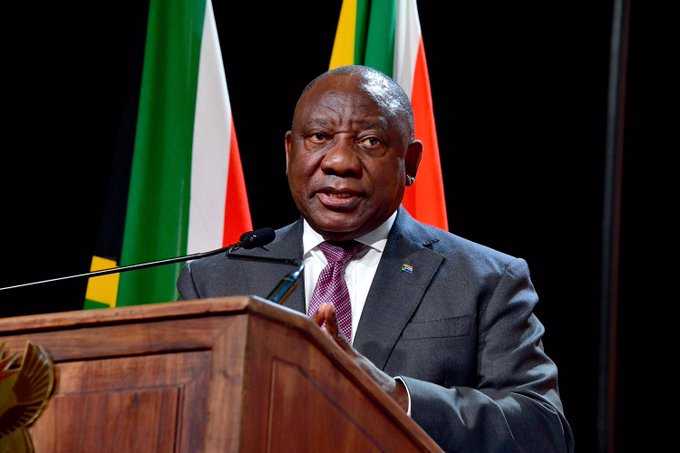
President Cyril Ramaphosa assured South Africans that government is using every means and resource at its disposal to get more capacity onto Eskom’s grid “as a matter of extreme urgency”.
Ramaphosa was addressing the nation through his weekly newsletter after South Africans have been experiencing a sustained period of the higher stages of load shedding.
He said government is taking action to address the myriad of challenges Eskom is facing, with particular focus on improving the performance of Eskom’s ailing coal fired power stations which serve at least 80% of South Africa’s energy needs.
“A team of independent experts is conducting a diagnosis of the problems at poorly performing power stations and taking action to improve plant performance. Six power stations have been identified for particular focus over the coming months to recover additional capacity.
“Eskom is also working to connect Kusile Unit 5 to the grid by September this year. Every urgent effort is being made to restore other units at Medupi, Kusile and Koeberg with significant capacity,” he said.
Ramaphosa added that Eskom is also taking steps to procure some 1000MW of energy from neighbouring countries with the power utility also aiming to “buy surplus power from companies with available generation capacity for a period of three years“.
Furthermore, government has also signed procurement deals in Bid Windows 5 and 6 of the Renewable Independent Power Producer Programme (REIPPP) which is expected to add some 2800MW of energy to the grid once completed in at least two years.
The President said government has allowed for private power producers to contribute to the strained grid.
“The licensing requirement for embedded generation projects has been removed. Since we first raised the licensing threshold to 100 MW, the pipeline of private sector projects has grown to more than 100 projects with over 9000 MW of capacity.
“We have cut red tape and streamlined regulatory processes, reducing the timeframes for environmental authorisations, registration of new projects and grid connection approvals,” he said.
Ramaphosa announced that soon, those who have installed solar panels on the roofs of businesses and homes will also be allowed to sell their excess electricity to the grid with work already underway for a pricing structure.
Taking stock
Reflecting on the serious challenges facing Eskom, the President said “a combination of factors…years in the making” have led the power utility to where it currently is.
“Lack of investment in new generating capacity, poor power plant maintenance, corruption and criminality, sabotage of infrastructure, rising municipal debt and a lack of suitable skills at Eskom have all created a perfect storm. There can be no sustainable solution without addressing all these factors in combination.
“We should not make the mistakes of the past. For many years, critical maintenance was deferred, and our power stations were run too hard in order to keep the lights on. As a country we are now paying the price for these miscalculations,” he said.
Ramaphosa acknowledged the destabilisation that load shedding has wrought on South Africans and businesses alike but called for patience as government implements solutions.
“As load shedding continues to wreak havoc on businesses, households and communities, the last thing South Africans want to hear are excuses or unrealistic promises. The demands for an immediate end to power cuts are wholly understandable. Everyone is fed up.
“We must be realistic about our challenges and about what it is going to take to fix them. While we all desperately want to, we cannot end load shedding overnight,” he said.
He added that while measures are being implemented, collaboration from all quarters of society will ensure that the Energy Action Plan bears fruit.
“While we cannot end load shedding immediately, what is certain is that if we work together with urgency to implement the Energy Action Plan, load shedding will steadily become less and less severe.
“Through collective action, we will much sooner reach the point where we have enough power to end load shedding altogether, “Ramaphosa concluded.
Eskom clarifies permanent load shedding
Eskom says that it has not announced permanent stage 2 and 3 load shedding in South Africa.
Responding to various reports on Sunday declaring permanent stage 2 and stage 3 load shedding is hitting the country for the next two years, Eskom spokesperson Sikonathi Mantshantsha said that this was a measure that was considered but ultimately rejected.
“Eskom has considered implementing permanent Stage 2 and 3 load shedding to give more predictability to the public. As (chief executive) Andrè de Ruyter stated during the session, this is not possible as it would not guarantee that load shedding would remain at the lower levels,” he said.
“(Headlines implying) there will be permanent stage 2 and 3 load shedding (are) inaccurate.”
The apparent confusion over permanent load shedding emanates from comments made by Eskom chairperson Mpho Makwana who stated that permanent load shedding would have to be implemented to give Eskom room to conduct necessary maintenance to its power stations and to give some level of predictability or consistency to South Africans impacted by blackouts.
He said that Eskom’s recovery plan would unfortunately not play out quickly and that it would take at least two years for the power utility to get its energy availability factor (EAF) up to 70%.
The recovery of generation performance will not happen within a short space of time, the execution of the recovery plan requires that power stations are given space and headroom to execute the recovery plan this requires either adding additional capacity to create space to do proper maintenance without firefighting , or create some predictability by implementing a permanent stage 2 or 3 for the next two years in order to give sufficient space for maintenance while giving the country a level of predictability or consistency to plan the livelihoods better. Shuttling from one stage to another within a short space of time is not good for the business community.”
As part of the recovery plan, Eskom will be addressing systemic issues, especially those relating to leadership and the entire organisational culture of the power utility, he said.