
By Lehlohonolo Lehana.
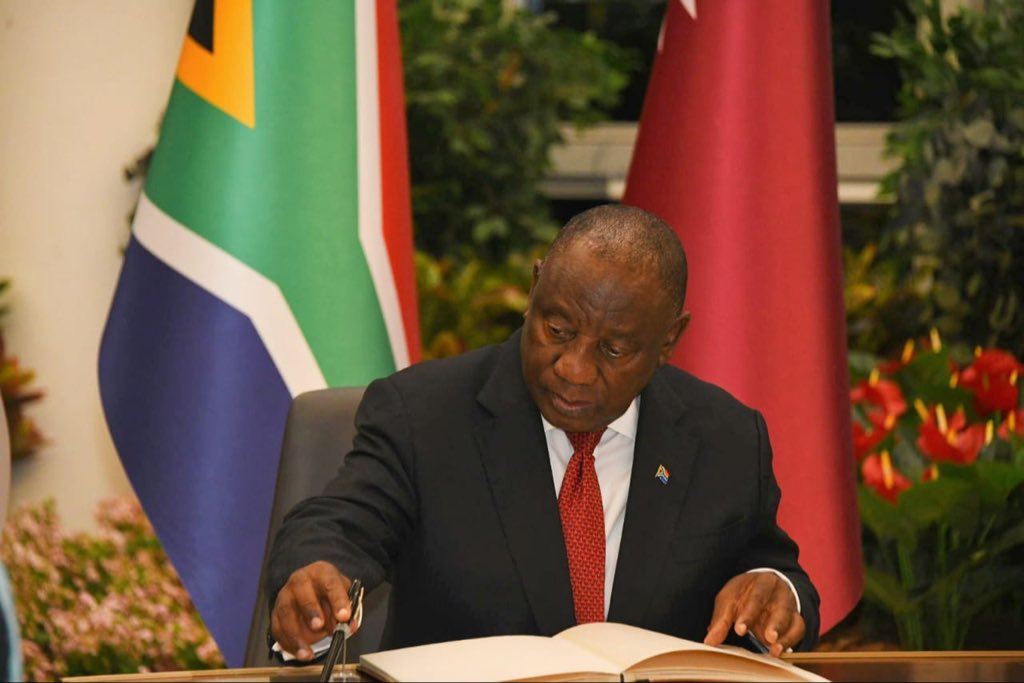
President Cyril President Cyril Ramaphosa has accused Lobby Groups AfriForum and the Solidarity Union of undermining South Africa’s sovereignty.
Ramaphosa spoke on the sidelines of Basic Education Lekgotla held at the Birchwood Hotel, East of Johannesburg.
Leaders from AfriForum and Solidarity met senior US officials in Washington this week and presented them with the names of African National Congress (ANC) members who they said should be sanctioned under the Global Magnitsky Act.
The law enables the US to target foreign officials who are party to corruption and human-rights violations.
A list of people implicated by the State Capture commission who “got off scot-free” was presented to the US government, and a call was made to take action against them, AfriForum CEO Kallie Kriel said in a video clip posted on social media platform X.
A commission headed by Raymond Zondo, retired chief justice, spent four years investigating graft during Jacob Zuma’s tenure as president and heard a plethora of testimony of how state departments and governments were systematically plundered.
A number of senior politicians, including serving members of Ramaphosa’s cabinet, were implicated in the looting spree, which the government estimates cost taxpayers more than R500 billion.
The lobby groups also delivered a memorandum to the US officials stating that Afrikaners are being culturally and educationally discriminated against, and that American and South African foreign policy aren’t aligned.
They said they don’t want South Africa to lose its preferential access to US markets because that would impact negatively on commercial farmers.
The organisation’s Washington tour comes after Trump ordered all US foreign assistance to South Africa be stopped and that his administration promote the resettlement of “Afrikaner refugees escaping government-sponsored, race-based discrimination, including racially discriminatory property confiscation” in South Africa.
“We must stop running to other countries. Our problems should be discussed and resolved here. That confirms our sovereignty and our standing as a free and independent nation. We may have differences, but we will find solutions.
Asked whether action should be taken against the groups, Ramaphosa acknowledged growing calls for accountability.
“There are people who say something must be done about them,” he said. “What they’re doing is creating division, not building the nation. Running around the world to have your grievances solved only sows discord. It causes South Africans to view each other negatively, which is not the right way to handle our challenges.”
Meanwhile the 2025 Lekgotla, convened under the government of national unity, comes at a critical moment, when South Africa’s presidency of the G20 presents an opportunity to push for global best practices in education.
However, without concrete action, the annual gathering risks being just another talk shop that fails to deliver meaningful change.
The latest World Bank South Africa Economic Update identifies basic education as one of the most critical drivers of inclusive growth.
“Our education system needs to be responsive to the evolving skills needs of the economy,” said Ramaphosa. Yet South Africa finds itself in 2025 still discussing reforms that could have fundamentally changed the country’s economic and social trajectory had they been aggressively implemented in the 1990s.
The world is racing ahead with education models designed to prepare students for the digital economy, while South Africa is playing catch-up. The World Economic Forum’s “Future of Jobs Report” highlights the rapid rise of AI-driven professions, yet local schools are still struggling to equip pupils with even the most basic skills.
There are now tools that can build a website in 10 seconds and compile a fully referenced research paper in about a minute,” Ramaphosa noted, warning that the country’s education system is not adapting fast enough. “We have to adapt to this new reality or risk the consequences of last century methods that cannot deliver new century outcomes.”
Another long-standing gap is the failure to promote vocational and technical education as viable career pathways. Countries like Germany have shown the success of vocational training, where nearly half the workforce holds a vocational qualification. In contrast, South Africa continues to treat technical education as a fallback for students who fail to meet university entry requirements.
“It should be seen as an attractive proposition for all learners,” Ramaphosa said, urging a shift in perception. “As stakeholders in the sector, we need to work together to address the prevalent bias towards general academic education and even the stigma that exists around choosing vocational occupations.”
Basic Education Minister Siviwe Gwarube addressed the opening of the department’s three-day gathering.
Gwarube called for partnerships with the private sector to assist the government in alleviating the financial burden.
Teaching and learning have been affected by budget cuts, with the Western Cape province forced to slash posts.
The Schools Act prescribes that the state must fund public schools from public revenue equally to ensure the proper exercise of the rights of learners to education and the redress of past inequalities in education provision.
However, the state’s purse is overstretched, affecting government’s ability to provide quality education for all.
Budget cuts in the education sector disproportionately affect poor and vulnerable communities and Gwarube also said this leads to an average teacher-to-learner ratio to trend upwards, which threatens learning outcomes.
Gwarube emphasised government’s commitment to delivering quality education to all children despite these challenges.