
By Lehlohonolo Lehana.
President Cyril Ramaphosa acknowledged South Africa would need significant assistance from the private sector through independent power generation and rail concessions.
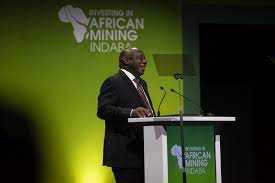
Ramaphosa was speaking at the Investing in African Mining Indaba held at the Cape Town International Convention Centre on Tuesday.
“Sometimes governments prefer to do things on their own but, faced with this type of crisis, we have seen that it is best to work with those who have a common interest,” Ramaphosa said.
“We want the private sector not to feel shy, not to stand back … but also not to stand on the rooftops and just criticise. We want them to get into the ring, so that we work together to solve our problems.”
Ramaphosa noted that mining production value reached R1.18 trillion in 2022, boosting South Africa’s GDP, exports and revenue, but the country is far from realising the full potential of its mining industry.
Energy Crisis
He told investors that government has already introduced the Energy Action Plan to improve “performance of our existing power stations and to add new generation capacity to the grid as quickly as possible”.
“Eskom has assembled experienced technical teams to improve performance and recover capacity at power stations, with an initial focus on the six least reliable stations. Through a regional power pool arrangement, we have already imported 300 MW of capacity from neighbouring countries and are working to increase this by an additional 1000 MW.
“The successful renewable energy programme is being strengthened. In the last six months, we have signed agreements for 25 projects representing 2800 MW of new capacity. These projects will soon be proceeding to construction.
“We are facilitating investment in new generation capacity by private producers by, among other things, removing the licensing threshold for embedded generation projects,” Ramaphosa said.
Furthermore, he said, Eskom is also looking to “purchase surplus power from companies with available generation capacity” to further strengthen the grid.
Reform in logistics
A critical area of reform is in logistics, where the Minerals Council of South Africa and Transnet have now partnered to stabilise and restore the operational performance of rail lines and ports.
Other reforms include opening key routes to third-party operators while a new policy framework for rail sets out actions to modernise the rail network, enable private investment, improve regulation and restore rail as a competitive mode of transport.
Similar efforts are under way to enable private investment in SA’s ports and certain container corridors, Ramaphosa said.
To tackle illegal mining and damage to infrastructure, the police service has established multidisciplinary Economic Infrastructure Task Teams that are operational in 20 identified hotspots.
“In the last six months, these teams have conducted hundreds of operations and made a significant number of arrests,” Ramaphosa said.
To improve the regulatory environment, government will continue working with industry on reducing backlogs in prospecting and mining applications, Ramaphosa said.