
By Lehlohonolo Lehana.
The Social Protection, Community and Human Development cluster says government is working around the clock to formalise the many informal settlements across South Africa.
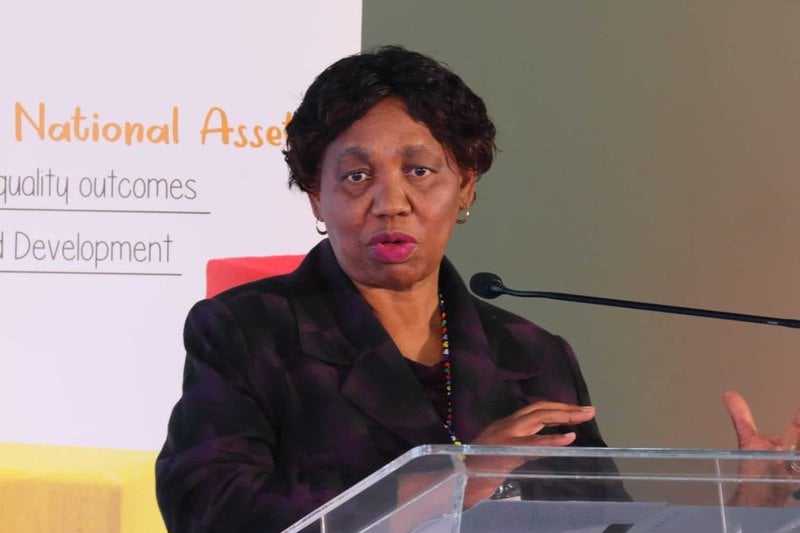
The cluster briefed media on Sunday, led by the Ministers of Basic Education, Angie Motshekga and Health, Dr Joe Phaahla.
According to the cluster, the Department of Public Works and Infrastructure has earmarked 14 000 hectares of State land for human settlements and to date, 2 689 hectares have been transferred to the Housing Development Agency.
Speaking on behalf of her colleagues, Motshekga said the department has an additional 32 land parcels, measuring 10 350 hectares, to undertake preliminary human settlement planning.
Furthermore, 64 000 housing opportunities are planned from the released land parcels and will contribute significantly to the attainment of the prescripts of the Freedom Charter, which says there shall be “houses, security and comfort.”
The cluster said with more informal settlements regularly being set up due to a variety of factors, the department has still made significant progress in upgrading these settlements, such that there are 1 284 informal settlements at various stages of upgrading throughout the country.
“In the last financial year, about 24 671 stands were created through the informal upgrading process,” Motshekga said.
The process of upgrading, according to Motshekga, includes the provision of basic services such as water, electricity, sanitation, and security.
By intensifying the upgrading of informal settlements, officials are addressing some of the recent shocks caused by floods and fires in various parts of the country.
“With climate change, natural disasters are becoming more frequent and most of our infrastructure was not designed to be resilient,” said Motshekga.
In the past five days, Motshekga pointed out that the country has experienced devastating floods in KwaZulu-Natal, Eastern Cape, Limpopo and Mpumalanga.
“For an effective response to these disasters, we need land, we need South Africans to embrace each other, especially when families are homeless, vulnerable and distressed.
“It is in times like this that we need to collaborate, unite and focus on solutions that will provide relief to all those in need.”
Motshekga also expressed appreciation for all the offers of assistance from partners in the private and public sectors and social partners who have initiated various interventions to assist in helping all those in distress.
“It will be a long road but together we can do so much more to minimise the impact of the devastating floods.”
Safety of children in schools
Motshekga reiterated President Cyril Ramaphosa’s call on the sector to institutionalise Care and Support for Teaching and Learning (CSTL) as a tool to improve learner outcomes.
“This recognises that quality education can only be achieved if learners and teachers are safe and healthy and if schools are caring and conducive spaces, free from violence, abuse and harm.
“Our schools must be safe, weapons-free, substance-free spaces for learners and teachers, where corporal punishment, sexual abuse, gender-based violence, homophobia, racism, substance abuse and bullying are not tolerated.”
Motshekga said children remain among the most vulnerable citizens in the country and must always be protected through proactive interventions and promotion of their rights, as enshrined in the Constitution and the Children’s Act 38 of 2005.
“All communities must play their parts in this regard.”
In addition, the Department of Social Development (DSD) is working tirelessly to put measures and interventions in place to address child-related rights violations, including, their protection against incidents of abuse and gender-based violence and femicide (GBVF).
The DSD, Motshekga, said it was working with various structures and government departments on the protection of children.
Programmes within the DSD include, amongst others, the family, prevention and support programme known as SINOVUYO, which strengthens the relationship between children and their parents.
The programme is said to have already reached 66 880 parents and caregivers in the current financial year.
The department also provides alternative care and support for children in need through Child and Youth Care Support as well as foster care initiatives.
Childhood literacy
Motshekga says the department is piloting and evaluating innovative ways to support teachers in the teaching of reading.
The pilot is currently taking place in 400 schools in the North West and Mpumalanga.
“The President has already signalled government’s plan to expand the provision of an early grade reading programme, which includes a minimum package of reading support materials, and professional support to teachers,” Motshekga said.
A central government priority, according to the cluster, is that children should learn to read with an adequate level of comprehension by Grade 4, or the age of 10.
Citing the Progress in International Reading Literacy Study (PIRLS) of 2016, Motshekga said most children do not yet reach this threshold.
However, she said that the situation has improved since the previous PIRLS assessments of 2011 and 2006.