
By Lehlohonolo Lehana.
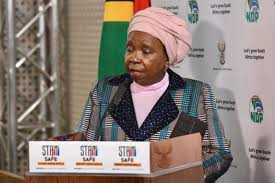
Cooperative Governance and Traditional Affairs Minister, Dr Nkosazana Dlamini Zuma says real-time auditing of procurement related to the national state of disaster will help protect against possible corruption.
Dlamini was speaking at a media briefing by various Ministers and Eskom to update the nation on government’s plans for the energy crisis.
“We have tried to ensure that the use of the energy procurement is not abused and that’s why the auditor-general will do the real-time auditing,” she said.
“Also we have said that the accounting officers will have to report to Parliament if they have used the emergency energy procurement according to these regulations every month.”
The measures are meant to assist the energy generating entities to restore their capacity as government battles to solve the load shedding crisis.
She said one of the lessons from the PPE scandals during the Covid-19 pandemic was to put the auditor-general at the forefront.
“When it comes to the issues of the energy emergency procurement, I think if you recall during Covid we didn’t put this upfront because it was a new thing. The real-time audit came much later after we had learnt what had happened.
“So this time we decided that it must come up front so that right from the beginning the auditor-general must be involved.”
Dlamini-Zuma added the government had no choice but to take this route as load shedding increased with time.
“[This] as a way of minimising the impact we had declared. The regulations are there to minimise that impact and assist Eskom in doing some of the things as normal legislation may be slower. Through the national disaster, they will be able to do them faster.
The regulations are also there to ensure we can save lives because if there is load shedding in the antenatal units… you can imagine what can happen.
“That is why the regulations emphasise that health infrastructure is exempted. Small businesses have closed all those things the regulations will try and assist,” she said.
Health Minister Joe Phaahla, whose sector remains under pressure from load shedding, added the regulations would exempt 213 critical healthcare facilities nationwide from load shedding.
So far, only about 137 hospitals have been exempted, and the remainder has experienced delays because of outstanding infrastructure.
Some hospitals are supplied by Eskom and others by municipalities, making the finalisation of exemption difficult.
“We are looking at the kinds of facilities where high-level key emergencies must be taken care of, which include major operations, ICUs. Two-hundred-thirteen of these facilities were identified as a priority, not that the more than 5 000 clinics are not important, but this was to identify the most essential,” Phaahla said.
He added all 213 priority facilities should be completely exempted by June, saying for now, it was about priority hospitals, and with time other facilities might be added.
Phaahla said there had been no recorded reports of people dying at home or in hospitals because of the impact of load shedding.
During the briefing, Dlamini-Zuma also addressed the crime issue, saying Police Minister Bheki Cele could decide whether to disperse additional police resources because of the regulations.
“On the issue of crime, regulation 51c does talk to security, so it is up to the minister to make sure there are directions that speak to that.