
By Lehlohonolo Lehana.
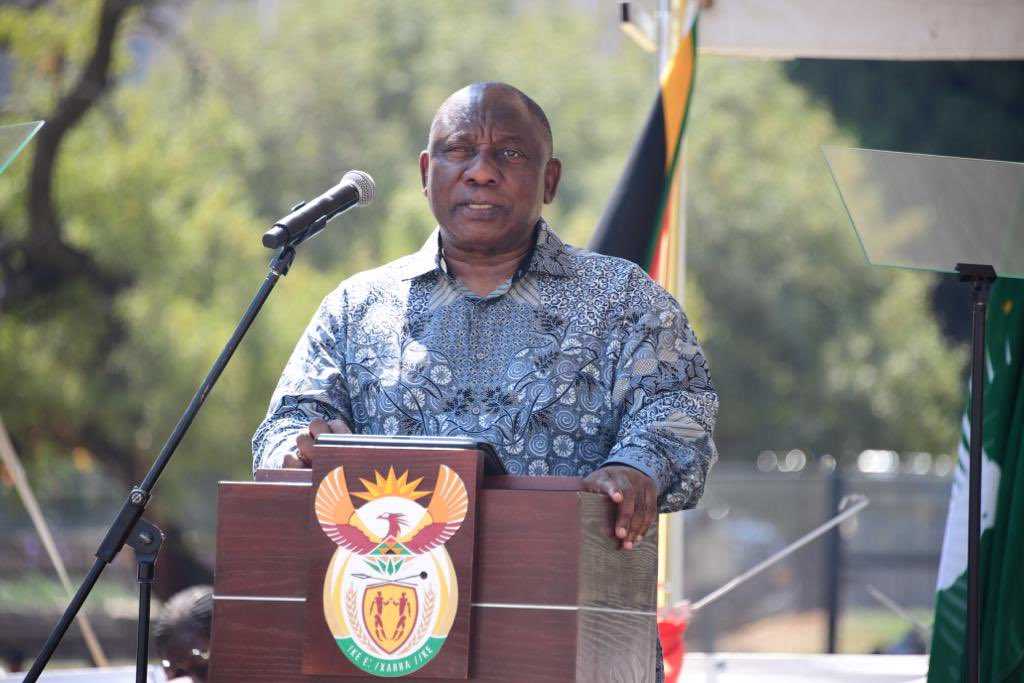
President Cyril Ramaphosa used the opening of his Human Rights Day speech in De Aar, Northern Cape, to take a swipe at the EFF shutdown held on Monday.
“Even though others would want to abuse the rights of others, intimidate them, compel them to participate in a protest, compel them to participate in days when they should not go to work.
“I am happy that the majority of South Africans did not heed the call, but they exercised their rights as South Africans,” said Ramaphosa to applause.
Ramaphosa was delivering a keynote address at the 2023 Human Rights commemorations held in De Aar, Northern Cape, on Tuesday.
The theme for this first commemorative day on the annual national calendar is “Consolidating and Sustaining Human Rights Culture into the Future”.
The history of Human Rights Day is grounded in the Sharpeville Massacre that took place on the 21 of March 1960, where apartheid police killed 69 anti-apartheid protesters.
Human Rights Day also honours 35 people who were killed on 21 March 1985 when apartheid police targeted community members after a funeral at Uitenhage/Langa.
Ramaphosa said his administration is trying to improve the functioning of local government to address the service delivery challenges in South Africa.
“We are working to improve the functioning of local government, which carries the greatest responsibility for the provision of these services,” he said.
Ramaphosa said government is making progress by providing services such as water infrastructure projects, social grants, education and free healthcare.
“According to Statistics South Africa, access to water and sanitation, electricity, housing and other services like waste removal has increased steadily over the last three decades,” he said.
The president, however, admitted that more needs to be done.
There can be no doubt that we have achieved much in securing the rights of all South Africans. But we know from daily experience that we need to do much more.”
He said that South Africa cannot claim to respect human rights if it doesn’t ensure that “all South Africans have access to land, housing, food, water, health care and education”.
“We cannot claim to respect human rights if we do not do everything we can to ensure all people have access to work and economic opportunity, and to live lives that are comfortable, safe and secure,” he added.
Social grants
The President highlighted several significant interventions against poverty by government including the provision of social grants, which are the main source of income for about a quarter of households.
Just over 2.5 million people were receiving social grants in 1999. Today, over 18 million people are receiving these grants, the President said.
“To relieve the pressure on poor households during COVID-19, government introduced the special R350 SRD grant. While this grant has been extended to the end of March 2024, work is underway to provide basic income support for the most vulnerable within the country’s fiscal constraints,” he said.
National Health Insurance Bill
The President further highlighted more interventions, which included the National Health Insurance (NHI) Bill meant to correct this state of affairs. The bill is currently before Parliament.
He said that the introduction of the National Health Insurance – or NHI – will enable every South African to receive quality health care regardless of their ability to pay.
“We are preparing for the implementation of the NHI through the national quality improvement plan and putting in place the necessary staff and funding. We are improving the quality of care in our clinics through the Ideal Clinic programme. Using the experience of the COVID vaccination record system, we will introduce an electronic solution to improve management of health records,” the President said.
Growing the economy
“If we are to advance and secure these social and economic rights into the future then we need to tackle poverty and inequality. We need to create employment and economic opportunity.
“To achieve this, to give us the means to enable the progressive realisation of all these rights, we need to grow our economy and achieve far greater levels of investment.”
He said the work that is being undertaken to increase investment in both economic and social infrastructure is a vital part of the effort to improve the provision of services to all South Africans.
Watch Live in the video below:
Video Courtesy of Presidency.
Meanwhile ActionSA leader Herman Mashaba said South Africans deserve a better government than the current one.
He commemorated the day alongside the party’s national spokesperson Lerato Ngobeni, provincial chairperson in Gauteng, Funzi Ngobeni, Sedibeng regional chairperson Mothobi Nqhatsetseng and hundreds of ActionSA activists.
Mashaba said next year the country will commemorate three decades of democratic government yet nearly 12 million South Africans are still without jobs, and about 25 million citizens depend on social grants.
Mashaba said the current governing party has failed to provide a better life for all and has abandoned the promise of the Constitution of an inclusive and prosperous future for the country.
He said the 2024 elections offer the best opportunity to replace what he called “the corrupt and dysfunctional ANC” with an ethical coalition government that will reignite the promise of 1994 and restore the basic human rights the victims of the 1960 Sharpeville massacre fought for.
The Pan Africanist Congress and Azapo were the first to arrive and began their commemorative activities. The Gauteng provincial government were also there.