
By Lehlohonolo Lehana.
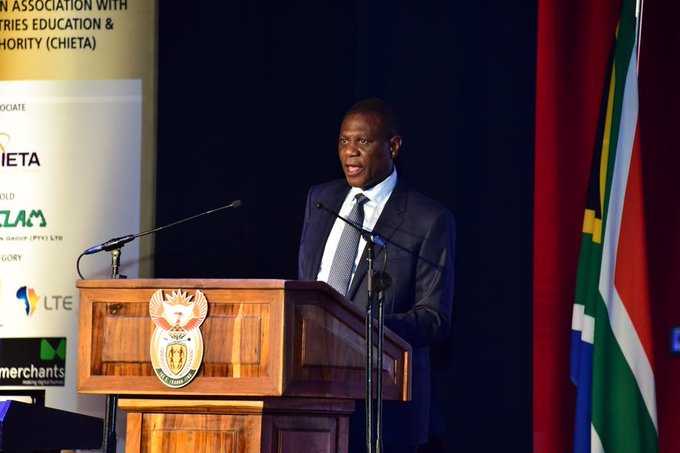
Deputy President Paul Mashatile on Friday made his inaugural public speech at the launch of the National Strategic Plan for HIV, tuberculosis (TB), and sexually transmitted diseases (STI) at Tlhabane Stadium, Rustenburg, North West.
Mashatile said: “On behalf of the SANAC Community, I would like, first and foremost, to convey my sincere gratitude to former Deputy President David Mabuza for the leadership he provided as Chairperson of the South African National AIDS Council as well as leading the process towards the National Strategic Plan 2023-2028 that we will be launching.
“Today, our country joins the rest of the world in observing World TB Day under the country theme: ‘Yes! You and I Can End TB’,” said the deputy president.
The theme is aimed at encouraging individual action to strengthen the national strategy against Tuberculosis.
It underlines the significance of taking personal responsibility and joining forces to eradicate Tuberculosis as a public health threat by 2030.
“We must recommit ourselves to raising greater levels of awareness about the disease alongside its terrible health, social, economic implications and strengthen other efforts to prevent the further spread of the disease in our communities,” said Mashatile.
“We think it is unacceptable that in the year 2023, we are still talking about stigma,” he told the crowds gathered in a marquee.
“We should therefore collectively champion interventions against social isolation associated with TB at the community level. We must also continuously maintain well-coordinated multi-sectoral interventions against stigma and discrimination in our communities.”
The Deputy President said the government and civil society will continue to work together to look at how to strengthen the systems that link people to care and scale up initiatives that encourage the use of TB prevention therapy.
He announced that in September this year, world leaders will gather at the United Nations General Assembly for the United Nations High-Level Meeting on TB.
“We cannot over-emphasise the importance of collaboration in the TB response. We can do more by leveraging our combined strengths and resources.”
The Deputy President is the sixth Chairperson of the South African National Aids Council (SANAC).
TB remains one of the leading causes of ill health and death in South Africa, exacerbated by patients who do not complete their treatment while others are either undiagnosed or are unreported even though they know their status.
He said government is determined to build a world free from the devastation of preventable and curable diseases such as TB and that it will continue to embark on catch-up programmes and shortened treatment.
This is after the infectious disease took a backseat due to the COVID-19 pandemic.
“However, regardless of the setback, we have made conscious efforts to rebuild and intensify TB interventions across the country,” he said.
To that effect, through the fourth National Strategic Plan (NSP), the State will continue to guide the collective response to HIV, TB and sexually transmitted infections (STIs).
“Viewed together, the plans set out in the NSP provide insight into the path we have travelled as a nation to overcome one of the most devastating human challenges of our time.”
The Deputy President also took the time to launch the fifth NSP for HIV, TB and STIs for the period 2023 to 2028 as adopted by Cabinet.
He described the plan as a blueprint and roadmap for a multi-sectoral, people-centred approach to eliminate HIV, TB and STIs as public health threats by 2030.
SANAC is leading several activities as part of the NSP rollout, which includes messaging about STI transmission, condom use, availability of family planning services and availability of ground-breaking HIV prevention tools.