
By Lehlohonolo Lehana.
Former South African President Thabo Mbeki has described the late Aziz Pahad as the most experienced international government official in the three previous administrations of the country.
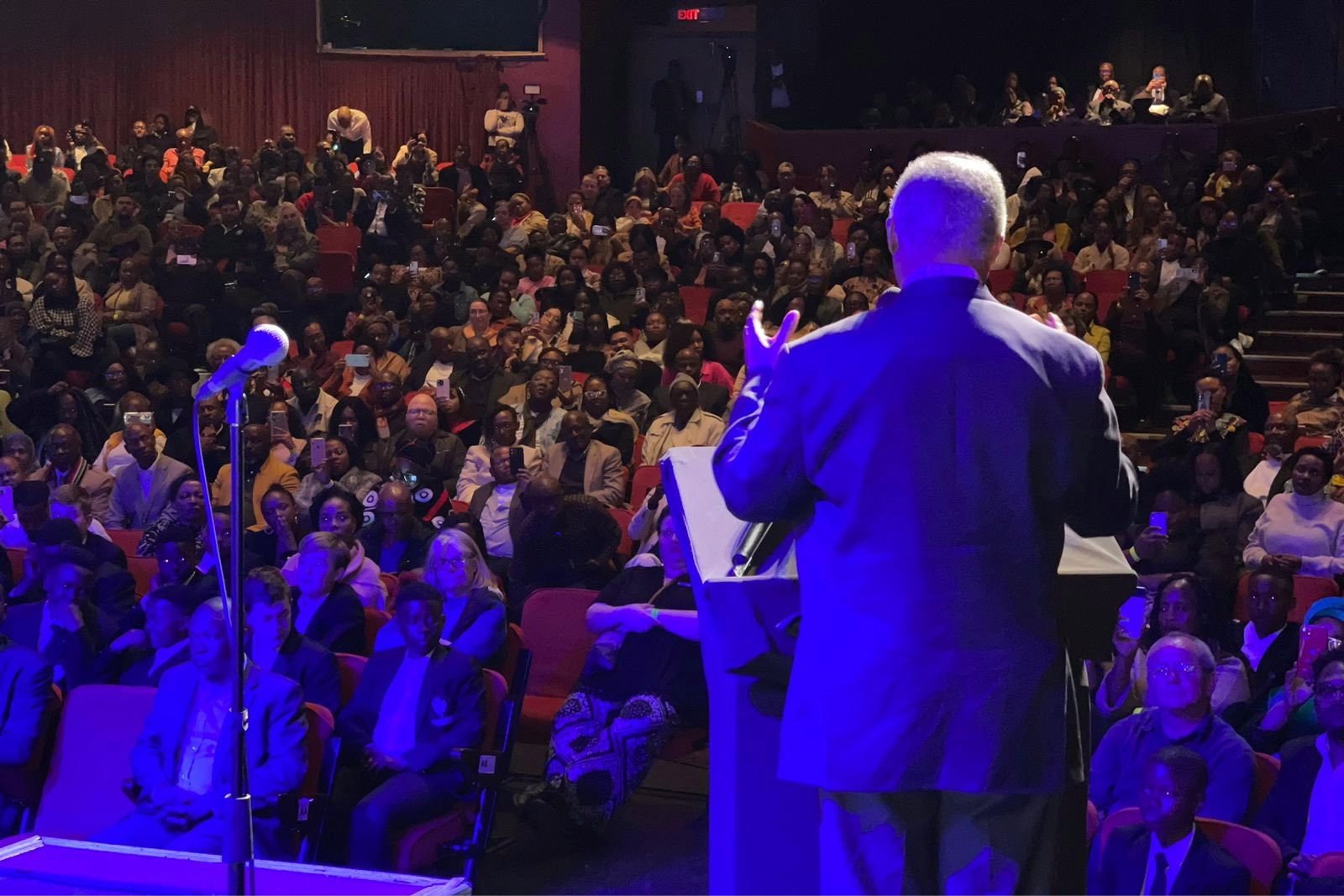
Mbeki delivered a keynote address at DIRCO’s inaugural Annual Aziz Pahad Peace, Security and Human Rights Dialogue.
Pahad passed on in 2023 and has been hailed as a diplomat par excellence.
Mbeki has focused on the posture of the US President Donald Trump, as the world is changing with China, Russia and other countries becoming more influential.
He said that with China and Russia growing their economic and political interests in the world, particularly in Africa, the question remains whether Africa especially is ready to position itself in the new world order.
“In light of all this, what does Africa do? Minister, Dirco must lead us to that. One US writer said: The post World War Two world order is gone. Western dominance is slipping away. The current world economic order is on the way out. Where does this position us and Africa if this is true”? asks Mbeki.
The former president also questioned what would be Africa’s response when Trump announced the US policy on Africa based on the intelligence report, which suggested that the ISIS group is rapidly expanding in Africa. He said the report is likely to inform Trump’s Africa policy as it warns of new attacks on the US and its citizens in the world by Al Qaeda and ISIS groups.
Mbeki said Pahad would have been very much disturbed by the executive orders that were recently signed by the Trump, particularly the drastic increasing of tariffs to influence the use of US dollars in the world.
He then questioned the current South Africa’s leadership’s preparedness to position the country in the seemingly coming multipolar system, which he said will soon replace the unipolar world order that currently exists, where the US bully everyone because of its financial and military power.
Mbeki also explained Pahad was at the centre of UN Missions to debunk the narrative of Weapons of Mass Destruction (WMD) in Iraq, before the USA invaded and destabilised that country.
He also tried to convince the American leader, George Bush but was left fuming that “President Bush doesn’t know how to think”.
He explained that he pleaded with both Bush and Tony Blair to heed the WMD experts and even offered to become their intermediary with Saddam Hussein in a bid to maintain peace.
South Africa had a special insight into Iraq’s potential for WMD because the apartheid government’s own biological, chemical and nuclear weapons programme in the 1980s led the countries to collaborate. The programme was abandoned after the end of white minority rule in 1994 but the expert team, known as Project Coast, was put back together by Mbeki to investigate the US and UK assertion that Saddam had WMD – the central premise for mounting an invasion.
Mbeki, who enjoyed positive relations with both Blair and Saddam, asked for the team to be granted access.
“Saddam agreed, and gave the South African team the freedom to roam unfettered throughout Iraq,” writes Matisonn, who says he drew on sources in Whitehall and the South African cabinet. “They had access to UN intelligence on possible WMD sites. The US, UK and UN were kept informed of the mission and its progress.”
Mbeki had a phone conversation with Bush in 2003 and tried to discourage him from going to war.
He also told Blair that he would be sending Pahad to meet with the Iraqi leadership, which stands accused of possessing WMD.
Pahad’s visit, part of the government’s attempt to avert war in the volatile region, was his second to the oil rich country after visiting last year to deliver Mbeki’s letter to his counterpart, calling on the latter to cooperate fully with the weapons inspectors.
Pahad said South Africa, as the only nation to have declared its nuclear arsenal, had a “historic and moral duty ” to persuade other nations to abandon their nuclear weapons programmes.
Mbeki warned that the wholesale removal of Saddam’s Ba’ath party could lead to a national resistance to the occupying coalition forces. But with huge military deployments already under way, Blair’s mind was clearly made up.
International Relations minister Ronald Lamola said Pahad’s legacy lives on in South Africa’s commitment to multilateralism, solidarity and the peaceful resolution of conflicts.
“Aziz Pahad played a very active role in South Africa’s mediation efforts … in the Israeli-Palestinian peace process and in negotiations in the Democratic Republic of Congo, Burundi and Angola,” he said. “He always understood that resolutions should be pursued through dialogue.”
Linking Pahad’s life to the broader post-apartheid project, Lamola highlighted the importance of redress and constitutionalism. He warned against complacency after six national elections, arguing that the dual legacy of apartheid — prosperity for whites and impoverishment for blacks — remains unresolved.
Lamola also stressed the importance of Africa’s own constitutional frameworks, such as the Constitutive Act of the African Union, the New Partnership for Africa’s Development and the African Peace and Security Architecture, saying Pahad would have expected South Africa to champion these initiatives.
Professor Angina Parekh-Pahad, widow of Aziz Pahad, also delivered a tribute at the Aziz Phad Dialogue. She stated that her late husband, had warned about threats to international peace & security while he was still alive.
Pahad served as Foreign Affairs Deputy Minister both under the late former president Nelson Mandela and former president Mbeki from 1994 to 2008. He was close to Mbeki, and when he (Mbeki) was recalled in 2008, Pahad also left the government.