
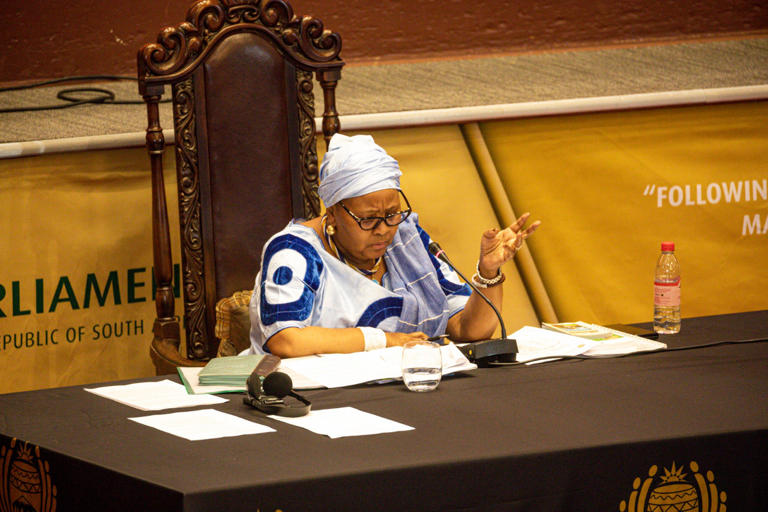
By Lehlohonolo Lehana.
The Pretoria High Court has denied former defence minister Nosiviwe Mapisa-Nqakula access to the investigation diary in the corruption case against her.
Mapisa-Nqakula is charged with 12 counts of corruption and one count of money laundering.
The charges stem from allegations that she received millions of rands in cash bribes from a contractor linked to the South African National Defence Force (SANDF).
The State has already disclosed sections A and B of the police docket against Mapisa-Nqakula.
However, it said it was not willing to hand over section C of the docket, which is the police book investigating diary.
Section B and C deal with the correspondence and investigation diary.
Mapisa-Nqakula’s defence believes that the disclosure of the two Sections contains information that will vindicate her.
The state, however, maintained that the contents were confidential.
She also requested full disclosure of a separate docket tied to Nombasa Ntsondwa-Ndhlovu’s contract fraud matter, including witness statements.
That case was struck off the roll last year after Ntsondwa-Ndhlovu invoked Section 342E of the Criminal Procedure Act (CPA), citing unreasonable delays in proceedings.
Judge Mokhine Mosopa handed down his judgement this morning, following arguments presented by both the defence and the state, which opposed her application.
Judge Mosopa said the motivation for the disclosure application was speculative.
“The court must guard against the risk that may lead to impeding the applicant’s case and the acts of proper administration of justice. The applicant failed to show the risk of such impediment in my considered view and failed to establish a prima facie effects which indicate the relevance of the disclosure of the C-section of the police docket.”
Mosopa explained that an investigation diary contains a chronological record of actions taken during an investigation, as well as instructions given to the investigating officer.
He highlighted that it was the state’s responsibility to justify why such disclosure should be withheld.
The judge emphasised that while the right to a fair trial is fundamental, the right to disclosure is not absolute.
He also referred to Ntsondwa-Ndhlovu’s pending representations to the national director of Public Prosecutions, highlighting that the matter had not yet been finalised.
“What is holding back the finalisation of the representations is unknown at this stage,” the judge said.
He further noted the state’s claim that the military docket could not be disclosed due to ongoing investigations.
Mosopa questioned the state’s inconsistency in granting Ntsondwa-Ndhlovu access to the docket while refusing the same to Mapisa-Nqakula.
“In my considered view, the disclosure of that docket is relevant for the applicant to prepare for her case in answer and defence considering that the respondent intend on using Ntsondwa-Ndlovu as a section 204 witness.”
He ordered the state to provide her legal team with progress reports on Ntsondwa-Ndhlovu’s pending representations but denied access to the investigation diary.
Meanwhile Graeme Hosken and Sam Sole for amaBhungane reported that they had obtained access to the affidavit implicating the Mapisa-Nqakula, and while it is untested in court and should be treated with caution, it provides a portrait of entitlement, bullying and corruption that appears entirely routine and matter of fact.
The affidavit was provided by defence tenderpreneur Ntsondwa-Ndhlovu in terms of Section 204 of the Criminal Procedure Act. She claims that the minister started demanding bribes after Ntsondwa-Ndhlovu approached Mapisa-Nqakula for help when one of her multimillion-rand contracts to provide logistics services to the Department of Defence hit a snag.
AmaBhungane further reports that Ntsondwa-Ndhlovu’s affidavit is so devastating that the defence will, of necessity, need to attack its legitimacy and Ntsondwa-Ndhlovu’s credibility.