
By Paul Vecchiatto.
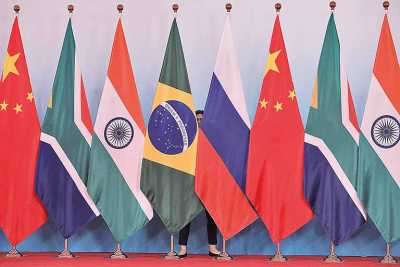
Nineteen countries expressed an interest in joining the Brics group of nations as it prepares to hold an annual summit in South Africa.
The emerging-markets bloc of Brazil, Russia, India, China and South Africa will meet in Cape Town on June 2-3 to discuss its enlargement, Anil Sooklal, South Africa’s ambassador to the group, said in an interview on Monday.
“What will be discussed is the expansion of Brics and the modalities of how this will happen,” he said.
“Thirteen countries have formally asked to join and another six have asked informally. We are getting applications to join every day,” Sooklal added.
China initiated the conversation about expansion when it was Brics chair last year, as the world’s second-biggest economy tries to build diplomatic clout to counter the dominance of developed countries in the United Nations.
The proposed enlargement triggered concern among other members that their influence will be diluted, especially if Beijing’s close allies are admitted.
China’s gross domestic product is more than twice the size of all four other Brics members combined.
The foreign ministers from the five member states have all confirmed they’ll attend the discussions in June, Sooklal said.
In addition to its membership, they will also discuss “hot spots” including Sudan, where a conflict between that army and a paramilitary force continued for a 10th day on Monday.
Since its formation as the Bric in 2006, the group has only admitted one new member, with South Africa joining in 2010. Saudi Arabia and Iran are among the countries who’ve formally asked to join, Sooklal said in February.
Meanwhile Sooklal, told a gathering of the bloc countries that the world was facing several situations simultaneously – but not once was Russia’s war in Ukraine mentioned.
Sooklal opened the 9th session of the meeting of BRICS deputy ministers and special envoys responsible for the Middle East and North Africa in Cape Town.
“It has been said that not since the Cold War has the world been in such crisis. [There are] a number of situations that we are confronting simultaneously, not just major power conflicts but also the issues around climate change, biodiversity loss anti-globalisation and the impact of so-called new technologies, the fourth industrial revolution,” he said.
He spoke about the conflict in Sudan, as well as climate change and the impact of the fourth industrial revolution, and his fellow ambassadors echoed his sentiments.
“We are extremely concerned about the developments in Sudan. We need to look at what we can do to see the cessation of hostilities between the warring parties. A return to peace and negotiations is what we want to see,” he said.
But there wasn’t a single mention of Russia’s war in Ukraine from any of the other ambassadors who were present.
The South African government maintains that diplomacy and dialogue is the only path to resolving the bloody war between Russia and Ukraine.
A year after Russian tanks rolled into Ukraine, South Africa has not shifted its position on the invasion and has maintained a neutral stance.