
By Lehlohonolo Lehana.
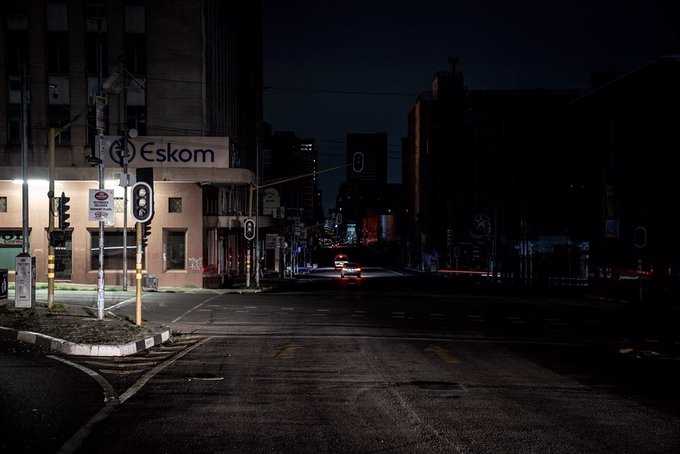
Load shedding has been escalated to Stage 4 from 05:00 on Saturday, not Stage 3 as previously communicated, Eskom said in the early hours of the morning.
In the early hours of Saturday (6 May), Eskom said that the further breakdown of generating units has led to the need for the company to alter the original weekend schedule.
Eskom said it would publish a further update as soon as there are any significant changes.
The changes come a day after Eskom outlined a detailed schedule for the weekend, alternating between Stage 3 and Stage 4 during the day.
South Africans have been warned to get ready for a cold and dark winter as demand for electricity is expected to skyrocket, and Eskom remains unable to provide a sufficient supply.
Presenting in a virtual update on the Energy Action Plan, the government’s strategy to revive Eskom and open up the national grid to independent power producers, the company said it is likely that generation capacity will continue to be severely constrained.
Thousands of megawatts are currently offline due to maintenance issues, trips or outages at power units across the country, said Eskom.
For access to other load shedding schedules, Eskom has made them available on loadshedding.eskom.co.za.
Smartphone users can also download the app EskomSePush to receive push notifications when load shedding is implemented, as well as the times the area you are in will be off.
Meanwhile South Africa could meet its climate change commitments and simultaneously prolong the lives of some of Eskom’s oldest power stations, given the low output from coal-fired power stations, says Rudi Dicks, the presidency official who sits on the National Energy Crisis Committee (Necom).
The Minister of Electricity Kgosientsho Ramokgopa, Eskom head of generation Bheki Nxumalo, and Dicks briefed journalists on progress made with implementing the national energy crisis committee on Friday afternoon.
Ramokgopa has proposed that old power stations should not be decommissioned according to the Eskom timetable amid an energy crisis. Dicks said a diagnostic study had been commissioned by Necom to determine the viability and cost of prolonging the life of coal power stations.
“This study will be completed in 2023, and no new schedule for decommissioning will be published until this is resolved,” said Dicks.
Dicks also noted that the low energy availability factor (EAF) of coal-fired power stations – below 50% – could mean that SA could still meet its climate change commitments without closing down coal. SA committed at the COP26 conference in December 2021 to reduce greenhouse gas emissions within a certain range as part of its fair share of the global effort to contain global warming at 1.5 degrees. On this basis, it raised $8.5 billion in funding from foreign governments to assist with the transition.
Said Dicks: Low EAF means a low load factor, meaning that carbon emissions are relatively low. The Presidential Climate Commission is doing some modelling because with high levels of load shedding and poor plant performance, in actual fact, if the trajectory continues the way it is, it will significantly help meet those targets.
Ramokgopa said it was possible to meet both climate goals and extend the life of coal.
“It doesn’t help us to decommission units performing well, such as the three due for decommissioning at Camden. We are modelling the impact of emissions and cost implications, and we will decide whether to extend the life and by what period. But I want to emphasise that we will not renege on our NDCs [Nationally Determined Contributions, the climate pledges that each country made] our decarbonisation agenda and net zero path by 2050. The revisions will be in those timelines.
Ramokgopa said he and several other ministers had met with the International Partners Group (the countries and entities that pledged funding for South Africa’s transition away from coal) and found a high degree of understanding for the country’s plight.
“There is an appreciation that we need to have the lights on as we decarbonise; we do it in an environment where the lights are on,” he said.
Camden, one of Eskom’s best-performing power stations, has three units – each 140MW – due for decommissioning in the next 12 months and another five units over the next two years.
Arnot is due for full decommissioning by March 2027, Grootvlei by September 2027, Hendrina by December 2025, and Kriel by November 2030.
At the time that SA made the deal with the IPG at COP26, it was assumed that all of these power stations would have to close by 2030, as well as an additional one, which was Tutuka.