
By Lehlohonolo Lehana.
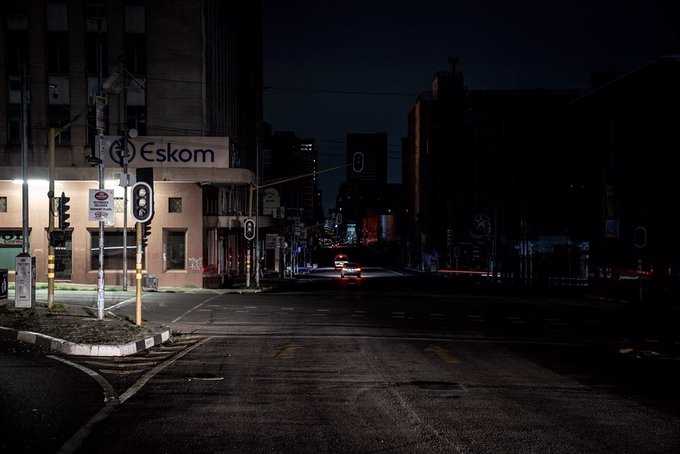
Due to the failure of additional generating units and the delay of several units to return to service, Stage 6 load shedding will be implemented at 16:00 on Sunday afternoon until further notice, Eskom said in a statement on Sunday.
The power utility said that this is expected to persist throughout the week.
This change follows various recent amendments to the original weekend schedule and the outlook for the days ahead.
The weekend was meant to be at a steady stage 4 however, on Saturday (6 May), breakdowns at the company forced Eskom to push to Stage 5.
According to Eskom, it would publish a further update as soon as any significant changes occur.
Breakdowns are currently at 19,333MW of generating capacity, while the generating capacity out of service for planned maintenance is 4,524MW.
“Since yesterday morning, a generating unit each at Duvha, Lethabo and Medupi power stations have returned to service.”
“Over the past 24 hours, a generation unit each at Majuba, Medupi and Tutuka power stations were taken out of service due to breakdowns,” said the company.
Furthermore, the delay in returning units to service at Arnot, Camden, Hendrina, Majuba, Matla and Tutuka power stations continues to add to the current capacity constraints.
Eskom said that its team is working around the clock to ensure that generating units are returned to service as soon as possible.
To mitigate further power outages and reduce demand, the company has urged consumers to switch off geysers from 17:00- 21:00.
For access to other load shedding schedules, Eskom has made them available on loadshedding.eskom.co.za.
Smartphone users can also download the app EskomSePush to receive push notifications when load shedding is implemented, as well as the times the area you are in will be off.
Meanwhile if the government is to implement a new court ruling ordering it to provide alternative power supplies and diesel for generators to clinics, hospitals, police stations and schools – taxpayers could be called on to pay more.
Minister of Public Enterprises Pravin Gordhan was ordered by the Pretoria High Court on Friday (6 May) to “take all reasonable steps within 60 days” to stabilise power supply to certain institutions during load shedding.
According to the court, if a building or area can’t be isolated from the grid to exempt it, Gordhan must make arrangements for alternative power supplies such as generators.
The court ruled that exemptions can only be granted if they do not pose a risk to the stability of the national electricity grid by being ’embedded’ into the surrounding network.
On top of that, the court found that the government had repeatedly gone against its constitutional and legal obligations to provide adequate healthcare, security and education due to continual rolling blackouts.
Vincent Magwenya, the spokesperson for the presidency, said that the ruling was, however, very likely to be appealed.
“We have significant concerns about the judgment and its impact on the stability of the grid and the negative effect on the fiscus,” the spokesperson said.
The department of public enterprises and the office of the electricity minister are both ‘studying’ the recent ruling and will respond at a later time.
The judgment found that there had been repeated breaches by the state of its Constitutional and statutory duties and that these breaches infringe citizens’ rights to healthcare, security and education.