
By Lehlohonolo Lehana.
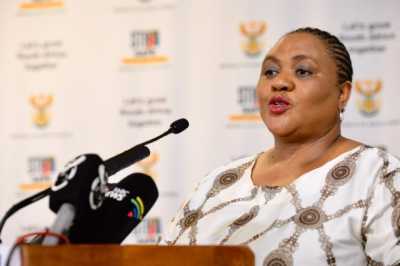
Agriculture,Land Reform and Rural Development Minister Thoko Didiza has tabled, in Parliament, a R17.2-billion budget for her department in the 2023/24 financial year, including transfers to provincial agriculture departments and relevant entities.
She highlights in her Budget Vote Speech the imperatives of addressing food security, spatial planning, rural development and the redistribution of land, particularly as communities across the country remain plagued by past injustices and unrestored land rights.
Didiza maintains that the lingering effects of Apartheid and colonialism created disparities in resource allocation, infrastructure and opportunities for growth in the agricultural sector.
Additionally, the multifaceted challenges have further hindered the ability of traditional agricultural areas to thrive. The limited market access of these spaces has curtailed the potential for economic growth and self-sustainability of these communities.
In the 2023/24 financial year, Didiza makes an investment case for these areas according to an assessment done by the department’s planning unit and a team from the National Agricultural Marketing Council.
The Department of Agriculture, Land Reform and Rural Development (DALRRD) also engaged with traditional leaders.
She stressed that support to black producers in agriculture and agro-processing is an important vehicle to bring about transformation in the sector.
In this regard, the department continues to strengthen the Blended Finance Model to increase access to affordable finance.
“To broaden the scope of support even further, the department is in the process of concluding agreements to extend the Blended Finance Model to commercial banks in the 2023/2024 financial year, and I will soon make an announcement in that regard,” Didiza said.
Support for subsistence and small-scale farmers
Through its conditional grants — the Comprehensive Agricultural Support Programme (CASP) and Ilima/Letsema — the department has in the past financial year supported 15 853 (through CASP) and 25 781 (through Ilima/Letsema) farmers.
“In this year, the provision of R2.15 billion will further assist farmers with production inputs and infrastructure from these two programmes,” the Minister said.
Through a Micro Agricultural Financial Institutions of South Africa (MAFISA) programme, which allows for the charging of lower interest rates on loans to farmers, a total of R19 million at the Land Bank is available to support small-scale producers.
“Since its inception, MAFISA has assisted over 25 732 farmers. During the 2022/2023 financial year, we committed to support 83 farms, and I can report that the preliminary performance report indicates that the target has been achieved.
“For the current financial year, the Land Development Support Programme will support 66 farms, with a budget of R449 million, with production inputs, on-farm agricultural infrastructure, mechanisation, implements and equipment, and operational costs.
“The department continues to conduct this work in partnership with commodity organisations and commercial banks,” Didiza said.
Energy Crisis
She said earlier this year, in response to the energy challenges in the sector, her office established a Task Team composed of sector partners.
The Task Team has engaged with Eskom on solutions to mitigate against the impact of energy cuts on the sector.
“In addressing alternative energy sources in the sector, we are setting up the R2.5bn Agro-Energy Fund at the Land Bank,” said Didiza.
“The focus for the Agro-Energy Fund will be on energy intensive agricultural activities.”
These will include irrigation, intensive agricultural production systems and cold chain related activities.
“The criteria that will be utilised is as follows: a large-scale farmer will receive 30% grant funding to be matched with a 70% loan portion, where the grant amount is capped at the maximum of R1.5 million,” she explained.
“A medium scale farmer will receive a 50%` grant to be matched with a 50% loan portion, where the grant is capped at the maximum of R1 million.”
Smallholder farmers will be supported by a grant portion of 70% to be matched with 30% loan she stated.
Reviving agriculture in communal areas
Didiza has reaffirmed government’s commitment to continue working with communities under communal areas and their leaders on a better land governance and administration system.
This follows a Summit on Communal Land Administration and Tenure, which was held last year, where government made a firm decision to divest its trusteeship of land in order to ensure that communities under communal areas can own and administer their own land.
“The National Development Plan (NDP – Vision 2030) recognises the need to integrate rural areas in agricultural development by mainly expanding irrigated areas and promoting dry-land farming where feasible. The NDP further envisions the conversion of underutilised land in communal areas and land reform projects into commercial production.
“This year, we will focus on these areas, including engagements with Amakhosi, to facilitate the development of area-based plans to revive agricultural production. The department has already begun with drone flyovers in some communal areas to map these areas in order to facilitate better planning,” Didiza said.
Cannabis Update
Didiza said the current Private Members Bill has been expanded to include commercialisation of cannabis and hemp.
Currently, the National Assembly is seized with processing public comments on this section of the Bill. The Inter-Ministerial Committee has also been meeting to give direction to ensuring that interim measures on commercialisation of hemp are realised.
These measures include changes to the existing tetrahydrocannabinol limit for hemp to 1% and amendment of Schedules 4 and 6 of the Medicines Control Act.
The Minister of Health is currently considering these changes.
Demonstration sites for hemp production have been set up in Rustenburg, in North West, and Roodeplaat, Gauteng. To date, the DALRRD has issued 397 permits for hemp production.