
By Lehlohonolo Lehana.
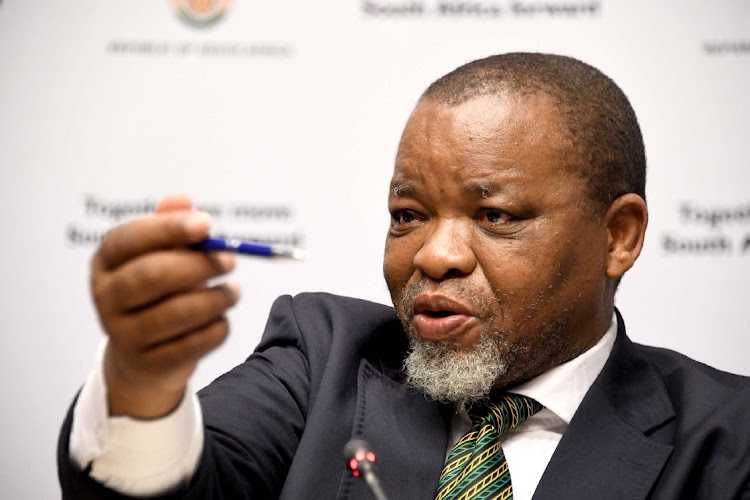
Mineral Resources and Energy (DRME) Minister Gwede Mantashe says, lack of grid capacity was the ‘single-most challenge’ in efforts to resolve the energy crisis.
Mantashe spoke during the tabling of his department’s budget vote in Parliament on Tuesday.
“The single most challenge we face to address is the grid unavailability because you can increase the generation but without the grid capacity the impact is not the same,” said Mantashe.
The country is currently alternating between stages 4 and 6 of load shedding due to high electricity demand and cold weather.
Mantashe said connectivity and universal access to electricity for citizens are still government priorities, despite the load shedding crisis.
“We have been given advice and one of those was that we should not be connecting more people because there is a shortage of electricity. Our view is that connectivity and universal access to electricity are necessary, it can’t wait for the grid. We must deal with the grid problem but connect our people.”
Mantashe rolled out the megawatts to be added — 5,000MW from independent renewable power producers in Bid Windows 7 and 8 by 31 March 2024, and further requests for proposals on 1,230MW battery storage procurement.
In the three months from July 2023, the DMRE will issue a request for proposals for 3,000MW gas-to-power, signally a potential new window of opportunity for Karpowership, the floating producer of electricity from gas whose bid has been stuck in legal and environmental challenges until a recent reprieve.
President Cyril Ramaphosa recently threw his support behind such power ships, although he did not name Karpowership, which also operates elsewhere along the African coast. “(Other countries)have brought in ships that are able to generate energy and immediately solved their energy problems and challenges. And I do believe that that is the way to go right now, to add those megawatts that we don’t have…” Ramaphosa said during his 11 May question slot in Parliament.
From January 2024 a request will be issued for procurement proposals for 2,500MW nuclear energy, presumably on the back of provisions in the 2019 Integrated Resources Plan (IRP2019) even as this document is reviewed, with the submission of a draft IRP2023 to Cabinet expected, according to Mantashe, sometime between July and September 2023.
Both proposals are hugely controversial. But the restated nuclear procurement plays into the longstanding, ultimately unsuccessful nuclear procurement from Russia by the Jacob Zuma administration. While National Treasury had resisted allocating monies, the potential nuclear deal was nixed in April 2017 by the legal challenge of Southern African Faith Communities Environment Institute (SAFCEI) and Earthlife Africa.
The CEO of Organisation Undoing Tax Abuse (OUTA), Wayne Duvenage says, the ships won’t be able to come online immediately and might take a year to become functional.
“Karpowership is only a viable solution if it entailed a short-term contract (five years maximum) to get us over the hump, as it were, and if the costs weighed up against the potential loss to the economy due to worsening load shedding,” said Duvenage.
He further noted that a 20-year contract would cost the country R200 billion. However, with the rise in costs and drop in rand value, it will more likely cost around R500 billion.
Mantashe, who also heads the mineral resources portfolio, told MPs the mining sector is one of the country’s best-performing sectors.
“The department’s budget for the 2023/24 financial year is R10.7 billion. You can notice that it’s one of the smallest budgets in our budget, confirming that we are not investing enough in revenue-generating departments.
“The mining industry contributes meaningfully to the Gross Domestic Product. The sector created 23 552 jobs between December 2021 and December 2022, resulting in the overall employment of 472 088 workers. According to SARS, the mining sector contributed R89 billion in corporate tax in the 2021/22 financial year,” Mantashe added.
While production dropped, he said the value of production registered R1.18 trillion in 2022, up from R1.1 trillion in 2021 on the back of strong global demand.
The sector created 23 552 jobs between December 2021 and December 2022, resulting in the overall employment of 472 088 workers.
Referring to data from the South African Revenue Service (SARS), Mantashe said the mining sector contributed R89 billion in corporate tax in the 2021/22 financial year and a further R28.45 billion through royalties in the same period, keeping its percentage contribution to the GDP at 7.53%.
“This is a clear indication that mining remains a strong pillar of our economy.”
Mantashe also highlighted the snippets from the latest Fraser Institute Survey, which placed South Africa in the worst position in recent memory.
However, the Minister believes that mining would contribute even better to the economy if the “binding” constraints in electricity, rail and port systems were urgently resolved.
“According to the survey, South Africa is in the bottom quartile on the investment attractiveness index.
“One of the indices highlighted in the Fraser Institute survey is the transparency of licensing systems. To this end, we have, in collaboration with the State Information Technology Agency (SITA), initiated a procurement process for a licensing system with integrity.