
By Lehlohonolo Lehana.
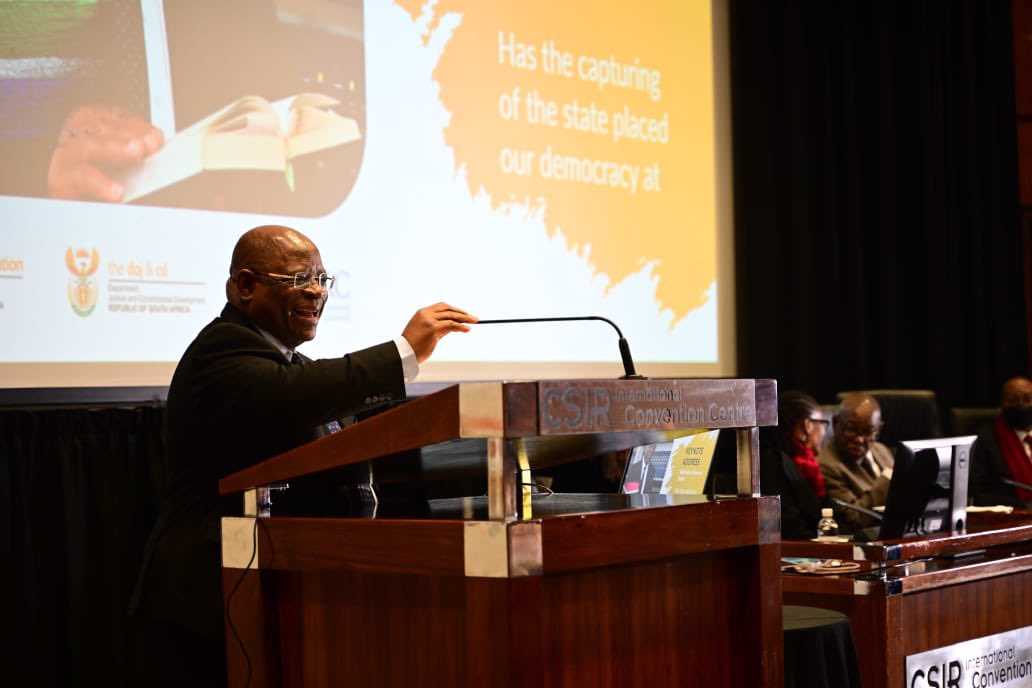
Chief Justice Raymond Zondo says his biggest fear is that South Africans remained vulnerable to the impact of corruption, despite his pride in the work of the State Capture Inquiry.
Zondo was speaking at a Human Sciences Research Council symposium organised to discuss the public impact of the state capture report and its implications.
Thursday marks exactly one year since Zondo, who chaired the commission, handed the final parts of the report to President Cyril Ramaphosa.
Zondo repeated that, as early as 2009, it had been clear from the actions of former president Jacob Zuma and the power shifts occurring at SOEs that there were problems, but that the opportunity to stop the corruption was ignored.
“The reason why we failed to stop state capture is because the ruling party refused to agree to the establishment of an inquiry that would probe the allegations. There were a number of opportunities for the majority party to agree, but it did not. The Guptas continued with their projects, and the transactions that happened afterward happened because they were not stopped,” he said.
In his report, Zondo had recommended safeguards to protect the country against state capture and lack of action by Parliament.
He repeated this recommendation, adding that electoral reform to allow for a constituency-based system would give voters more power.
He also lambasted Parliament for failing to take steps to ensure state capture was exposed before the looting of around R58 billion from the state’s coffers.
“The reason why it failed is well-known. It is because the majority party refused to agree to the establishment of an inquiry to investigate the allegations,” said Zondo.
“There were a number of instances where there was an opportunity for the majority party in Parliament to agree, but it did not and therefore, the Guptas continued with their project and the transactions that happened afterwards happened because there were not talked about by Parliament.”
Zondo said he believes there is an urgent need for the establishment of an anti-state capture and anti-corruption standing committee in the legislature.
“The other possibility is one that the commission has pointed out in its report, namely there should be a standing anti-state capture and anti-corruption commission that works the same way as the state capture, where we can call anybody, whether it is the president, any member of Parliament, or any minister to come and answer questions where there are allegations of corruption and state capture.
“Even if the majority in Parliament do not want certain questions to be asked in that commission either to protect the president or ministers, there would be full opportunities for everything to be explored, and the evidence given would be given in the open, at least there wouldn’t be anything that is swept under the carpet.
“If it is established through that commission that there is serious corruption and state capture, there will be a strong public opinion which might force even a majority in parliament to do something because of the strong public opinion.”
Meanwhile the Parliamentary Monitoring Group (PMG) says any good work being done by parliament to tackle corruption and the State Capture report is being undermined by politicians being unwilling to do what’s needed.
The PMG has published its latest review of the parliament’s processing of the State Capture Report, looking into what parliament has done on Zondo’s findings and recommendations a year ago.
The PMG is an information service that tracks parliament’s daily activities while also publishing reports and other documents, giving a window into the performance of each government department.
The State Capture report, published in June 2022, argued that weaknesses in parliamentary oversight and executive accountability had, over time, contributed to corruption and maladministration in government.
At the time, the State Capture commission recommended that parliament consider reforms to improve its oversight and accountability function. However, the actual outcomes from the commission and report have not year yielded the political response the public came to expect following the explosive revelations that came from the process.
Oversight in parliament broadly refers to the parliament’s role in monitoring and supervising the government’s actions through reviewing and evaluating government activities and ensuring they are legal and effective.
Recommendations made by the State Capture report related to things like procurement, parliamentary processes, financial oversight, state-owned entities and inquiry reforms, among many others.
Almost a year later, the actual action taken on the report has been debatable.
Some political figureheads argue that the report strengthened oversight measures. However, others point to the need for further implementation, investment and skills to improve the oversight function of parliament.
Opposition party members – specifically those standing against the ANC – say that not a single recommendation has been adopted and implemented in South Africa since the report was tabled.
PMG said that parliament’s performance around oversight and accountability has been mixed, with some pockets of progress. However, there are clear failings on “big” matters that overshadow any good work being done.
The group said there are a handful of political disincentives to conducting oversight, such as asking government colleagues awkward questions, or having to trudge through mundane and ‘low profile’ tasks and duties.
“While tools for oversight are important, ultimately, the political will to fully use such tools, despite the inherent obstacles, is paramount. Having the necessary tools is one thing, and implementing them is another.”
“On the rare occasion when a scandal is uncovered, opposition members may embrace it enthusiastically. Usually, however, oversight involves mundane work that provides very little of the public profile important to politicians concerned with retaining their seats,”PMG said.
The organisation added that for members of the majority ANC, it may involve asking colleagues in government awkward questions.
To best improve sufficient parliamentary oversight, the PMG said that the main incentive should be stressed: oversight is a critical part of a democratic society committed to effective government and transformation.
Watch Live in the video below:
Video Courtesy of SABC.