
By Lehlohonolo Lehana.
The comments by Chief Justice Raymond Zondo on the first anniversary of his handing over the final reports of the State Capture Commission of Inquiry have ruffled feathers within the legislature and the executive.
The presiding officers of Parliament have requested an urgent meeting with him. The principle of the separation of powers between the three arms of the state has been invoked to suggest that Zondo has overstepped the mark.
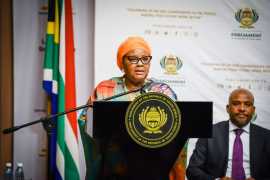
Parliament’s National Assembly Speaker Nosiviwe Mapisa-Nqakula and National Council of Provinces Chairperson, Amos Masondo, met with the Chief Justice on Wednesday at Constitution Hill.
In June 2022, Zondo handed over the final volume on the state capture report to President Cyril Ramaphosa.
A year later, at the colloquium, Zondo reflected on major points raised in testimonies from about 300 witnesses, including President Ramaphosa, and more than eight million pages of documentation. He said there were different forms of state capture and that the capturing of the state placed democracy at risk.
Mapisa-Nqakula said Parliament remains committed to implementing the recommendations of the commission of inquiry into state capture, despite remarks to the contrary by Zondo.
She said of the 19 recommendations in the commission’s report, pertaining specifically to the work of Parliament, 11 had been implemented while eight were still underway.
Mapisa-Nqakula said Parliament had developed an implementation plan, and 22 relevant parliamentary committees had been tasked with overseeing the executive’s actions regarding the recommendations.
According to the Mapisa-Nqakula, six lawmakers implicated in the commission’s report were referred to the Joint Committee on Ethics and Members’ Interests, and an additional six were referred to an external entity. Of those, the committee found against three; cleared five, while two were still outstanding.
“At least two MPs have since resigned from Parliament and so fall outside the scope of the application of the ethics code,” she said.
Among them was House Chair Cedric Frolick, linked by the commission to the controversial facilities management company Bosasa, who was cleared by the committee last month.
Other cleared MPs include the late Tina Joemat-Pettersson, and Labour Minister Thulas Nxesi.
On the commission’s recommendation for amendments to the Intelligence Service Oversight Act, to ensure that Parliament’s Joint Standing Committee on Intelligence provides a consolidated account of its work during its five-year term, Mapisa-Nqakula said the committee had concluded this was unnecessary.
The committee does not disclose its work to other members of parliament and the public.
“After careful consideration, the Joint Standing Committee on Intelligence concluded that no amendments to current legislation are necessary as the existing law already addresses the commission’s concern.”
She also said that while the commission emphasised the importance of high-level public scrutiny when appointing heads of state institutions, it was of the view that laws concerning the selection process for such positions were already in place.
“To enhance the integrity of these appointments, Parliament will develop guidelines that incorporate relevant laws and best practices, as appropriate,” added the Speaker.
Mapisa-Nqakula denied that Parliament had rejected any of the commission’s recommendations while stressing that there was never any directive in the report that compelled the government to give progress reports on their implementation.
Meanwhile Parliament will conduct more research on the implementation of the commission of inquiry into state capture’s recommendation on the oversight of the presidency.
Mapisa-Nqakula said Parliament had considered the possibility of overseeing aspects of the presidency that were currently supervised by existing structures.
“The Parliamentary Budget Office conducted research to identify aspects of the presidency budget not subjected to parliamentary scrutiny and concluded more research on how this can be done was needed.
“The PBO concluded that Parliament should strengthen its oversight over the presidency and recommended further research.”
She said the Rules Committee concluded that the desk-top research done should be supplemented by a visit to explore international best practices.
“This comprehensive approach will establish a solid foundation for the seventh Parliament, and the findings of the fact-finding mission – scheduled for July 2023 – will be processed,” added the Speaker.
Watch Live in the video below:
Video Courtesy of SABC.