
By Lehlohonolo Lehana.
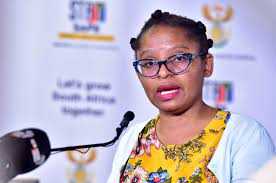
Minister in the Presidency Khumbudzo Ntshavheni says calls for the scrapping of broad-based black economic empowerment (B-BBEE) without an alternative economic transformation and empowerment policy are premature and have no basis in economic data.
Ntshavheni addressed the Black Business Council Summit on Thursday.
The summit comes amid pushback from some sectors of society against the Employment Equity Amendment Act, which was recently signed into law by President Cyril Ramaphosa.
The act seeks to advance the transformation of South Africa’s workforce by “setting equity targets for economic sectors and geographical regions and requiring enterprises to develop transformation plans”.
Among its key provisions, the bill empowers the Minister of Employment and Labour to set employment-equity targets for economic sectors, as well as regions where transformation is lagging.
This will allow employers to align their plans to achieve the targets for the employment of black people under the broad-based black economic empowerment (B-BBEE) codes of good practice with their employment equity plans.
But various organisations, including the Democratic Alliance (DA), trade union Solidarity and business interest group Sagelika have already approached the High Court to challenge the new law.
Ntshavheni said the pushback against transformation policies was clearly spurred on by racism.
“An unequal society is detrimental to the interest of all, be it government, private sector, non-governmental sector, and citizens (both black and white) as demonstrated by the events of July 2021.”
Ntshavheni also emphasised the importance of access to education.
“Education or access thereof also contributes to the deepening inequality in South Africa – with a 30% influence on inequality gap. However, education also holds a key to addressing disparities in society by providing equal opportunities for all.
“Investing in quality education, particularly for historically disadvantaged communities, equips individuals with the knowledge and skills needed to participate meaningfully in the economy, reducing income inequality and promoting social mobility.
Meanwhile Broad-Based Black Economic Empowerment (B-BBEE) Commissioner, Tshediso Matona, says since 2017, the B-BBEE Commission has — through its annual National Status and Trends on B-BBEE Report — noticed that audited entities implement between 50% and 60% of ESD funds.
Enterprise and Supplier Development (ESD) funds are aimed at bolstering small business to make them competitive and sustainable.
Matona said SMEs continue to raise concerns over limited access to funding.
Taking part in a Youth Month Webinar organised by the Government Communication and Information System (GCIS) – in collaboration with the B-BBEE Commission – Matona said their main aim is to measure how ESD funds can be used effectively to promote the development and growth of black-owned enterprises.
“The aim is to build the capacity of local SMMEs to be ready to compete and strengthen the local economy, and the company’s commitment to sustainable development and support of SMMEs,” Matona said.
Matona said the ESD, also known as Statement 400, is one of the elements of B-BBEE aimed at strengthening local procurement, enhancing local supplier development programmes and increasing financial support towards black-owned entities.
“The mandate of the commission is to investigate either on its own initiative or in response to complaints received, or any matter concerning B-BBEE,” he said.
Matona said as part of their mandate, they will promote advocacy, access to opportunities and educational programmes and initiatives of B-BBEE.