
By Lehlohonolo Lehana.
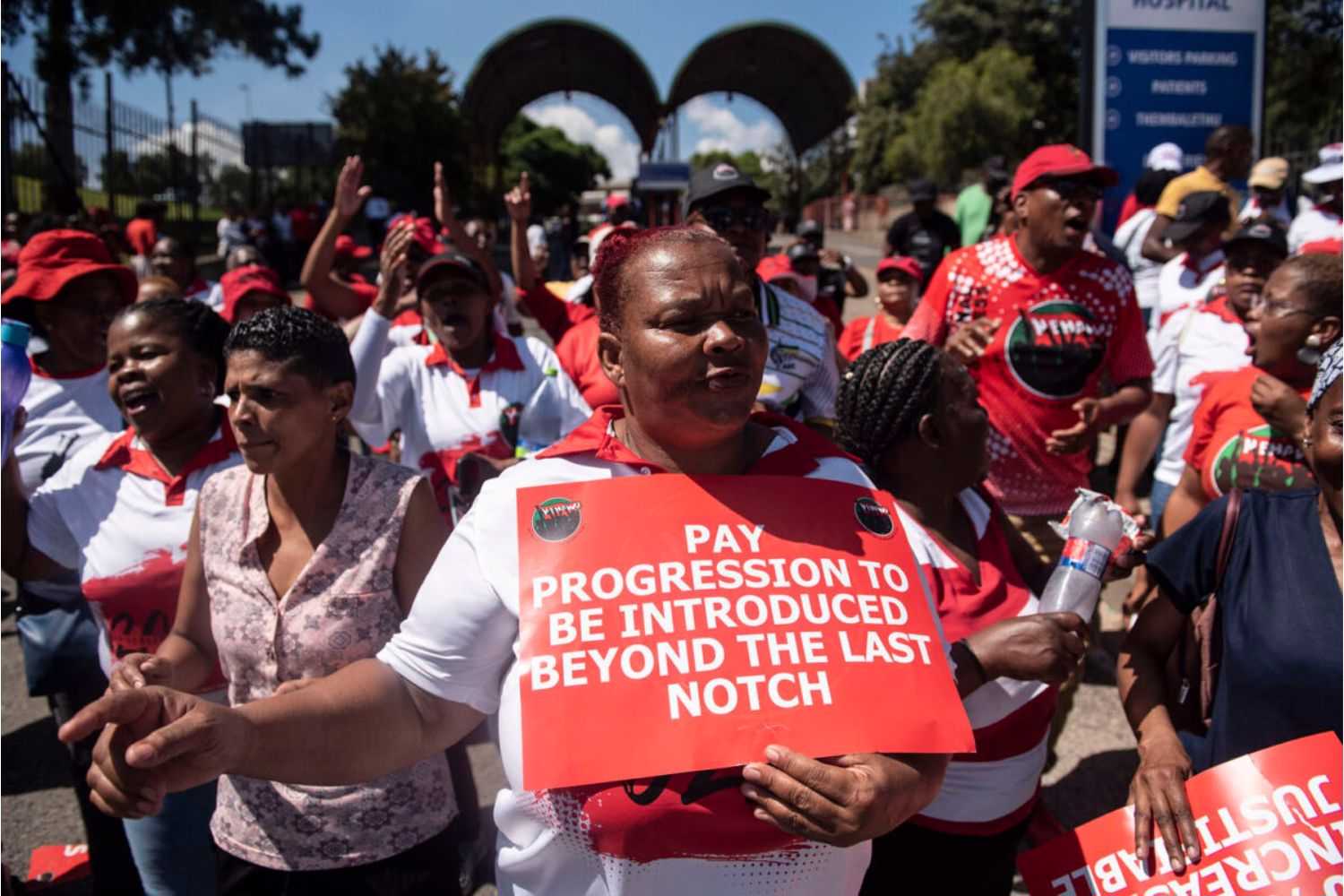
The National Education, Health and Allied Workers’ Union (Nehawu) has expressed anger to President Cyril Ramaphosa’s approval of a 3% salary increase for all public office bearers.
Ramaphosa has signed off on a 3% increase in the salaries of all public office bearers (POBs), according to a statement from the presidency.
The decision follows recommendations made by the Independent Commission for the Remuneration for public office bearers that salaries of all public office bearers, including ministers, judges, magistrates and traditional leaders, be increased by 3.8% for the 2022/2023 financial year.
“Having considered the commission’s recommendations and serious economic challenges facing the country, the president has decided that the salaries of all public office bearers be increased by 3%,” it said.
Nehawu’s spokesperson Lwazi Nkolonzi said the union had called on the president to reject the commission’s recommendation.
“We called on Ramaphosa to reject the recommendation precisely because of the challenges confronting our country with high levels of unemployment, poverty and inequality.
“Our call also centred on the fact that the government butchered public service workers who are at the coalface of service delivery by offering them an increment far below the inflation rate.
“We find it absolutely unethical for Ramaphosa to agree to salary of public office bearers amidst the challenges confronting the country.”
Ramaphosa has submitted the notice of his decision to parliament for approval before publication regarding the salaries of judges and magistrates.
Amid the proposal, some POBs had demanded a 7% increase in light of recent inflationary numbers, while others called for even more, as they pointed to a 20.6% decrease in their effective pay in recent years.
However, finance minister Enoch Godongwana said the fiscus could only afford a 1.5% increase and pleaded with the commission to re-assess the prevailing adverse economic conditions and the extent to which the general population faces despair, especially the survival of the population on government social assistance schemes and containing the wage bill to distribute funding to extreme priority programmes.
The Treasury added that the salary recommendations are tone-deaf in a country battling high poverty levels, forcing Ramaphosa into a debt balancing act.
“Public office bearers are already receiving above-average remuneration, and the current recommendation by the commission will increase earnings beyond tolerable scales when budget constraints do not permit for such increases,” said the Treasury.
South Africa recorded a primary budget deficit in the year through March, missing National Treasury’s target for a surplus, after revenue collections fell short of estimates due to higher-than-anticipated value-added tax refunds.
Compensation accounts for almost a third of state expenditure and is crowding out spending on other priorities. Rating companies have flagged the country’s wage bill as an ongoing economic risk.
The country’s central bank has been implementing a restrictive policy stance in an effort to curb inflation, that’s now at 6.3%. Gross domestic product in South Africa expanded only 0.4% in the three months through March after contracting a revised 1.1% in the previous quarter.