
By Lehlohonolo Lehana.
Minister of Public Enterprises Pravin Gordhan says the Just Energy Transition (JET) presents “huge opportunities” for South Africa and emphasised that through this transition, no one will be left behind.
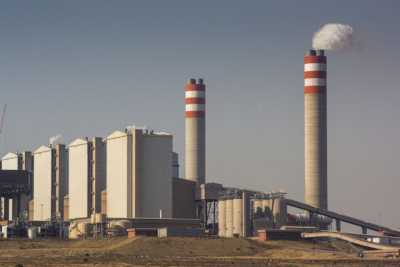
Gordhan and the Presidential Climate Commission visited Komati power station.
He says Komati Power Station not only represents a practical example of how South Africa will conduct its Just Energy Transition but also provides a glimpse into Eskom’s future.
The power station, which was decommissioned in October last year, is the first coal fired power station in Eskom’s fleet to transition to a renewable energy hub.
The Komati Power Station was planned in the 1950s. Building started in 1958, and the first unit, Unit 5, was commissioned on 6 November 1961 and Unit 9, the last, in March 1966.
Komati has nine generating units with a total installed capacity of 1 000MW – 5 X 100MW units and 4 x 125MW.
It was mothballed in the eighties because Eskom had surplus capacity and built new power stations, including Majuba, which had to be in commercial service.
Komati’s first unit was returned to service in 2008 when Eskom started to struggle to meet demand.
It reached a landmark on 9 February 2012 with six units on load for the first time since 5 October 1989.
“Whilst there’s a section that will say we have shutdown the power station. In fact, we are bringing it down so that it can rise again. It’s not a complete shutdown. We are not breaking anything. We are repurposing and preparing it for a different kind of future and it’s a future that the world itself…is preparing for.
“Komati is South Africa’s reality. It’s where South Africa’s Just Energy Transition is going to be tested and prepared for. Komati is the place where…the tyre hits the road,” he said.
Eskom envisions that within the next few years, the Komati site will feed some 370MW of solar, wind and battery storage power to the grid.
“The ‘just’ in the Just Energy Transition is absolutely crucial. Not only for saying how do we ensure that our communities cope with the changes that are going to take place at Komati but also in the course of changing the nature of the relationship between Komati and the communities around Komati.
Residents living on the periphery of the Komati Power Station in Middelburg in Mpumalanga are accusing government and the Presidential Climate Commission of failing to properly consult them on the transitioning of the coal-powered station into a renewable energy hub.
“We have people who lost jobs and I’m one of the victims from 2018. But now the chances that are coming back, are they going to cater for everyone? We understand that they will transfer us, but now, what about the contactors? Lots of people are at home; some their houses taken, cars repossessed,” laments one of the locals.
Turning to the question of the employment of people who previously worked at the plant, Gordhan highlighted that these workers have either been relocated to other plants or are being re-skilled to do other jobs.
“There are both a number of ideas but also the beginnings of new programmes which will address the issue of jobs, the issue of training and people development and learning how to deal with new forms of technology that we have to inevitably deal with,” he said.
The Presidential Climate Commission Chief Operations Officer, Lebogang Mulaisi expressed satisfaction on the progress made thus far in re-purposing the Komati Power Station despite challenges encountered.
“There’s a multitude of challenges re-purposing, relocating people sorting out economic issues in the area and making sure that all the auxiliary economic activity is there in the area remain. Those are the challenges that are being faced; have the workers being up-skilled with the requisite training that’s needed for them to be used on this site for the future. Those are the challenges. But we are going to have a session with the community members and do in depth analysis in terms of what are the challenges and close the gaps,” she said.