
By Lehlohonolo Lehana.
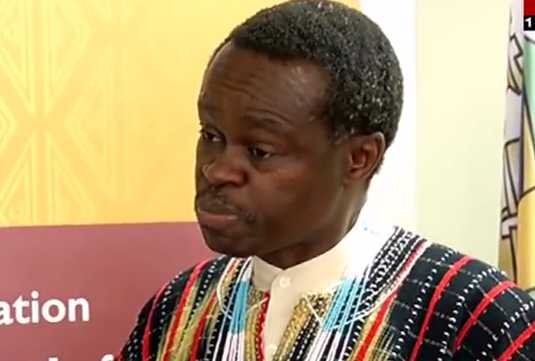
Professor P.L.O Lumumba delivered the Economic Freedom Fighters (EFF) 10th Anniversary Public Lecture on the Past, Present and Future of Pan-Africanism at Sarah Baartman Hall, University of Cape Town.
Temperatures reached boiling point between EFF members and the LGBTQIA+ community on Monday during protests held at the University of Cape Town against a planned lecture by Lumumba.
The professor has unleashed the ire of staff and students for his public support of the criminalisation of the LGBTQIA+ community.
Lumumba, who in an interview with DigiTalk TV, said homosexuals should be “cured”, is a vocal supporter of Uganda’s anti-homosexual bill, which criminalises homosexuality with harsh punishments, including the death penalty.
EFF leader Julius Malema, who led a protest outside the Ugandan embassy in Pretoria, has widely criticised the bill.
Demonstrations with staff, students, and members of the LGBTQIA+ community were held under heightened security around the upper campus.
The private security of the university formed a human chain blocking student protesters from the hall.
Many students held banners reading “EFF has blood on its hands” and “To Hell with Homophobia”.
Lumumba was invited by the EFF to deliver a public lecture on Monday evening, as part of the party’s 10-year anniversary celebrations.
Lumumba said the EFF had made the right diagnosis in 2013 when it was formed that after political freedom there must be economic freedom.
He has called for Africa to push for economic freedom to avoid being beholden to Western policies.
Lumumba said he felt saddened each time he saw a number of young people from Africa drowning in the Mediterranean trying to reach Europe.
The continent of Africa must fight for economic freedom.
He said the African Union (AU) was correct when it adopted Agenda 2063 and the African Continental Free Trade Area (AfCFTA).
The AfCFTA is an ambitious trade pact to form the world’s largest free trade area by creating a single market for goods and services of almost 1.3bn people across Africa and deepening the economic integration of Africa. The trade area could have a combined gross domestic product of around $3.4 trillion, but achieving its full potential depends on significant policy reforms and trade facilitation measures across African signatory nations.
The AfCFTA aims to reduce tariffs among members and covers policy areas such as trade facilitation and services, as well as regulatory measures such as sanitary standards and technical barriers to trade.
The agreement was brokered by the African Union (AU) and was signed by 44 of its 55 member states in Kigali, Rwanda on March 21, 2018. The only country still not to sign the agreement is Eritrea, which has a largely closed economy.
Watch live in the video below:
Video Courtesy of EFFSA.