
Staff Reporter.
Minister of Forestry, Fisheries and the Environment, Barbara Creecy, says ambitious targets to preserve the planet were meaningless unless they are backed with enabling means of implementation for developing countries.
She referred to the international community adopting the landmark Kunming Montreal Global Biodiversity Framework in December last year as an example, noting that the framework contains a key ambition to preserve biodiversity, ecosystems and human life.
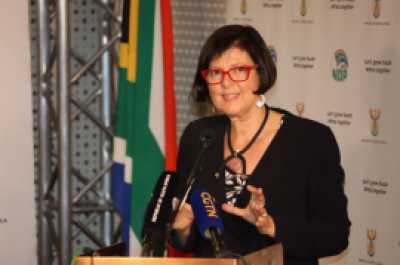
Creecy was addressing the G20 Environment and Climate Sustainability Ministerial meeting in India.
She added that 17 of the major biodiverse countries in the world are developing countries. She emphasised further that developed countries need to assist with securing at-scale, predictable and appropriate funding streams for developing countries’ efforts to conserve and protect biodiversity.
Particularly, she said, the G20 countries can work together to protect biological diversity.
The Minister also reiterated South Africa’s commitment to the sustainable regulated use of fishing resources; the active prevention of illegal and unregulated fishing and the incorporation of traditional small-scale fishers into the fishing sector through the allocation of fifteen-year rights to qualifying applicants.
“We remain committed to the international agreement of a legally binding instrument on plastic pollution, including in the marine environment. To counteract marine plastic pollution we are actively engaged in supporting municipalities to improve household waste collection and landfill compliance as well as building an active waste reclaiming and recycling industry.
“As we tackle climate change we must continue to strive for greater balance and ambition and action on all three aspects of the Paris Agreement, namely mitigation, adaptation and the means of implementation. We must also adhere to the Rio Principles, in particular equity and common but differentiated responsibilities and respective capabilities, which are also applicable within the G20 context,” the Minister said.
Creecy explained the importance of the G20 tackling existential challenges for humanity.
“No single country can on its own address climate change, biodiversity loss and pollution. The importance of the G20 is the momentum it can create for common ambition in tackling these existential challenges for humanity. However, as we sit here today, we must maintain momentum behind the United Nations system and not pre-empt or revisit negotiated outcomes,” the Minister said.
The Ministerial meeting will consider recommendations prepared by senior officials in the G20’s Environment and Climate Sustainability Working Group (ECSWG).