
By Lehlohonolo Lehana.
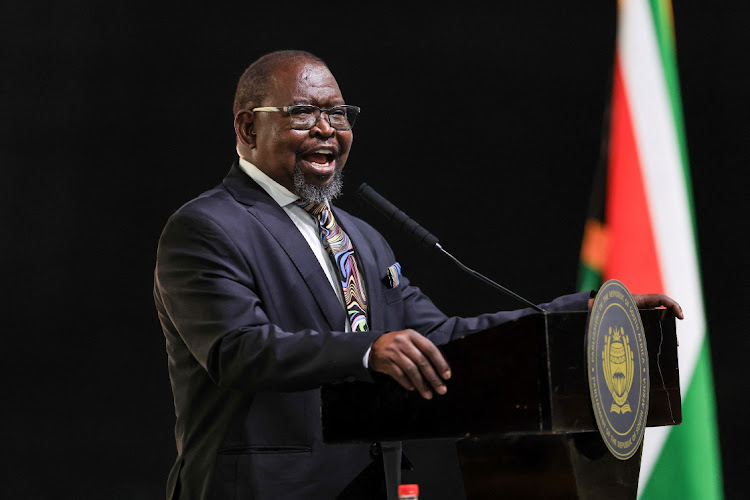
Finance Minister Enoch Godongwana delivered a Budget on Wednesday that aimed to fill the revenue shortfall by the burying of the proposed VAT hikes while keeping mounting debt levels under control.
This was the third scheduled attempt to table the Budget, after one attempt was blocked by legal action, and another torpedoed by coalition deadlock over the now withdrawn VAT increase.
The minister had to fill a R75 billion fiscal gap without derailing essential services or sacrificing investor confidence.
His tabling of Budget 3.0 comes after his VAT hike proposals were met with political backlash, legal challenge and threatened to collapse the government of national unity (GNU).
In the end, Godongwana climbed down on the VAT increase, and the Western Cape high court ruled in favour of an application by the Democratic Alliance (DA) for an order setting aside the adoption of the fiscal framework through which it would have been effected.
This comes as the International Monetary Fund projects that the country’s debt-to-GDP ratio could hit 88.7% by 2030, far above the treasury’s forecast in March that it would stabilise at 76.2%.
Godongwana presented a less controversial budget ‘version 3.0’, which includes some ‘budget cuts’ but also lower revenue forecasts as GDP growth has been revised down.
“This is not an austerity budget, declared Godongwana. However, it was not all good news as the fuel levy will increase for the first time in three years and government debt as a percentage of GDP is expected to increase to 77.4% in 2025/2026.
Godongwana announced that the general fuel levy on petrol will increase by 16c to R4.01 per litre and on diesel by 15c to R3.85 per litre on 4 June 2025.
The fuel levy increase was one of the main announcements, but National Treasury officials were quick to caution that the increase is linked to inflation and does not amount to an increase in revenue per se. Government’s U-turn on the Vat hike necessitated the increase, but it would bring in only about R3.5 billion to R4 billion in the current financial year.
Despite the increase in SA’s debt-to-GDP ratio, National Treasury Director-General Duncan Pieterse stressed the government’s commitment to “fiscal consolidation and stabilising the public finances”.
He said more focus should be placed on SA’s primary surplus and that the forecast budget deficit as a percentage of GDP remained “intact” at 4.6% for 2025/26. However, Pieterse conceded that the latest debt-to-GDP ratio forecast represents the highest since 1994.
There will be a slight increase in the gross borrowing requirement to R588.2-billion from the R582-billion foreseen in Budget 2.0. That will include payments to Eskom of R80.2-billion, R30-billion less than the 2024 Budget estimate.
The Budget deficit for this fiscal year is now seen amounting to 4.8% of GDP and is projected to narrow to 3.4% by 2027/28.
“Compared to the March estimates, tax revenue projections have been revised down by R61.9-billion over the three years. This reflects the reversal of VAT increase and the much weaker economic outlook,” the minister said.
The Treasury has slashed its forecast for South African economic growth in 2025 to 1.4% from 1.9% in March, a reflection of ongoing domestic challenges and a worsening global outlook in the face of US President Donald Trump’s chaotic tariff policies and trade wars.
In his speech, the minister said that in total an additional R7.5-billion that had been allocated to the South African Revenue Service (SARS) over the next three years, and that any resulting windfall from improved revenue collection would mean the mystery tax measures would not need to be implemented.
“As SARS utilises this investment to raise additional revenue, which I believe can be at least R35-billion, the R20-billion to close the current revenue gap will not have to be raised through taxes,” Godongwana said.
He said SARS was also aiming to “… target illicit trade in tobacco and other areas, which should boost revenue over the medium term”.
All in all, it seems that a viable Budget has been pulled out of Godongwana’s fedora against a fraught and fraying political and economic backdrop.
Reactions
Build One South Africa (BOSA)
BOSA leader Mmusi Maimane says the budget presented by Godongwana paves a way for a good budget next year.Maimane said the country needs a plan where everyone can come together and speak about what’s being funded.
Democratic Alliance
DA spokesperson Karabo Khakhau expressed her party’s approval of the budget presented by Godongwana.
“It is a workable outcome in the context of trying economic times,” it said.
The party said was not prepared to get behind a budget that maintained unsustainable government expenditure on the back of raising VAT, making struggling South Africans pay for inefficiencies and waste in Government – “but today’s version from Minister Godongwana has gone some way to undo this.”
African National Congress (ANC)
The ANC has also welcomed the budget, indicating this will work well for the people and economy.
ANC national spokesperson, Mahlengi Motsiri-Bhengu, said the budget was developmental and struck a careful balance between ensuring economic growth.
Freedom Front Plus (FF+)
Freedom Front Plus (FF+) also welcomed the budget.
Economic Freedom Fighters (EFF)
However, the EFF leader Julius Malema said this was just an austerity budget and not pro-poor.
“So clearly, this is not a pro-poor budget and as a result, we don’t support it. Everything else that was said, is what will have been told and was always disagreed to that,” Malema.
MK Party
MK Party’s Des van Rooyen said there was no budget but all big english and empty promises.
ActionSA
ActionSA only welcomed the additionalR7.5 billion was allocated to the South African Revenue Service (SARS)over the medium term—an investment we have long championed.
But they rejected the regressive suite of taxes and levies, particularly in the absence of meaningful action to curb government wastage.
Inkatha Freedom Party (IFP)
IFP leader, Velenkosini Hlabisa, described the budget as “good”.
“The good aspect is that the frontline services, education, health, and social grants were maintained. More funding is going to infrastructure, which will generate job opportunities and create an opportunity for the country to grow its economy,” Hlabisa said.
Meanwhile MK Party has tabled a motion of no censure against Godongwana and a vote of no confidence in President Cyril Ramaphosa, citing failed leadership and economic mismanagement.
The party said in a statement on Wednesday that the minister’s February budget failed to address South Africa’s record-high unemployment, rising poverty and extreme inequality.
The party described the minister’s handling of the budget as “chaotic,” pointing to the failed budget sittings, dubbed Budget 1.0 and Budget 2.0 which they say cost taxpayers R2.4 million.
These sessions collapsed over differences between ANC and DA MPs, who are part of the government of national unity (GNU).
The party says Ramaphosa’s decision to include “fringe” political groups in the GNU has delegitimised the administration and weakened its ability to govern effectively.
The vote of no confidence, although unlikely to succeed in the National Assembly given the ANC’s alliances, sends a signal of growing dissent in parliament. It also underscores the difficulty Ramaphosa faces in keeping the GNU stable
Read the full Budget Here: https://www.treasury.gov.za/documents/National%20Budget/2025/default.aspx.