
By Lehlohonolo Lehana.
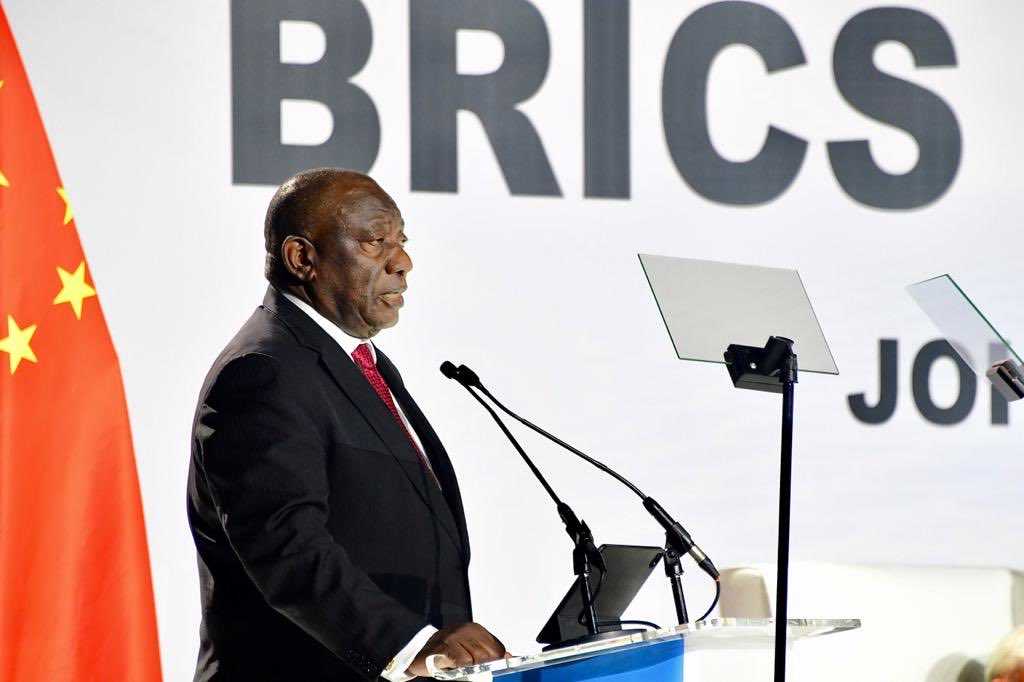
President Cyril Ramaphosa says leaders of the BRICS Bloc have decided to invite Ethiopia, Egypt, Argentina, Iran, Saudi Arabia and the United Arab Emirates to become full members from 1 January 2024.
Ramaphosa made the announcement at the summit being held this week in Johannesburg. It will be the first expansion since 2010.
“We have consensus on the first phase of this expansion process, and other phases will follow,” Ramaphosa said.
The inclusion of Saudi Arabia, the world’s largest oil exporter, along with Iran, the UAE and Brazil, would mean the group brings together several of the largest energy producers with the developing world’s largest consumers, giving it outsized economic clout. With most of the world’s energy trade taking place in dollars, the expansion also enhances the bloc’s ability to push more trade to alternative currencies.
An expanded BRICS would also mean more say for the group in world affairs and may lead to a different type of global economy.
Ramaphosa said the six were selected after “BRICS countries reached consensus on the guiding principles, standards, criteria and procedures of the BRICS expansion process” – but did not provide more details about the specific criteria.
The push for expansion was largely driven by China but had the backing of Russia and South Africa. India was concerned a bigger BRICS would transform the group into a mouthpiece for China, while Brazil was worried about alienating the West.
“India will work with other BRICS aspirants to help join the grouping,” Prime Minister Narendra Modi said at the briefing in Johannesburg.
More than 20 nations from the Global South had formally requested to join ahead of the summit.
Reactions
Analysts have said that one of the countries that could benefit from a trading regime outside of dollar dominance is Iran.
“Iran will clearly benefit the most,” said Na’eem Jeenah, a senior researcher at the South African think tank, Mapungupwe Institute for Strategic Reflection.
He said its inclusion “highlights the fact that it’s not as politically isolated as the US wants it to be”.
Inclusion could also be an “economic lifeline” due to increased bilateral trade.
Members would start trading with each other in their own currencies. For Iran, this would be great,” he said.
Jeenah added that Argentina was a “shoe-in” as its inclusion was championed by Brazil, China and India. Among the African states, he said analysts expected Algeria, which has oil reserves, or Nigeria, which is the continent’s most populous country and leading economy, could have been included.
Visiting Professor of International Relations at Wits, Professor John Stremlau, says the selection of new additional members to the BRICS bloc has Chinese influence written all over it.
Stremlau says while the process of selection is unknown, he believes that China had a greater influence due to its economic clout.
“Why these six? Argentina is a democracy, Ethiopian is in war with Amhara and the rest are authoritarian regimes. Certainly the Chinese influence on this selection is evident, because the Chinese are very good in development and brokered an accord between Iran and Saudi Arabia. Having them in the BRICS is useful from that perspective.”
Stremlau says he was surprised by the exclusion of countries like Nigeria, Mexico, and Indonesia.
“There were no sub-Saharan countries, just Egypt and Ethiopia which are above the Sahara. South Africa’s goal of getting more African countries seems to have failed. There is no Nigeria on the list and, relatively speaking, that is the wealthy sub-Saharan country on the continent, but I think Nigerans are not interested on joining the BRICS.”
Stremlau says it remains unclear what role Iran will play when it joins.
Watch Live in the video below:
Video Courtesy of GCIS.