
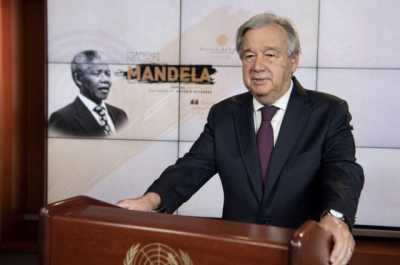
By Lehlohonolo Lehana.
United Nations (UN) Secretary-General, António Guterres says, the world cannot afford a divided global economy and financial system, diverging strategies on technology, and conflicting security frameworks.
Guterres made the remarks at the BRICS [Brazil, Russian Federation, India, China and South Africa] Summit, in Johannesburg today.
“The IMF [International Monetary Fund] estimates that such a fracture could cost 7% of global GDP [gross domestic product] – a cost that would be disproportionately borne by low-income countries, mainly in Africa.
“And so I have come to Johannesburg with a simple message, in a fracturing world with overwhelming crises, there is simply no alternative to cooperation.”
He advised leaders to urgently restore trust and reinvigorate multilateralism for the 21st century.
“This requires the courage to compromise in the reforms necessary for the common good.
“It requires full respect for the UN Charter, international law, universal values, and all human rights – social, cultural, economic, civil, and political. And it requires much greater solidarity,” he stressed, admitting that none of this was easy.
“But it is essential. And is essential, especially for Africa.”
He acknowledged that Africa, a historical victim of slavery and colonialism, continues to confront grave injustices.
“On average, African countries pay four times more for borrowing than the United States and eight times more than the wealthiest European countries.”
Guterres also noted that African states account for just 4% of global greenhouse gas emissions, but are an epicentre of climate chaos.
“Looking ahead, I see two priorities for action and justice. First, on the economic front. Redesigning today’s outdated, dysfunctional, and unfair global financial architecture is necessary, but I know it won’t happen overnight. Yet we can – and must – take practical action now.”
He has since proposed an effective debt workout mechanism, and other steps necessary to multiply the resources available for developing countries are vital for sustainable development in Africa and its people.
Guterres, has also urged developed countries to keep their promises to developing nations by meeting the climate finance commitment of US$100 billion.
This is after rich nations made a pledge in 2009 to the less wealthy countries at a UN Climate Change Conference in Copenhagen, Denmark, to assist them in adapting to climate change and alleviate rises in temperature by 2020.
Guterres also called on the wealthy nations to double adaptation finance, replenish the Green Climate Fund, and operationalise the loss and damage fund this year.
He also added that the continued exclusion of developing countries from holding permanent seats in the United Nations Security Council and under representation in world institutions, is a recipe for serious world fragmentation which could lead already existing tensions to boil over.
“I believe, two areas require a particularly important reform effort. One is the Security Council; the second, the Bretton Woods system. If we are not able to reform our institutions to make sure they reassume a truly universal character, we risk fragmentation, and fragmentation can be one day, a factor of confrontation.
“[History] has shown time and again that multi-polarity without strong multilateral institutions is no guarantee for stability; it might even become a catalyst for chaos. We must urgently restore trust and reinvigorate multilateralism. This requires the courage to compromise for the common good,” Guterres said.
The UN Security Council, considered one of the world body’s most powerful groups, is made up of 15 permanent and non-permanent members. The five permanent members are the United States of America, the United Kingdom, France, China and Russia.
Africa’s 54 states are represented on the council by three non-permanent seats currently held by Gabon, Ghana and Mozambique.