
By Lehlohonolo Lehana.
The Department of Public Works and Infrastructure (DPWI) has launched a massive crackdown on hijacked buildings and revealed that 1 260 government-owned buildings have been flagged as being illegally occupied.
This comes after the meeting of an inter-ministerial committee, which is looking into last week’s Marshalltown disaster in which 77 people perished in a fire in a hijacked State building.
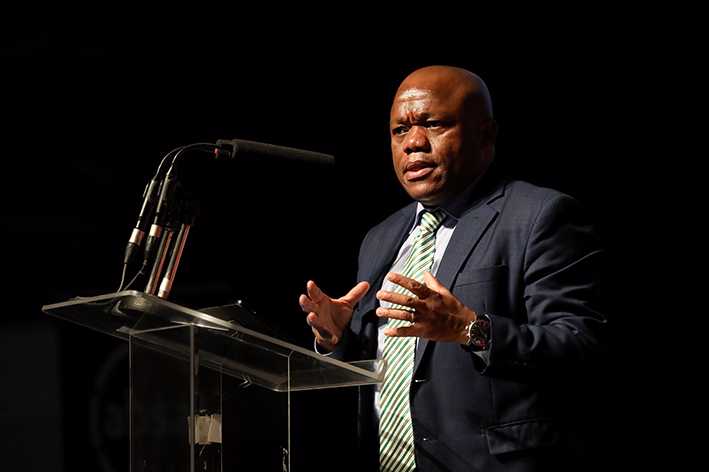
Public Works and Infrastructure Minister Sihle Zikalala will lead the task of identifying all hijacked buildings in the country, as well as indicate what should be done with all those properties.
As the department responsible for State property management, the department was already in the process of identifying misappropriated State properties within its own asset register.
This includes:
– Recovery of stolen or illegally transferred properties and hijacked buildings.
– Regularisation of occupancy in properties due to legacy housing policies.
– Further investigation and identification of more properties that are illegally occupied.
The department launched Operation Bring Back to operationalise investigations and recovery of those assets that are illegally occupied or stolen.
The department will intensify the operation in all metros and municipalities throughout the country.
“Each metro or municipality will have to indicate how many properties it has on its asset register, the state of those assets, what they are used for and its current status. Depending on the status of those properties, the Ministry of Public Works and Infrastructure will recommend what should be done,” the Department of Public Works and Infrastructure said in a statement.
Among the current decisions of the department’s Operation Bring Back, a nationwide call is to be made for individuals and institutions to avail themselves for amnesty and to regularise their occupation of properties in line with the applicable laws of the country
These properties could be sold to the individuals concerned, be leased or be used as a rental stocks.” “This intervention by the Ministry of Public Works and Infrastructure will include a forensic investigation of the asset register and the identification of illegally occupied properties without amnesty and may lead to the institution of criminal prosecutions and/or expropriation of unclaimed properties,” the department said.
The department will, as a matter of urgency, commission multidisciplinary built environment consultants to investigate the structural, civil, building, electrical, mechanical and safety integrity of the identified buildings and make recommendations on how to rejuvenate the CBDs of all metros and municipalities.
President Cyril Ramaphosa meanwhile said rooting out criminality in accommodation in the inner city is a priority.
“As a starting point, municipal authorities across the country dealing with inner city decay need to redouble their efforts to revitalise these areas, use regulatory and legislative provisions to safeguard human life, and hold landlords, whose premises have become headquarters of criminal activity, accountable.
“We have heard about progress in some areas. It was reported that last year, for example, the City of Johannesburg managed to return some 47 “hijacked” buildings to their lawful owners. Once rehabilitated, these buildings could provide safe and decent low-cost housing for the poor, “Ramaphosa said.
The President emphasised that similar to most South Africans, people living in buildings like the Usindiso Building, want a decent quality of life.
They want a safe place to live close to work opportunities and services. We need clean, safe, liveable and vibrant inner cities that attract people to live, work or study. We want our inner cities to attract businesses and investment.
“We cannot allow certain parts of our cities to suffer chronic neglect and become ‘no-go areas’ because of rampant criminal activity.
“We have to obey the law and observe regulations that exist for our safety and for the safety of others. We need to work with officials seeking to strike a balance between the rights of tenants and regard for their safety and wellbeing. Above all, we need to report acts of criminality and not be party to them,” he said.